Ji Jiapeng, Sha Ying, Li Zeheng, Gao Xuehui, Zhang Teng, Zhou Shiyu, Qiu Tong, Zhou Shaodong, Zhang Liang, Ling Min, Hou Yanglong, Liang Chengdu
Zhejiang Provincial Key Laboratory of Advanced Chemical Engineering Manufacture Technology, College of Chemical and Biological Engineering, Zhejiang University, Hangzhou 310027, China.
Beijing Key Laboratory for Magnetoelectric Materials and Devices, Beijing Innovation Center for Engineering Science and Advanced Technology (BIC-ESAT), Department of Materials Science and Engineering, College of Engineering, Peking University, Beijing 100871, China.
Research (Wash D C). 2020 Jun 26;2020:5714349. doi: 10.34133/2020/5714349. eCollection 2020.
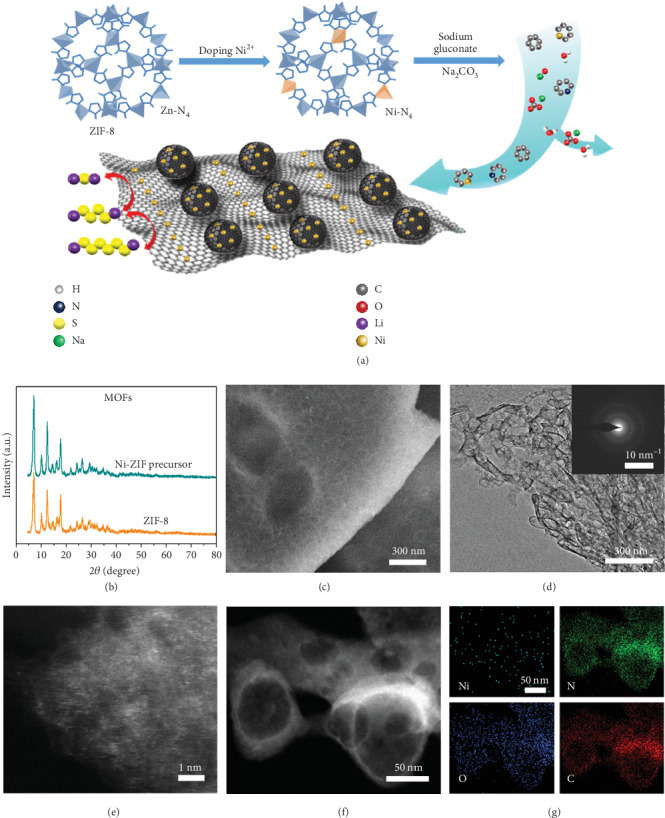
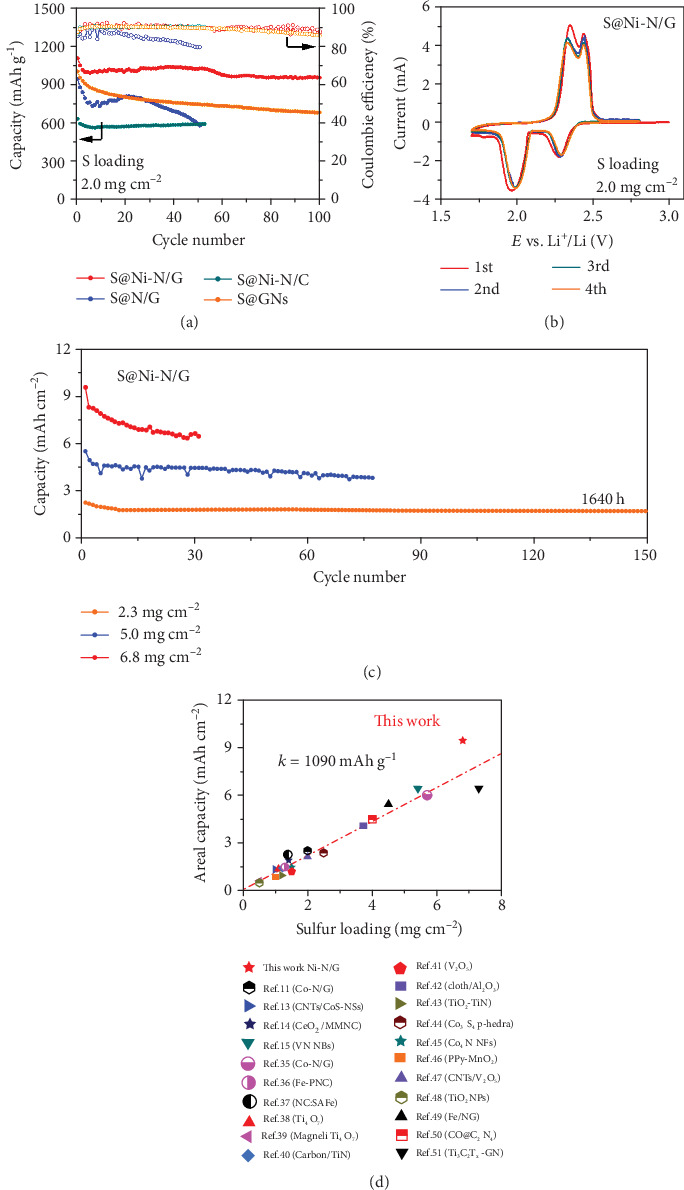
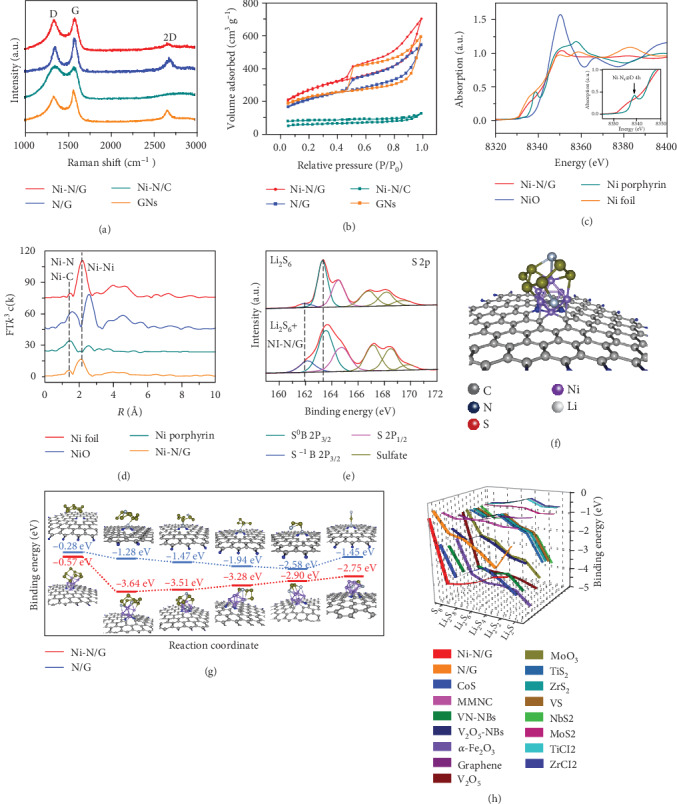
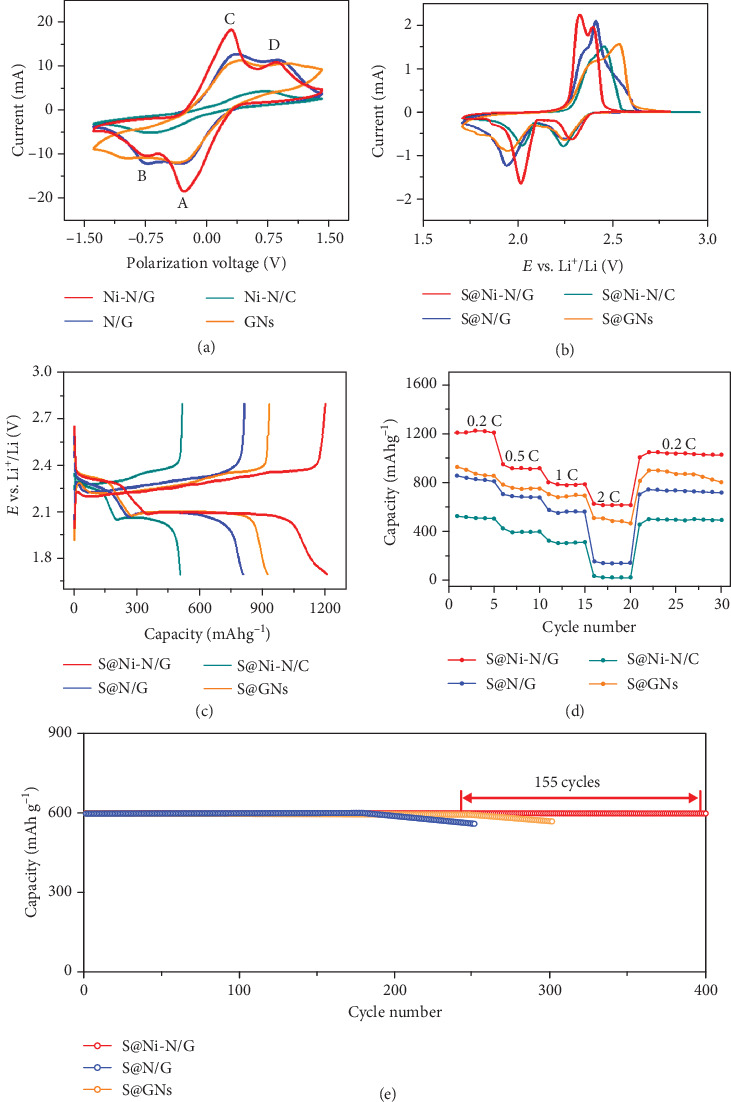
The shuttle effect hinders the practical application of lithium-sulfur (Li-S) batteries due to the poor affinity between a substrate and Li polysulfides (LiPSs) and the sluggish transition of soluble LiPSs to insoluble LiS or elemental S. Here, we report that Ni hexatomic clusters embedded in a nitrogen-doped three-dimensional (3D) graphene framework (Ni-N/G) possess stronger interaction with soluble polysulfides than that with insoluble polysulfides. The synthetic electrocatalyst deployed in the sulfur cathode plays a multifunctional role: (i) selectively adsorbing the polysulfides dissolved in the electrolyte, (ii) expediting the sluggish liquid-solid phase transformations at the active sites as electrocatalysts, and (iii) accelerating the kinetics of the electrochemical reaction of multielectron sulfur, thereby inhibiting the dissolution of LiPSs. The constructed S@Ni-N/G cathode delivers an areal capacity of 9.43 mAh cm at 0.1 C at S loading of 6.8 mg cm, and it exhibits a gravimetric capacity of 1104 mAh g with a capacity fading rate of 0.045% per cycle over 50 cycles at 0.2 C at S loading of 2.0 mg cm. This work opens a rational approach to achieve the selective adsorption and expediting of polysulfide transition for the performance enhancement of Li-S batteries.
穿梭效应阻碍了锂硫(Li-S)电池的实际应用,这是由于基底与多硫化锂(LiPSs)之间的亲和力较差,以及可溶性LiPSs向不溶性LiS或元素硫的缓慢转变。在此,我们报道嵌入氮掺杂三维(3D)石墨烯框架(Ni-N/G)中的镍六原子簇与可溶性多硫化物的相互作用比与不溶性多硫化物的相互作用更强。部署在硫阴极中的合成电催化剂发挥着多功能作用:(i)选择性吸附溶解在电解质中的多硫化物,(ii)作为电催化剂加速活性位点处缓慢的液-固相变,以及(iii)加速多电子硫的电化学反应动力学,从而抑制LiPSs的溶解。构建的S@Ni-N/G阴极在0.1 C、硫负载量为6.8 mg cm时的面积容量为9.43 mAh cm,在0.2 C、硫负载量为2.0 mg cm时,其重量容量为1104 mAh g,在50个循环中容量衰减率为每循环0.045%。这项工作为实现选择性吸附和加速多硫化物转变以提高Li-S电池性能开辟了一条合理的途径。