Speck Rebecca M, Ye Xin, Bernthal Nicholas M, Gelhorn Heather L
Evidera, 7101 Wisconsin Ave, Suite 1400, Bethesda, MD, 20814, USA.
Daiichi Sankyo, Inc., 211 Mount Airy Rd, Basking Ridge, NJ, 07920, USA.
J Patient Rep Outcomes. 2020 Jul 16;4(1):61. doi: 10.1186/s41687-020-00217-6.
The purpose of this study was to evaluate the psychometric properties of the PROMIS-Physical Function (PF) and Worst Stiffness Numeric Rating Scale (NRS) among patients with tenosynovial giant cell tumors (TGCT).
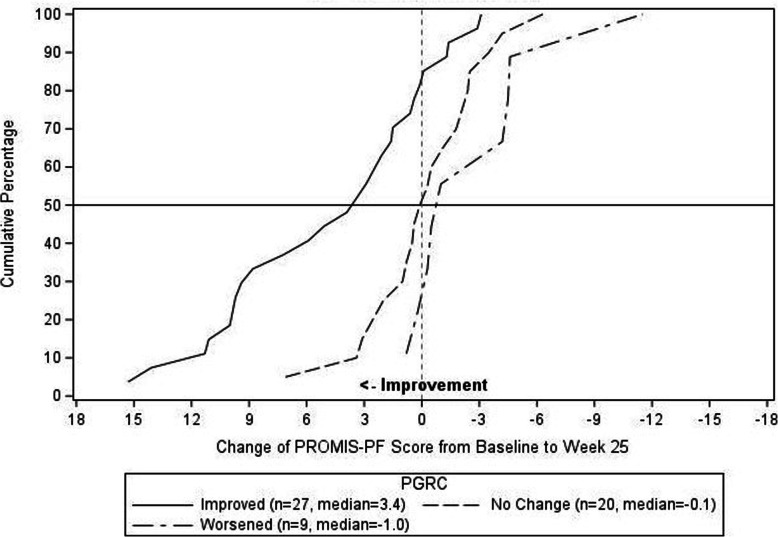
Measurement properties of the customized lower extremity (LE) and upper extremity (UE) PROMIS-PF scales and Worst Stiffness NRS were assessed using data from the Phase 3 ENLIVEN trial (n = 120). Anchor- and distribution-based analyses were utilized to derive a responder threshold for meaningful change over time. The Patient Global Rating of Concept (PGRC)-Physical Functioning and Patient Global Impression of Change (PGIC)-Stiffness served as anchors. Responsiveness and responder threshold analyses were from baseline to week 25.
Cronbach's alpha values for internal consistency reliability were 0.93 and 0.91 for the PROMIS-PF LE and UE, respectively. Test-retest reliability intra-class correlation coefficients were > 0.75 for both instruments. Convergent validity for both instruments was supported by moderate to strong correlations (≥0.30) with the Brief Pain Inventory and EQ-5D. Known-groups validity was established between subgroups stratified by pain level (p < 0.05). Responsiveness was supported by evaluating change scores among different levels of change in PGRC-Physical Functioning and PGIC-Stiffness (overall F values < 0.001). Triangulation of responder definition analyses resulted in a threshold of ≥3 for the PROMIS-PF and ≥ 1 for the Worst Stiffness NRS.
This study is the first to establish the psychometric properties of patient-reported outcome measures in TGCT. The evidence demonstrates that the PROMIS-PF and Worst Stiffness NRS have good reliability, validity, and responsiveness, and provides guidance for the interpretation of meaningful change.
本研究旨在评估滑膜巨细胞瘤(TGCT)患者中患者报告结果测量信息系统-身体功能(PROMIS-PF)和最严重僵硬数字评定量表(NRS)的心理测量特性。
使用来自3期ENLIVEN试验(n = 120)的数据评估定制的下肢(LE)和上肢(UE)PROMIS-PF量表以及最严重僵硬NRS的测量特性。采用基于锚点和分布的分析方法得出随时间有意义变化的应答者阈值。患者整体概念评定-身体功能(PGRC-身体功能)和患者整体变化印象(PGIC-僵硬)作为锚点。从基线到第25周进行反应度和应答者阈值分析。
PROMIS-PF量表下肢和上肢的内部一致性信度Cronbach's α值分别为0.93和0.91。两种工具的重测信度组内相关系数均>0.75。两种工具与简明疼痛量表和EQ-5D的相关性为中度至高度(≥0.30),支持了它们的收敛效度。通过按疼痛水平分层的亚组之间建立了已知组效度(p < 0.05)。通过评估PGRC-身体功能和PGIC-僵硬不同变化水平之间的变化分数,支持了反应度(总体F值<0.001)。应答者定义分析的三角测量法得出,PROMIS-PF量表的阈值≥3,最严重僵硬NRS的阈值≥1。
本研究首次确立了TGCT患者报告结局指标的心理测量特性。证据表明,PROMIS-PF量表和最严重僵硬NRS具有良好的信度、效度和反应度,并为有意义变化的解释提供了指导。