Clinical Division of General Psychiatry, Department of Psychiatry and Psychotherapy, Medical University of Vienna, Vienna, Austria.
Centre for Public Health, Department of Epidemiology, Medical University of Vienna, Vienna, Austria.
BMC Psychiatry. 2020 Jul 16;20(1):375. doi: 10.1186/s12888-020-02781-z.
The prevalence of major depressive disorder (MDD) in women is up to 50% higher as compared to men. However, little is known about discrepancies in health care utilization between depressed female and male patients. Consequently, the aim of the present study was to elucidate gender differences regarding the frequency of hospital admissions and the length of inpatient treatment for MDD across the lifespan.
This nationwide, registry-based study analyzed all inpatient admissions in psychiatric hospitals due to recurrent/non-recurrent MDD episodes according to ICD-10 (moderate (F32/33.1), severe (F32/33.2), severe with psychotic features (F32/33.3)) in Austria across 14 years. We calculated weekly admission rates per 100,000 patients by directly age-standardized rates.
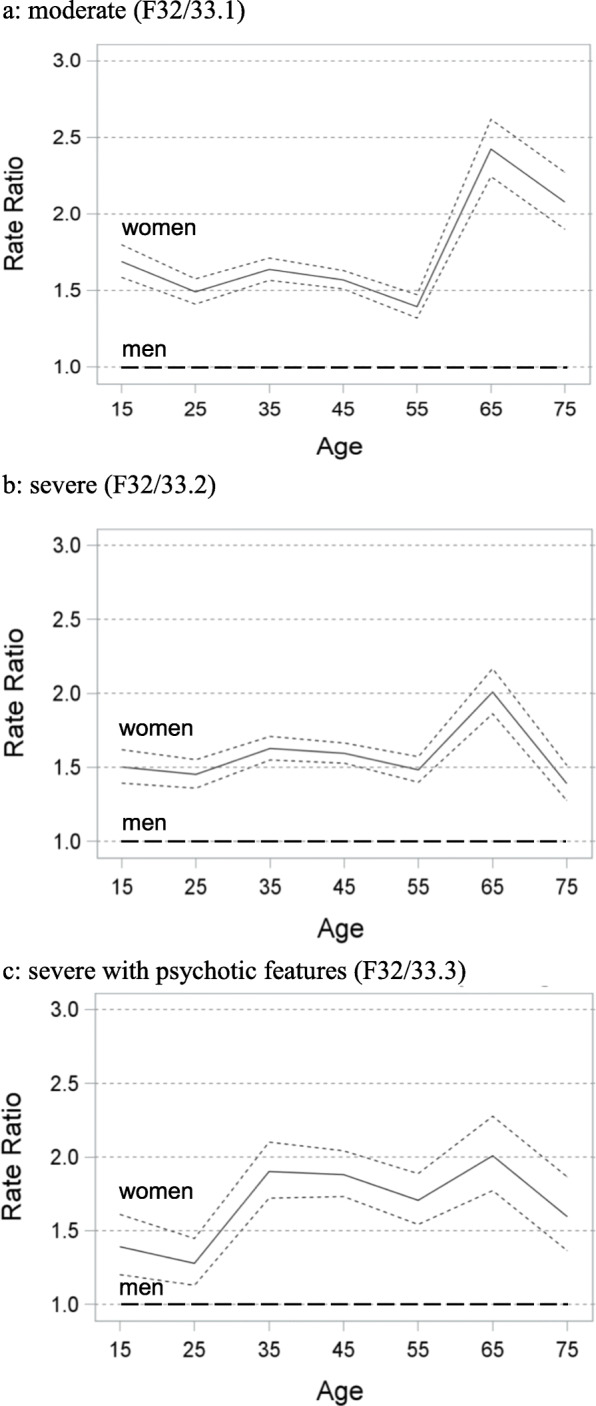
Across 232,289 admissions (63.2% female) the population based admission rates in MDD were significantly higher in women (p < 0.001). Female to male ratios across subgroups were 1.65 (F32/33.1), 1.58 (F32/33.2), 1.73 (F32/33.3), and peaked around 65 years (ratio ≥ 2 for all subgroups). Length of hospital stay for women was significantly longer in all depression subtypes (p < 0.001).
Elevated rates of inpatient treatment in women cannot solely be explained by a higher MDD prevalence and are dependent on age and type of depressive episode. Irrespective of the type and severity of the mood episode, women exhibit longer hospitalisation times.
女性重度抑郁症(MDD)的患病率比男性高 50%。然而,人们对抑郁女性和男性患者在医疗保健利用方面的差异知之甚少。因此,本研究旨在阐明一生中因反复发作/非反复发作 MDD 住院的女性和男性患者的住院频率和住院时间的性别差异。
这项基于全国范围的注册研究分析了奥地利 14 年来所有因 ICD-10(中度(F32/33.1)、重度(F32/33.2)、伴有精神病特征的重度(F32/33.3))反复发作/非反复发作 MDD 入院的精神科医院住院患者。我们通过直接年龄标准化率计算了每 10 万患者每周的入院率。
在 232,289 次入院(63.2%为女性)中,女性 MDD 的人群入院率明显更高(p<0.001)。各亚组的女性与男性比例分别为 1.65(F32/33.1)、1.58(F32/33.2)、1.73(F32/33.3),并在 65 岁左右达到峰值(所有亚组的比值≥2)。所有抑郁亚型女性的住院时间均明显较长(p<0.001)。
女性住院治疗率的升高不能仅仅用 MDD 患病率较高来解释,还取决于年龄和抑郁发作的类型。无论情绪发作的类型和严重程度如何,女性的住院时间都更长。