VMTH of College of Veterinary Medicine, Chungnam National University, N13-2, #308, 99 Daehak-ro, Yuseong-gu, Daejeon, Republic of Korea.
College of Veterinary Medicine, Kangwon National University, Chuncheon, Korea.
BMC Vet Res. 2020 Jul 16;16(1):246. doi: 10.1186/s12917-020-02458-5.
As a co-receptor for fibroblast growth factor 23, klotho plays a pivotal role in phosphate metabolism. The kidney is known to be the main source of soluble alpha-klotho and the principal regulator of its concentration. Previous studies in human participants showed that the concentration of soluble alpha-klotho in serum and urine decreased in chronic kidney disease (CKD) patients. However, no previous study has assessed soluble alpha-klotho levels in dogs. This study aimed to measure serum and urinary alpha-klotho levels in CKD dogs and identify their associations with International Renal Interest Society (IRIS) CKD stages and other parameters known to be associated with CKD.
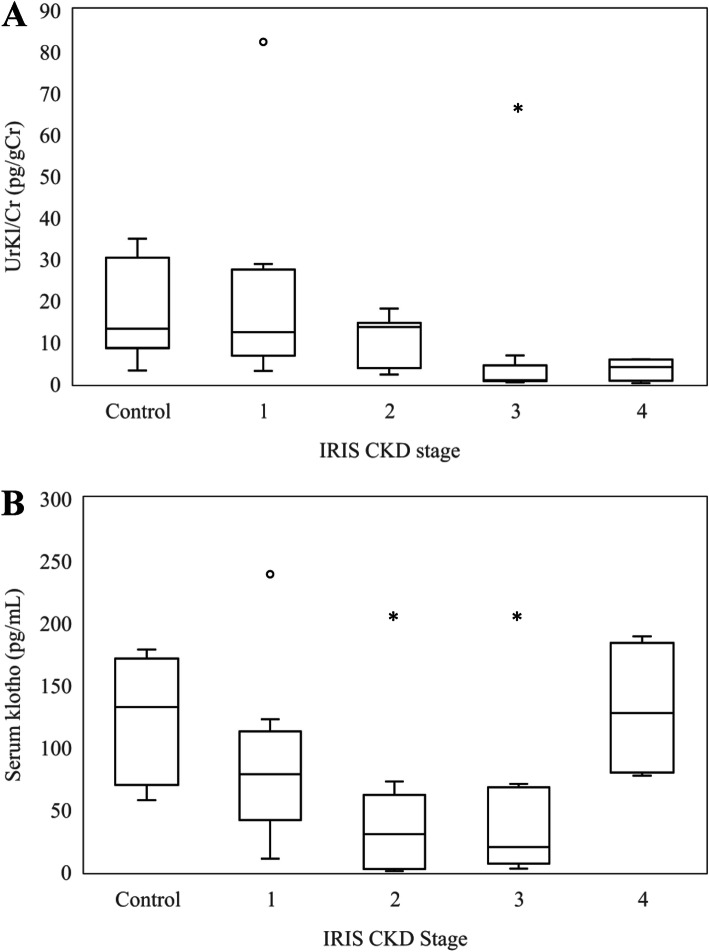
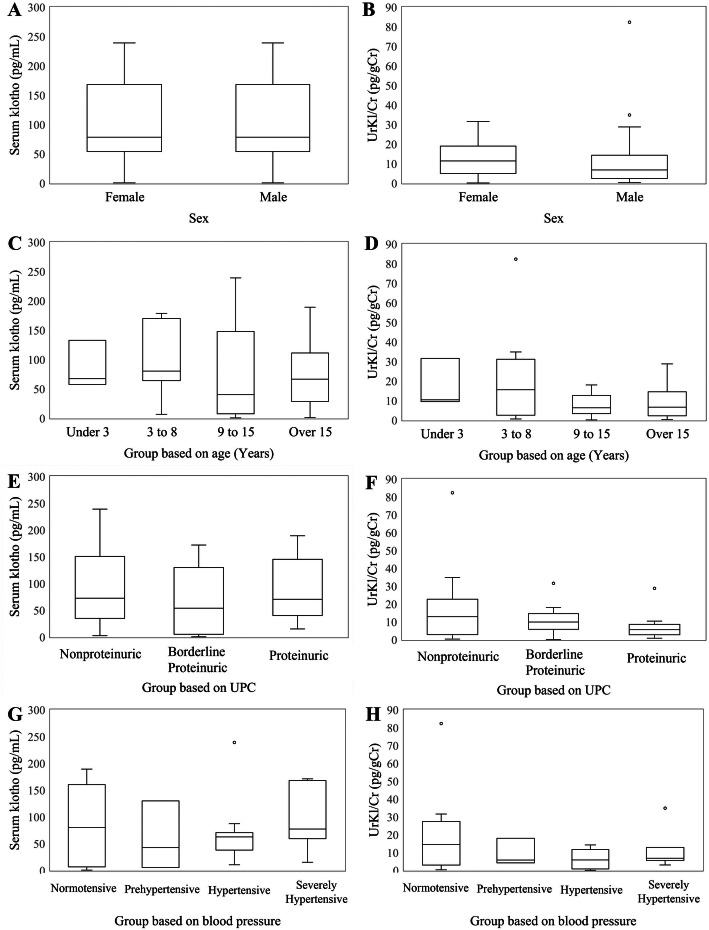
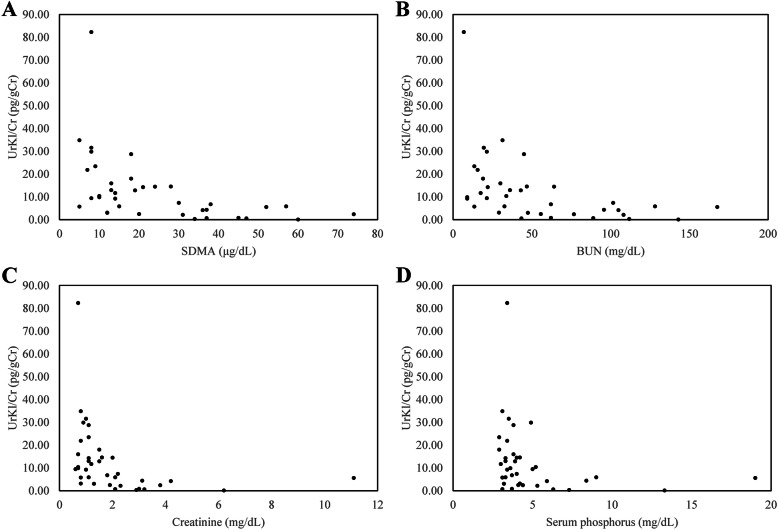
Serum and urinary alpha klotho concentrations were measured by a commercially available canine-specific sandwich enzyme-linked immunosorbent assay kit and compared between groups by a nonparametric Kruskal-Wallis test. Spearman's correlation coefficient was used to evaluate the relationships between variables. A stepwise multiple regression analysis was performed to estimate the effects of independent predictors on klotho concentrations. The urine klotho-to-creatinine ratio (UrKl/Cr) was significantly lower in stage 3 dogs than the control group and was significantly lower in dogs with stage 3 and 4 CKD than in those with stage 1 and 2 disease. UrKl/Cr was negatively correlated with serum symmetric dimethylarginine (sSDMA), blood urea nitrogen (BUN), creatinine, and phosphorus concentration. Serum alpha-klotho concentration in dogs with stages 2 and 3 CKD was significantly lower than those in the control group. There was no significant correlation between serum alpha-klotho and BUN, creatinine, and phosphorus concentrations. No statistically significant differences were observed in UrKl/Cr and serum alpha-klotho concentration between groups based on sex, age, urine protein-to-creatinine ratio (UPC), or blood pressure.
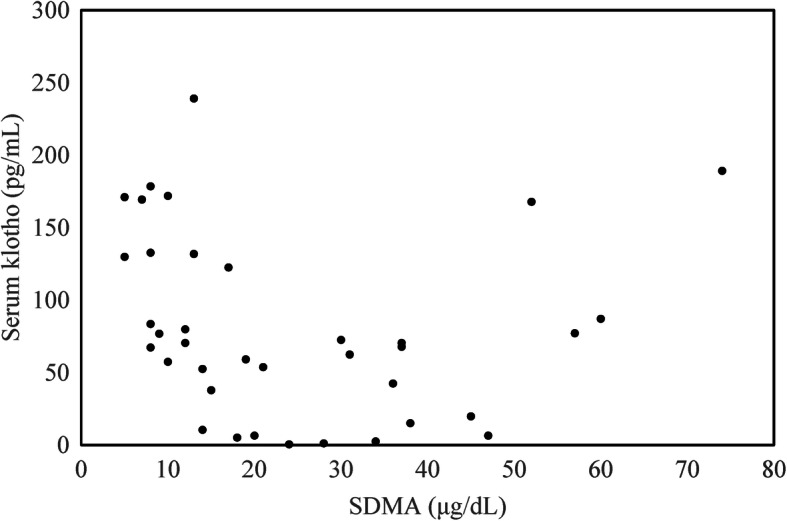
UrKl/Cr decreased in dogs with advanced CKD, and it was negatively correlated with sSDMA, BUN, creatinine, and phosphorus concentrations. Thus, klotho is associated with CKD and its clinical consequences, including CKD-mineral bone disorder, in dogs. Although serum klotho concentration was negatively correlated with sSDMA levels, it was not apparently related to IRIS CKD stage or other parameters known to be associated with CKD.
Klotho 作为成纤维细胞生长因子 23 的共受体,在磷酸盐代谢中发挥着关键作用。已知肾脏是可溶性α-klotho 的主要来源,也是其浓度的主要调节剂。先前在人类参与者中的研究表明,血清和尿液中可溶性α-klotho 的浓度在慢性肾脏病(CKD)患者中降低。然而,以前没有研究评估过犬中可溶性α-klotho 的水平。本研究旨在测量 CKD 犬的血清和尿液α-klotho 水平,并确定其与国际肾脏协会(IRIS)CKD 分期和其他已知与 CKD 相关的参数之间的关联。
通过商业上可获得的犬特异性夹心酶联免疫吸附测定试剂盒测量血清和尿液αklotho 浓度,并通过非参数 Kruskal-Wallis 检验比较组间差异。Spearman 相关系数用于评估变量之间的关系。进行逐步多元回归分析以估计独立预测因子对 klotho 浓度的影响。与对照组相比,第 3 期犬的尿 klotho-肌酐比值(UrKl/Cr)显著降低,第 3 期和 4 期 CKD 犬的 UrKl/Cr 显著低于第 1 期和 2 期疾病犬。UrKl/Cr 与血清对称二甲基精氨酸(sSDMA)、血尿素氮(BUN)、肌酐和磷浓度呈负相关。第 2 期和 3 期 CKD 犬的血清α-klotho 浓度明显低于对照组。血清α-klotho 与 BUN、肌酐和磷浓度之间无显著相关性。基于性别、年龄、尿蛋白与肌酐比值(UPC)或血压,各组间 UrKl/Cr 和血清α-klotho 浓度无统计学差异。
在患有晚期 CKD 的犬中,UrKl/Cr 降低,与 sSDMA、BUN、肌酐和磷浓度呈负相关。因此,klotho 与犬的 CKD 及其临床后果(包括 CKD 矿物质骨异常)有关。尽管血清 klotho 浓度与 sSDMA 水平呈负相关,但与 IRIS CKD 分期或其他已知与 CKD 相关的参数无明显关系。