Hospices Civils de Lyon, Hôpital Louis Pradel, Service d'Anesthésie-Réanimation, Lyon, France.
INSERM U1060, Laboratoire CarMeN, IHU OPeRa, Lyon, France.
Crit Care. 2020 Jul 16;24(1):442. doi: 10.1186/s13054-020-03122-y.
Veno-arterial extracorporeal membrane oxygenation (VA-ECMO) has been increasingly used over the last decade in patients with refractory cardiogenic shock. ECMO weaning can, however, be challenging and lead to circulatory failure and death. Recent data suggest a potential benefit of levosimendan for ECMO weaning. We sought to further investigate whether the use of levosimendan could decrease the rate of ECMO weaning failure in adult patients with refractory cardiogenic shock.
We performed an observational single-center cohort study. All patients undergoing VA-ECMO from January 2012 to December 2018 were eligible and divided into two groups: group levosimendan and group control (without levosimendan). The primary endpoint was VA-ECMO weaning failure defined as death during VA-ECMO treatment or within 24 h after VA-ECMO removal. Secondary outcomes were mortality at day 28 and at 6 months. The two groups were compared after propensity score matching. P < 0.05 was considered statistically significant.
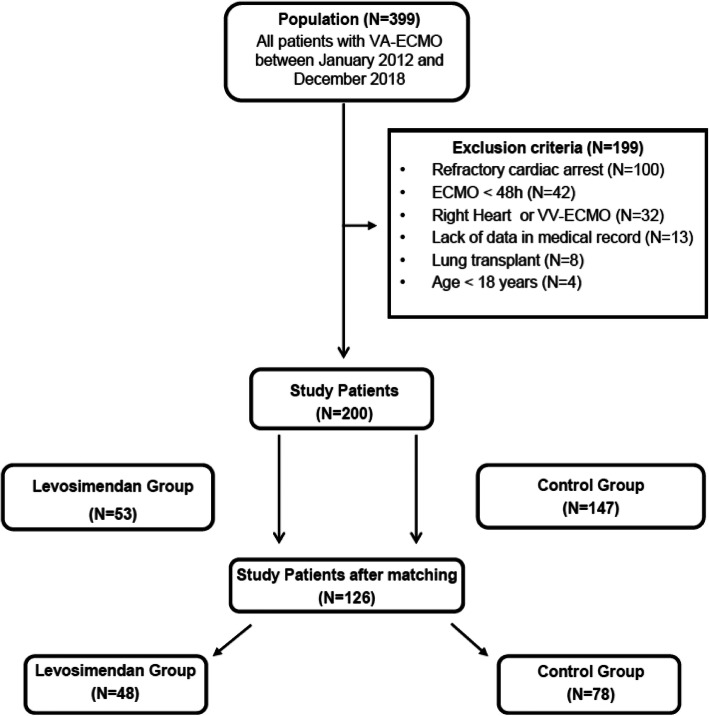
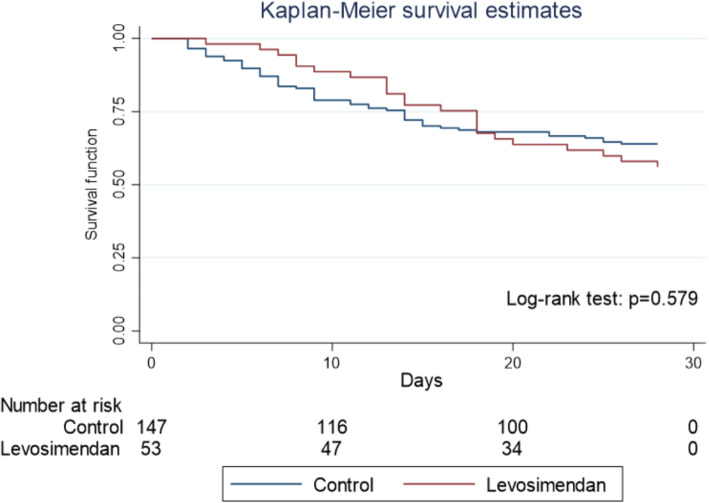
Two hundred patients were analyzed (levosimendan group: n = 53 and control group: n = 147). No significant difference was found between groups on baseline characteristics except for ECMO duration, which was longer in the levosimendan group (10.6 ± 4.8 vs. 6.5 ± 4.7 days, p < 0.001). Levosimendan administration started 6.6 ± 5.4 days on average following ECMO implantation. After matching of 48 levosimendan patients to 78 control patients, the duration of ECMO was similar in both groups. The rate of weaning failure was 29.1% and 35.4% in levosimendan and control groups, respectively (OR: 0.69, 95%CI: 0.25-1.88). No significant difference was found between groups for all secondary outcomes.
Levosimendan did not improve the rate of successful VA-ECMO weaning in patients with refractory cardiogenic shock.
ClinicalTrials.gov, NCT04323709 .
在过去的十年中,体外膜肺氧合(VA-ECMO)在难治性心源性休克患者中的应用日益增多。然而,ECMO 脱机可能具有挑战性,并导致循环衰竭和死亡。最近的数据表明,左西孟旦在 ECMO 脱机方面可能具有潜在的益处。我们试图进一步研究左西孟旦是否可以降低难治性心源性休克患者的 ECMO 脱机失败率。
我们进行了一项观察性单中心队列研究。所有 2012 年 1 月至 2018 年 12 月期间接受 VA-ECMO 的患者均符合条件,并分为两组:左西孟旦组和对照组(未使用左西孟旦)。主要终点是 VA-ECMO 脱机失败,定义为 VA-ECMO 治疗期间或 VA-ECMO 移除后 24 小时内死亡。次要结局为 28 天和 6 个月的死亡率。两组在倾向评分匹配后进行比较。p<0.05 被认为具有统计学意义。
共分析了 200 例患者(左西孟旦组:n=53,对照组:n=147)。两组患者在基线特征上无显著差异,除 ECMO 持续时间外,左西孟旦组更长(10.6±4.8 天 vs. 6.5±4.7 天,p<0.001)。左西孟旦给药平均在 ECMO 植入后 6.6±5.4 天开始。在匹配了 48 例左西孟旦患者和 78 例对照组患者后,两组 ECMO 的持续时间相似。左西孟旦组和对照组的脱机失败率分别为 29.1%和 35.4%(OR:0.69,95%CI:0.25-1.88)。两组间所有次要结局均无显著差异。
左西孟旦并未改善难治性心源性休克患者的 VA-ECMO 脱机成功率。
ClinicalTrials.gov,NCT04323709。