Division of Hematology-Oncology, Department of Medicine, Zuckerberg San Francisco General Hospital, University of California, San Francisco.
Vascular Biology Center, Division of Hematology-Oncology-Transplantation, Department of Medicine, University of Minnesota Medical School, Minneapolis.
JAMA Netw Open. 2020 Jul 1;3(7):e2010874. doi: 10.1001/jamanetworkopen.2020.10874.
Sickle cell disease (SCD) is characterized by chronic pain and episodic acute pain caused by vasoocclusive crises, often requiring high doses of opioids for prolonged periods. In humanized mouse models of SCD, a synthetic cannabinoid has been found to attenuate both chronic and acute hyperalgesia. The effect of cannabis on chronic pain in adults with SCD is unknown.
To determine whether inhaled cannabis is more effective than inhaled placebo in relieving chronic pain in adults with SCD.
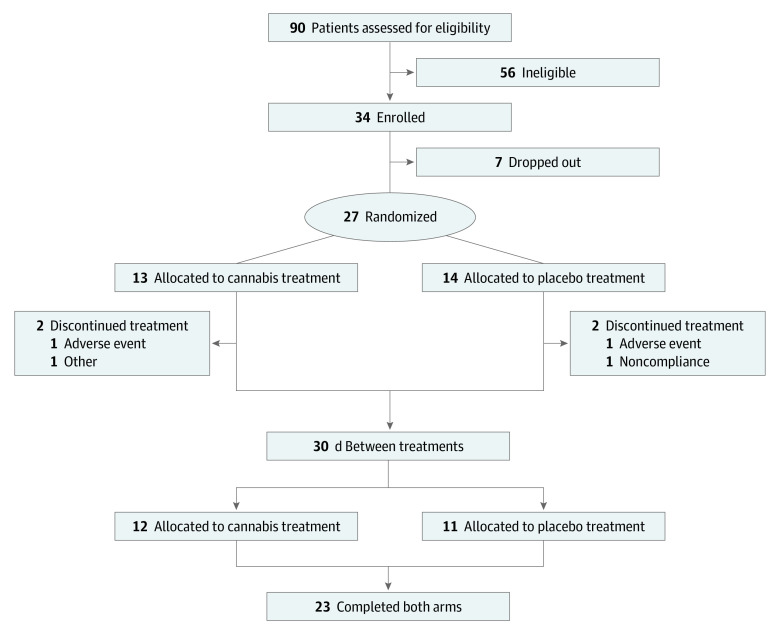
DESIGN, SETTING, AND PARTICIPANTS: This pilot randomized clinical trial included participants with SCD with chronic pain admitted to a single inpatient clinical research center for 2 separate 5-day stays from August 2014 to April 2017. Participants inhaled either vaporized cannabis (4.4% Δ-9-tetrahydrocannabinol to 4.9% cannabidiol) 3 times daily or vaporized placebo cannabis. Pain and pain interference ratings using the Brief Pain Inventory were assessed throughout each 5-day period. Participants with SCD and chronic pain on stable analgesics were eligible to enroll. A total of 90 participants were assessed for eligibility; 56 participants were deemed ineligible, and 34 participants were enrolled. Of these, 7 participants dropped out before randomization. Of 27 randomized participants, 23 completed both treatment arms of the crossover study and were included in the final per protocol analysis. Data analysis was completed in June 2019, with the sensitivity analysis conducted in April 2020.
Inhalation of vaporized cannabis plant (4.4% Δ-9-tetrahydrocannbinol to 4.9% cannabidiol) or placebo cannabis plant using a vaporizer 3 times daily for 5 days.
Daily pain assessed with visual analog scale and Brief Pain Inventory.
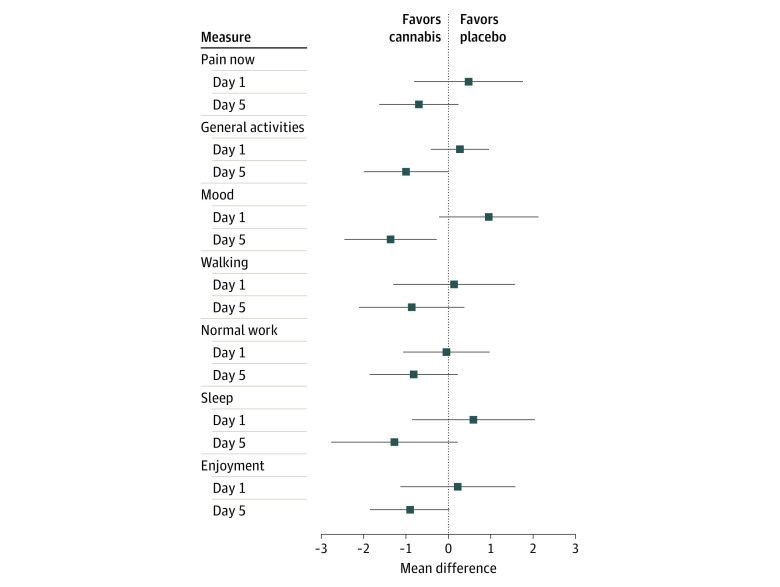
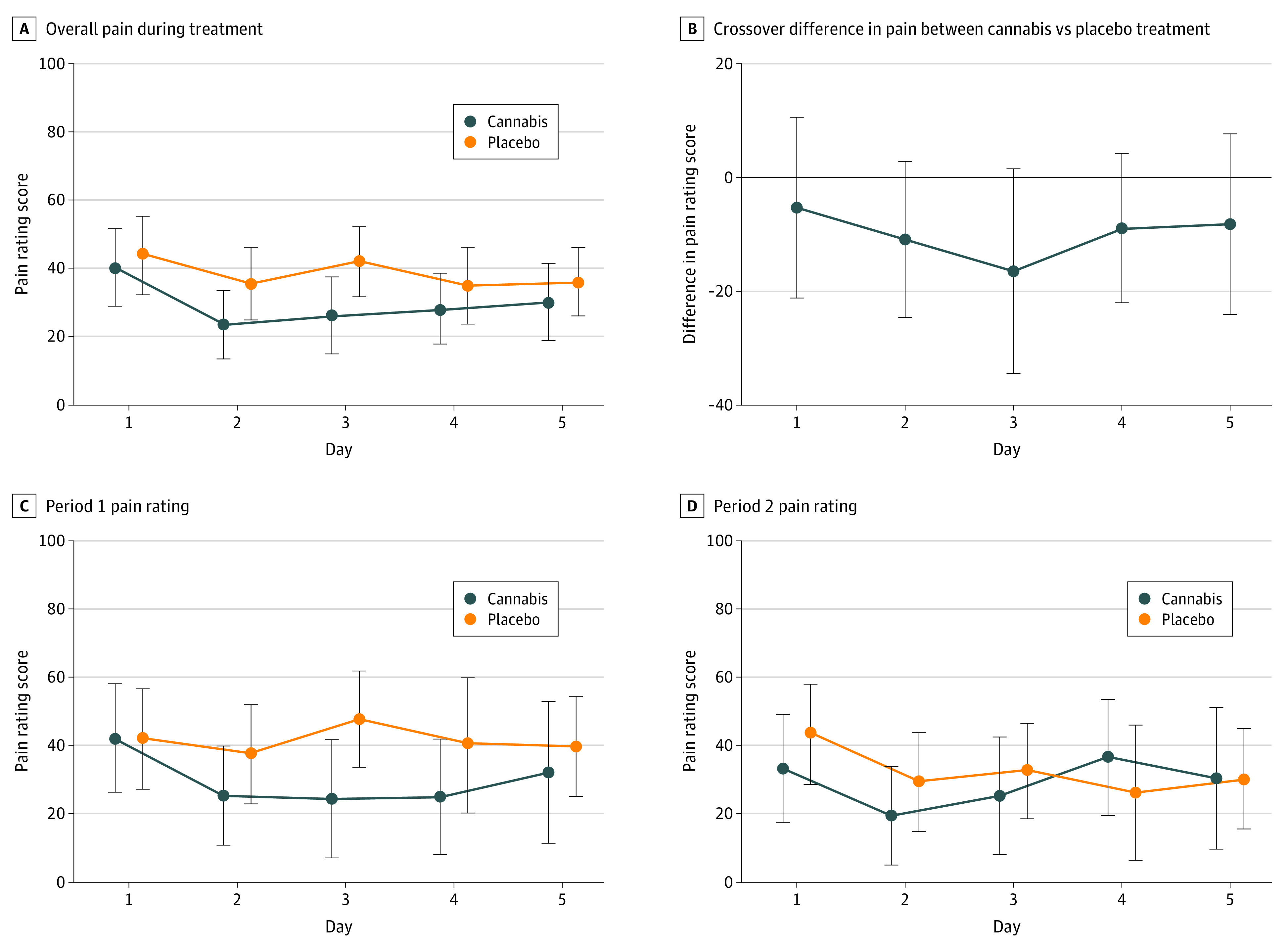
A total of 23 participants (mean [SD] age, 37.6 [11.4] years; 13 [56%] women) completed the trial. The mean (SD) difference in pain rating assessment between the cannabis and placebo groups was -5.3 (8.1) for day 1, -10.9 (7.0) for day 2, -16.5 (9.2) for day 3, -8.9 (6.7) for day 4, and -8.2 (8.1) for day 5; however, none of these differences were statistically significant. There was no statistically significant mean (SD) difference in pain interference ratings between cannabis and placebo between days 1 and 5 for interference in general activities (day 1: 0.27 [0.35]; day 5: -1.0 [0.5]), walking (day 1: 0.14 [0.73]; day 5: -0.87 [0.63]), sleep (day 1: 0.59 [0.74]; day 5: -1.3 [0.8]), or enjoyment (day 1: 0.23 [0.69]; day 5: -0.91 [0.48]), but there was a statistically significant mean (SD) difference in decrease in interference with mood (day 1: 0.96 [0.59]; day 5: -1.4 [0.6]; P = .02). No differences in treatment-related adverse effects were observed. Use of concomitant opioids was similar during both treatment periods.
This randomized clinical trial found that, compared with vaporized placebo, vaporized cannabis did not statistically significantly reduce pain and associated symptoms, except interference in mood, in patients with SCD with chronic pain.
ClinicalTrials.gov Identifier: NCT01771731.
重要性:镰状细胞病(SCD)的特征是慢性疼痛和血管阻塞性危象引起的阵发性急性疼痛,通常需要长期使用大剂量的阿片类药物。在 SCD 的人源化小鼠模型中,已发现一种合成大麻素可减轻慢性和急性痛觉过敏。大麻对 SCD 成人慢性疼痛的影响尚不清楚。
目的:确定吸入式大麻是否比吸入式安慰剂更能缓解 SCD 成人的慢性疼痛。
设计、地点和参与者:这是一项随机临床试验,纳入了 2014 年 8 月至 2017 年 4 月期间在一家住院临床研究中心住院的 2 次、每次 5 天的 SCD 慢性疼痛成人患者。参与者每天吸入 3 次雾化大麻(4.4% Δ-9-四氢大麻酚至 4.9%大麻二酚)或雾化安慰剂大麻。在每个 5 天的过程中,使用 Brief Pain Inventory 评估疼痛和疼痛干扰评分。纳入的 SCD 患者需要稳定的镇痛药物,且具有慢性疼痛。共有 90 名患者符合入选标准,56 名患者被认为不符合入选标准,34 名患者入选。其中,7 名患者在随机分组前退出。在 27 名随机分组的参与者中,23 名完成了交叉研究的两个治疗臂,并被纳入最终的方案分析。数据分析于 2019 年 6 月完成,敏感性分析于 2020 年 4 月进行。
干预措施:每天使用雾化器吸入 3 次雾化大麻植物(4.4% Δ-9-四氢大麻酚至 4.9%大麻二酚)或安慰剂大麻植物,持续 5 天。
主要结局和测量指标:每天使用视觉模拟量表和 Brief Pain Inventory 评估疼痛。
结果:共有 23 名参与者(平均[标准差]年龄,37.6[11.4]岁;13[56%]名女性)完成了试验。与安慰剂组相比,大麻组和安慰剂组在第 1 天、第 2 天、第 3 天、第 4 天和第 5 天的疼痛评分评估中,疼痛评分的平均(标准差)差异分别为-5.3(8.1)、-10.9(7.0)、-16.5(9.2)、-8.9(6.7)和-8.2(8.1),但这些差异均无统计学意义。在第 1 天和第 5 天,大麻组和安慰剂组在一般活动(第 1 天:0.27[0.35];第 5 天:-1.0[0.5])、行走(第 1 天:0.14[0.73];第 5 天:-0.87[0.63])、睡眠(第 1 天:0.59[0.74];第 5 天:-1.3[0.8])和享受(第 1 天:0.23[0.69];第 5 天:-0.91[0.48])方面的干扰评分差异无统计学意义,但在情绪干扰评分的降低方面差异有统计学意义(第 1 天:0.96[0.59];第 5 天:-1.4[0.6];P=0.02)。未观察到与治疗相关的不良事件的差异。在两个治疗期,阿片类药物的使用相似。
结论和相关性:这项随机临床试验发现,与雾化安慰剂相比,雾化大麻在 SCD 慢性疼痛患者中,除了情绪干扰外,在统计学上并没有显著减轻疼痛及其相关症状。
试验注册:ClinicalTrials.gov 标识符:NCT01771731。