Department of Consultation-Liaison Psychiatry and Psychosomatic Medicine, University Hospital Zurich, Zurich, Switzerland.
Department of Clinical Psychology and Psychotherapy Research, University of Zurich, Zurich, Switzerland.
BMC Psychiatry. 2020 Jul 17;20(1):378. doi: 10.1186/s12888-020-02783-x.
More than 120,000 refugees and asylum seekers are currently living in Switzerland. The prevalence of mental disorders among this population is significantly higher than that in the general population. While effective treatment options and cross-cultural, specialized treatment centers exist, they tend to be overloaded by their target populations. General outpatient primary health care providers might be able to compensate for the lack of specialized treatment slots. To date, however, it is unknown how often and under what conditions (e.g., length of waiting lists) refugees and asylum seekers are treated outside of specialized centers and whether there are barriers that prevent providers in outpatient settings from treating more patients in this subgroup. The present study aimed to assess the challenges and barriers faced by psychiatrists and psychotherapists working in outpatient settings in Switzerland in treating refugees and asylum seekers to determine the potential capacity of this group to provide mental health care.
An online survey was conducted during the winter of 2017/2018. The survey was constructed in three official languages and took 10-15 min to complete. Spearman's correlations, Mann-Whitney U-Tests, and Chi-squared tests were conducted to analyze the data.
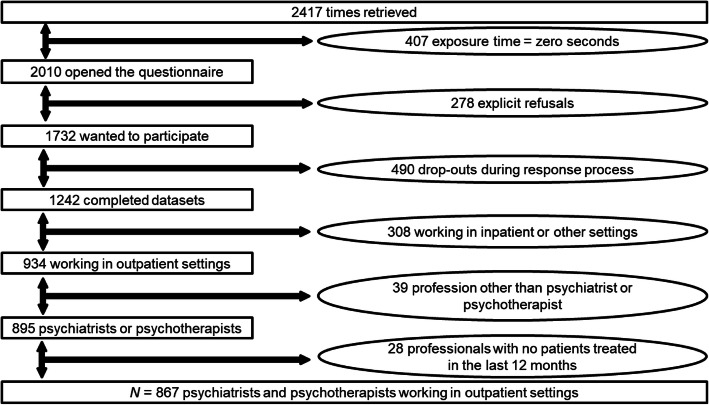
Eight hundred and sixty-seven (N = 867) psychotherapists and psychiatrists working in outpatient settings completed the survey: 43% of them reported having treated between 1 and 9 refugees or asylum seekers in the past 12 months, and a further 13% reported treating 10 or more. Interpreters were used for almost every other patient with a refugee or asylum-seeker background. At the same time, the funding of interpreters, as well as the funding of treatment in general, were reported to be the biggest hurdles to treating more refugees and asylum seekers.
Given the low number of patients rejected for capacity reasons (between 2 and 5%) and the median waiting times for the admission of new patients ranging between 2 and 3 weeks, outpatient primary mental health care providers might treat more refugees and asylum seekers and relieve specialized treatment centers. However, barriers such as lack of funding of interpreters seem to hinder them. Appropriate steps by the authorities are needed to improve the current situation.
目前,超过 12 万名难民和寻求庇护者居住在瑞士。该人群中心理障碍的患病率明显高于一般人群。虽然存在有效的治疗方法和跨文化的专业治疗中心,但它们往往因目标人群过多而不堪重负。普通门诊初级保健提供者可能能够弥补缺乏专业治疗名额的问题。然而,迄今为止,尚不清楚难民和寻求庇护者在何种情况下(例如,等待名单的长短)在专业中心之外接受治疗的频率,以及是否存在阻碍门诊环境中的提供者在这一亚组中治疗更多患者的障碍。本研究旨在评估在瑞士门诊环境中工作的精神科医生和心理治疗师在治疗难民和寻求庇护者方面面临的挑战和障碍,以确定该群体提供精神保健的潜在能力。
在 2017/2018 年冬季进行了在线调查。该调查以三种官方语言进行,完成调查需要 10-15 分钟。采用 Spearman 相关系数、Mann-Whitney U 检验和卡方检验对数据进行分析。
867 名在门诊环境中工作的心理治疗师和精神科医生完成了调查:其中 43%的人报告在过去 12 个月内治疗了 1 至 9 名难民或寻求庇护者,另有 13%的人报告治疗了 10 名或更多。几乎每一位有难民或寻求庇护者背景的患者都使用了翻译。与此同时,报告称治疗更多难民和寻求庇护者的最大障碍是翻译员的资金以及治疗本身的资金。
鉴于因能力原因而拒绝的患者人数较少(2%至 5%之间),以及新患者入院的中位数等待时间为 2 至 3 周,门诊初级精神保健提供者可能会治疗更多的难民和寻求庇护者,并减轻专业治疗中心的负担。然而,缺乏翻译员资金等障碍似乎阻碍了他们。当局需要采取适当措施来改善当前的情况。