Liu Jie, Yu Ruiguang, Ma Biao
Department of Power Mechanical Engineering, Beijing Jiaotong University, Beijing 100044, P. R. China.
Beijing Key Laboratory of New Energy Vehicle Powertrain Technology, Beijing 100044 P. R. China.
ACS Omega. 2020 Jul 1;5(27):16448-16454. doi: 10.1021/acsomega.0c00725. eCollection 2020 Jul 14.
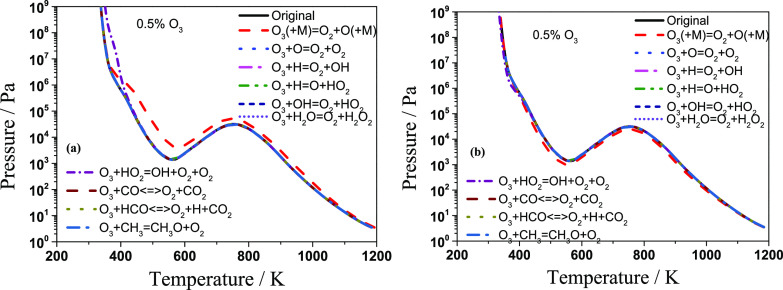
In this study, the effects of ozone addition on the cool flame and NTC (negative temperature coefficient) regions of stoichiometric CH/O mixtures are computationally studied through the explosion limit profiles. The results show that with minute quantities of ozone addition (the mole fraction of ozone is 0.1%), the cool flame area is enlarged to the low-temperature region. Further increases in the mole fraction of ozone gradually weaken the NTC behavior, and a monotonic explosion limit is eventually achieved. The sensitivity analysis of the main reactions involving ozone reveals that the explosion limit is mainly controlled by the ozone unimolecular decomposition reaction O (+M) = O + O (+M). However, as its reverse reaction is a third-body reaction, this reaction will lose its effect on the explosion limit in the high-pressure region. On the contrary, the reaction O + HO = OH + O + O has a significant effect on the explosion limit in the high-pressure and low-temperature region, as the concentration of HO increases through the rapid third-body reaction H + O + M = HO + M.
在本研究中,通过爆炸极限曲线对添加臭氧对化学计量比CH/O混合物的冷焰和负温度系数(NTC)区域的影响进行了计算研究。结果表明,添加微量臭氧(臭氧的摩尔分数为0.1%)时,冷焰区域向低温区扩大。臭氧摩尔分数的进一步增加会逐渐削弱NTC行为,最终实现单调爆炸极限。对涉及臭氧的主要反应的敏感性分析表明,爆炸极限主要由臭氧单分子分解反应O(+M)=O+O(+M)控制。然而,由于其逆反应是三体反应,该反应在高压区域将对爆炸极限失去作用。相反,反应O+HO=OH+O+O在高压和低温区域对爆炸极限有显著影响,因为通过快速三体反应H+O+M=HO+M,HO的浓度会增加。