Department of Surgical Pathology, Hyogo College of Medicine, Nishinomiya, Japan.
Department of Neurosurgery, Hyogo College of Medicine, Nishinomiya, Japan.
Brain Pathol. 2020 Nov;30(6):1119-1133. doi: 10.1111/bpa.12887. Epub 2020 Aug 6.
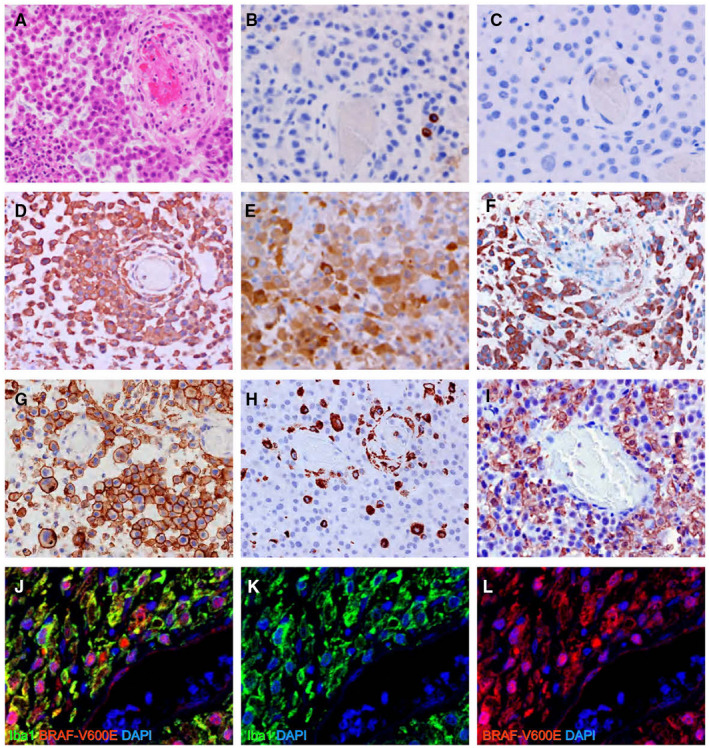
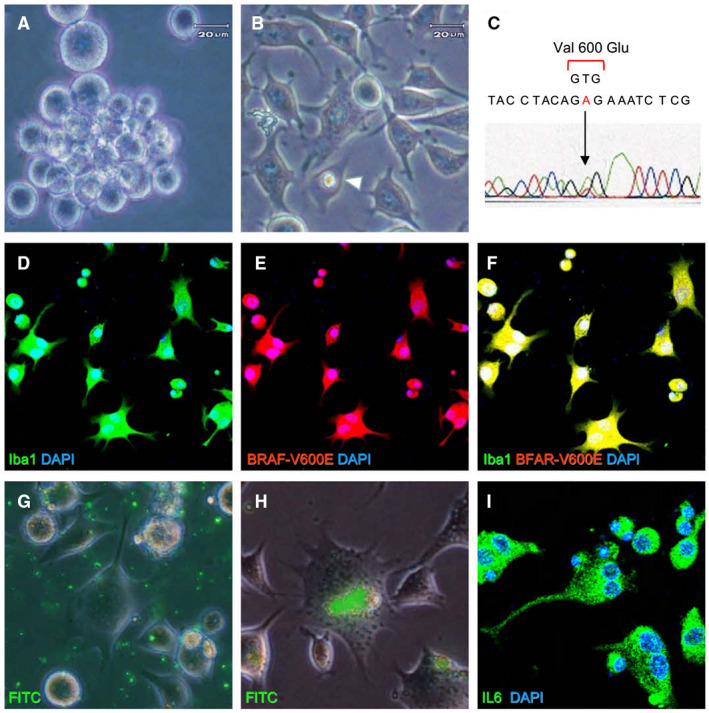
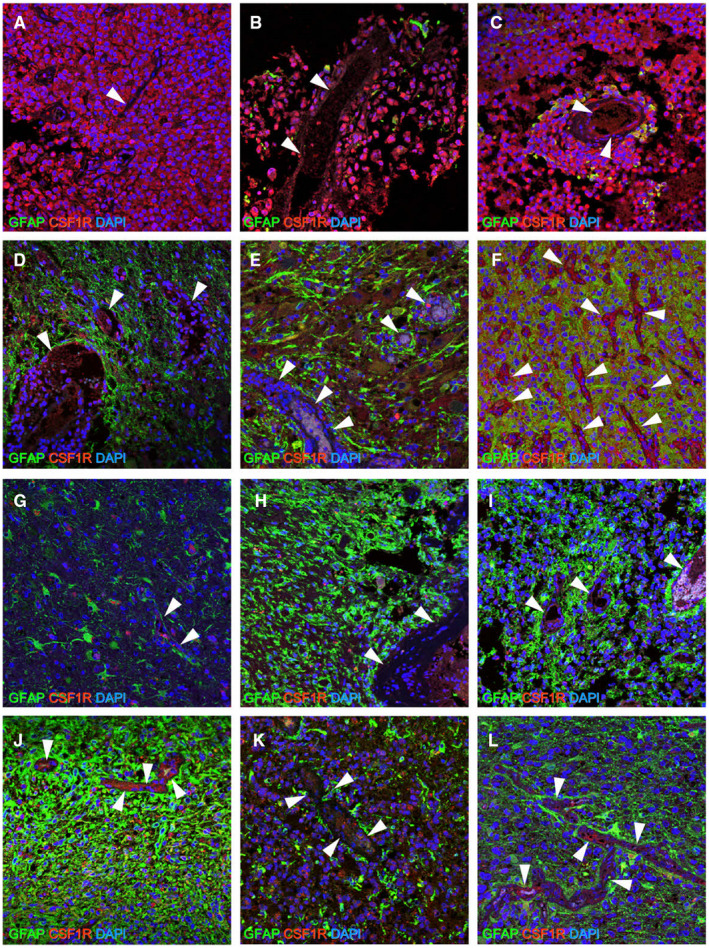
Epithelioid glioblastoma (E-GBM) was recently designated as a subtype of glioblastoma (GBM) by the World Health Organization (2016). E-GBM is an aggressive and rare variant of GBM that primarily occurs in children and young adults. Although most characterized cases of E-GBM harbor a mutation of the BRAF gene in which valine (V) is substituted by glutamic acid (E) at amino acid 600 (BRAF-V600E), in addition to telomerase reverse transcriptase promoter mutations and homozygous CDKN2A/B deletions, the origins and cellular nature of E-GBM remain uncertain. Here, we present a case of E-GBM that exhibits antigenic and functional traits suggestive of microglia. Although no epithelial [e.g., CKAE1/3, epithelial membrane antigen (EMA)] or glial (e.g., GFAP, Olig2) markers were detected by immunohistochemical staining, the microglial markers CD68 and Iba1 were readily apparent. Furthermore, isolated E-GBM-derived tumor cells expressed microglial/macrophage-related genes including cytokines, chemokines, MHC class II antigens, lysozyme and the critical functional receptor, CSF-1R. Isolated E-GBM-derived tumor cells were also capable of phagocytosis and cytokine production. Treating E-GBM-derived tumor cells with the BRAF-V600E inhibitor, PLX4032 (vemurafenib), resulted in a dose-dependent reduction in cell viability that was amplified by addition of the CSF-1R inhibitor, BLZ945. The present case provides insight into the cellular nature of E-GBM and introduces several possibilities for effective targeted therapy for these patients.
上皮样胶质母细胞瘤(E-GBM)最近被世界卫生组织(2016 年)指定为胶质母细胞瘤(GBM)的一个亚型。E-GBM 是一种侵袭性和罕见的 GBM 变体,主要发生在儿童和年轻人中。尽管大多数特征明确的 E-GBM 病例携带 BRAF 基因的突变,其中缬氨酸(V)被谷氨酸(E)取代,位于氨基酸 600 位(BRAF-V600E),此外还存在端粒酶逆转录酶启动子突变和纯合性 CDKN2A/B 缺失,但 E-GBM 的起源和细胞性质仍不确定。在这里,我们报告了一例 E-GBM,其表现出提示小胶质细胞的抗原和功能特征。尽管免疫组织化学染色未检测到上皮 [例如 CKAE1/3、上皮膜抗原(EMA)] 或神经胶质(例如 GFAP、Olig2)标志物,但很容易检测到小胶质细胞标志物 CD68 和 Iba1。此外,分离的 E-GBM 衍生肿瘤细胞表达小胶质细胞/巨噬细胞相关基因,包括细胞因子、趋化因子、MHC 类 II 抗原、溶菌酶和关键功能受体 CSF-1R。分离的 E-GBM 衍生肿瘤细胞也能够吞噬和产生细胞因子。用 BRAF-V600E 抑制剂 PLX4032(vemurafenib)处理 E-GBM 衍生的肿瘤细胞会导致细胞活力呈剂量依赖性降低,而添加 CSF-1R 抑制剂 BLZ945 则会增强这种降低。本病例提供了对 E-GBM 细胞性质的深入了解,并为这些患者的有效靶向治疗提出了几种可能性。