Ken Parker Brain Tumour Research Laboratories, Brain and Mind Centre, Faculty of Medicine and Health, University of Sydney, Camperdown, NSW 2050, Australia.
Int J Mol Sci. 2022 Dec 9;23(24):15612. doi: 10.3390/ijms232415612.
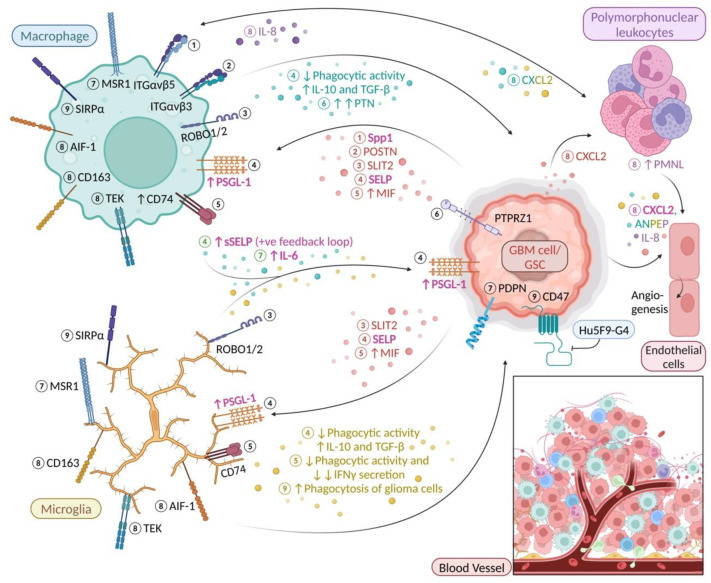
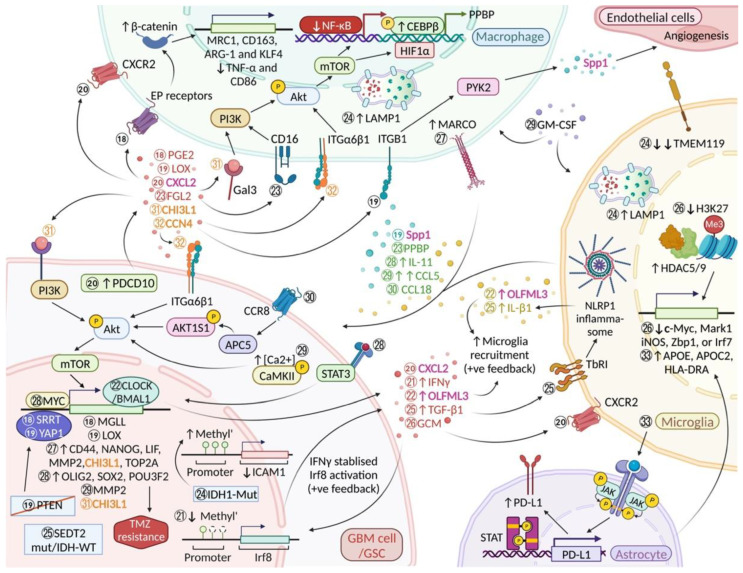
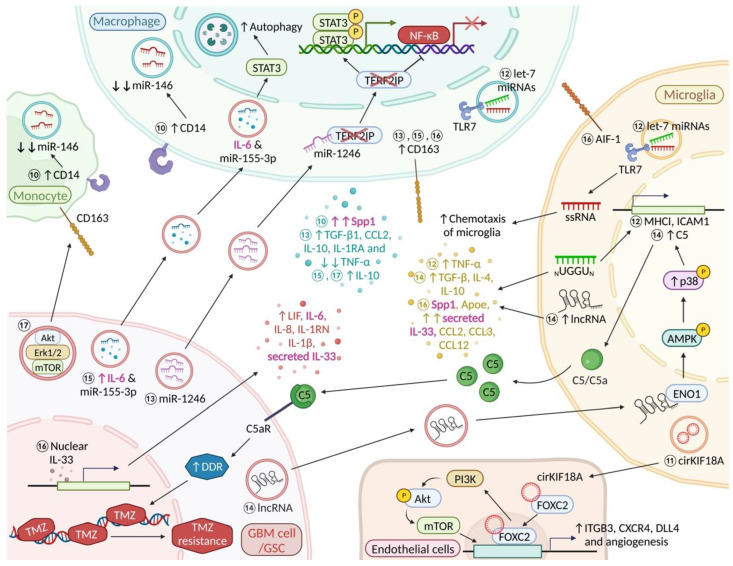
Evidence is accumulating that the tumour microenvironment (TME) has a key role in the progression of gliomas. Non-neoplastic cells in addition to the tumour cells are therefore finding increasing attention. Microglia and other glioma-associated macrophages are at the centre of this interest especially in the context of therapeutic considerations. New ideas have emerged regarding the role of microglia and, more recently, blood-derived brain macrophages in glioblastoma (GBM) progression. We are now beginning to understand the mechanisms that allow malignant glioma cells to weaken microglia and brain macrophage defence mechanisms. Surface molecules and cytokines have a prominent role in microglia/macrophage-glioma cell interactions, and we discuss them in detail. The involvement of exosomes and microRNAs forms another focus of this review. In addition, certain microglia and glioma cell pathways deserve special attention. These "synergistic" (we suggest calling them "Janus") pathways are active in both glioma cells and microglia/macrophages where they act in concert supporting malignant glioma progression. Examples include CCN4 (WISP1)/Integrin α6β1/Akt and CHI3L1/PI3K/Akt/mTOR. They represent attractive therapeutic targets.
越来越多的证据表明肿瘤微环境(TME)在胶质瘤的进展中起着关键作用。因此,除了肿瘤细胞之外的非肿瘤细胞正受到越来越多的关注。小胶质细胞和其他与胶质瘤相关的巨噬细胞是这方面研究的核心,特别是在治疗考虑的背景下。关于小胶质细胞的作用以及最近在胶质母细胞瘤(GBM)进展中血液来源的脑巨噬细胞的新观点已经出现。我们现在开始了解允许恶性神经胶质瘤细胞削弱小胶质细胞和脑巨噬细胞防御机制的机制。表面分子和细胞因子在小胶质细胞/巨噬细胞-神经胶质瘤细胞相互作用中起着突出的作用,我们将详细讨论它们。外泌体和 microRNAs 的参与构成了本综述的另一个重点。此外,某些小胶质细胞和神经胶质瘤细胞途径值得特别关注。这些“协同”(我们建议称之为“两面神”)途径在神经胶质瘤细胞和小胶质细胞/巨噬细胞中均活跃,它们协同作用支持恶性神经胶质瘤的进展。例如 CCN4(WISP1)/整合素α6β1/Akt 和 CHI3L1/PI3K/Akt/mTOR。它们代表有吸引力的治疗靶点。