Mahey Reeta, Kandpal Shobha, Gupta Monica, Vanamail Perumal, Bhatla Neerja, Malhotra Neena
Department of Obstetrics & Gynecology, All India Institute of Medical Sciences, New Delhi, India.
Obstet Gynecol Sci. 2020 Jul;63(4):480-489. doi: 10.5468/ogs.20003. Epub 2020 Jul 15.
The incidence of women in the reproductive age group diagnosed with cancer has recently increased. However, very few patients opt for or are offered fertility preservation (FP) strategies because of a significant lack in awareness. The present study was conducted to evaluate the knowledge of the effect of cancer treatment on fertility and available options for FP.
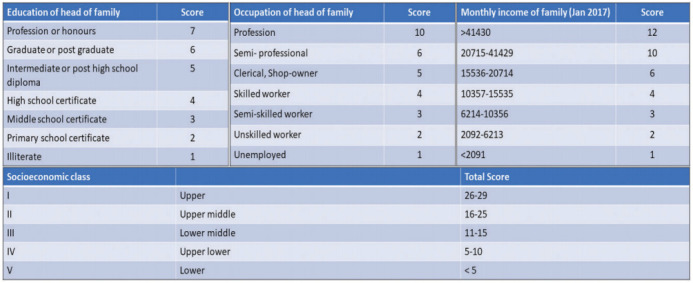
This was a cross-sectional study conducted at a tertiary care center from March 2019 through August 2019. One hundred female patients with gynecological or nongynecological cancer and 18-40 years of age were interviewed. The participants were categorized on the basis of the modified Kuppuswamy socioeconomic status (SES) scale and the responses of the patients in the different categories were compared.
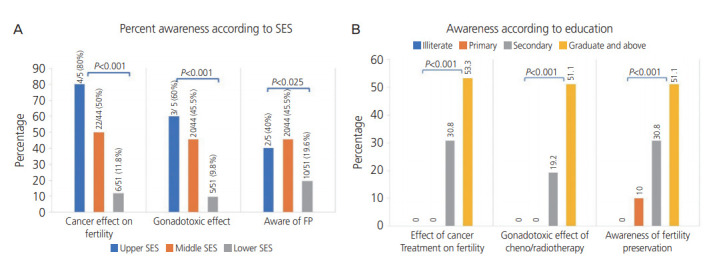
More than half the patients (63%) were in the 20-35-year age group. Most of the patients (71%) were married, and of them, 28 (39.4%) desired to have children. Only 32% of the patients were aware of the detrimental effect of cancer and its treatment on future fertility, and of them, only 28% could specify the gonadotoxic effect of chemotherapy. Knowledge was significantly higher in the upper and middle SES levels than it was in the lower SES level (P<0.001). More than half of the patients (68%) were not aware of the existing FP options, whereas one-third of the patients (32%) were given information about FP by their physicians.
The overall awareness of the gonadotoxic effect of cancer therapy and available FP options in the present study was poor. Awareness of FP among both patients and clinicians needs to be increased.
近期,被诊断患有癌症的育龄期女性的发病率有所上升。然而,由于认知严重不足,很少有患者选择或被提供生育力保存(FP)策略。本研究旨在评估对癌症治疗对生育力的影响以及现有的FP选项的认知情况。
这是一项于2019年3月至2019年8月在一家三级医疗中心开展的横断面研究。对100名年龄在18 - 40岁的患有妇科或非妇科癌症的女性患者进行了访谈。参与者根据改良的库普苏瓦米社会经济地位(SES)量表进行分类,并比较不同类别患者的回答。
超过一半的患者(63%)年龄在20 - 35岁之间。大多数患者(71%)已婚,其中28名(39.4%)希望生育子女。只有32%的患者意识到癌症及其治疗对未来生育力的有害影响,其中只有28%能够明确指出化疗的性腺毒性作用。社会经济地位较高和中等水平的患者的认知明显高于较低水平的患者(P<0.001)。超过一半的患者(68%)不知道现有的FP选项,而三分之一的患者(32%)从医生那里获得了关于FP的信息。
在本研究中,对癌症治疗的性腺毒性作用和现有的FP选项的总体认知较差。患者和临床医生对FP的认知都需要提高。