Service of Nephrology and Hypertension, Lausanne University Hospital and University of Lausanne, Rue du Bugnon 17, 1011, Lausanne, Switzerland.
University Center of Legal Medicine Lausanne-Geneva, Rue Michel-Servet 1, Geneva University Hospital, Geneva, Switzerland.
BMC Nephrol. 2020 Jul 20;21(1):289. doi: 10.1186/s12882-020-01946-y.
Men have larger kidneys than women, but it is unclear whether gender remains an independent predictor of kidney size (expressed as weight or length) after correction for body size. We analysed autopsy data to assess whether relative renal length and weight (e.g. corrected for body weight, height or body surface area (BSA)) are also larger in men. Assuming that kidney size is associated with nephron number, opposite findings could partly explain why women are less prone to the development and progression of chronic kidney disease than men.
All forensic autopsies performed between 2009 and 2015 at the local university hospital of Geneva in individuals of European descent aged ≥18 years without a known history of diabetes and/or kidney disease were examined. Individuals with putrefied or severely injured bodies were excluded. Relative renal weight and length were respectively defined as renal weight divided by body weight or BSA and renal length divided by body height or BSA.
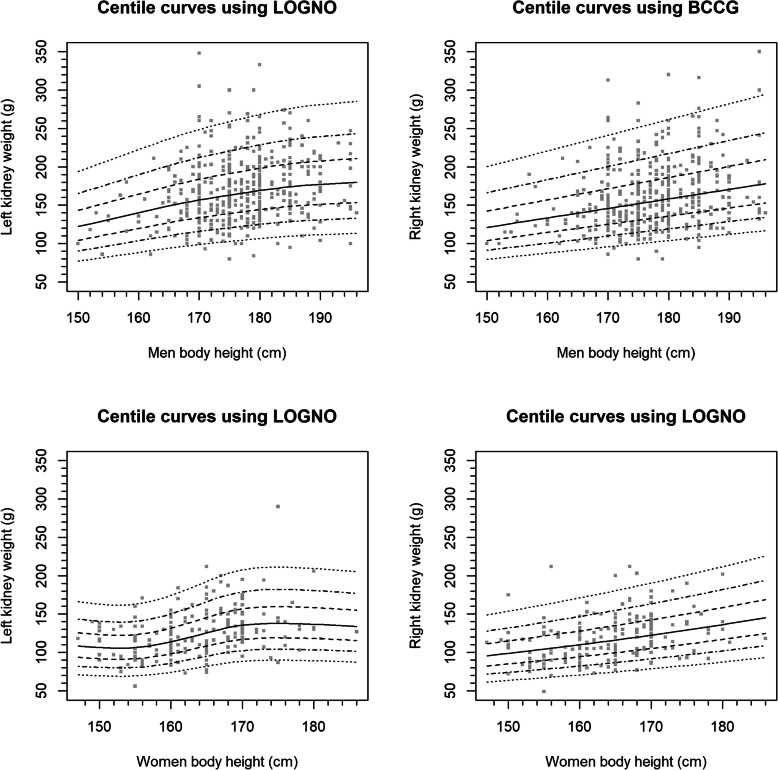
A total of 635 autopsies (68.7% men) were included in the analysis. Left kidneys were on average 8 g heavier and 2 mm longer than right kidneys (both: p < 0.05). Absolute renal weight (165 ± 40 vs 122 ± 29 g) and length (12.0 ± 1.3 vs 11.4 ± 1.1 cm) were higher in men. Relative renal weight was also higher in men, but relative renal length was larger in women. In multivariable regression analysis, body height, body weight, the degree of blood congestion or depletion at autopsy and age were determinants of renal weight, whereas arterial hypertension and smoking were not. Percentile curves of renal weight and length according to sex and body height were constructed.
Absolute and relative renal weights were both smaller in women. This is in line with recent studies stating that nephron numbers are also lower in women. Relative renal length was longer in women, suggesting that female kidneys have a more elongated shape. In comparison with older autopsy studies, renal weight appears to be stable over time.
男性的肾脏比女性大,但在纠正体型后,性别是否仍然是肾脏大小(以体重或长度表示)的独立预测因素尚不清楚。我们分析了尸检数据,以评估相对肾长和肾重(例如,按体重、身高或体表面积(BSA)校正)是否也更大。假设肾脏大小与肾单位数量有关,那么相反的发现可能部分解释了为什么女性比男性不易发生慢性肾脏病的发展和进展。
在日内瓦当地大学医院进行的所有尸检中,选择 2009 年至 2015 年间年龄≥18 岁、无已知糖尿病和/或肾脏病史的欧洲裔个体,排除尸身腐烂或严重受损的个体。将肾重除以体重或 BSA 定义为相对肾重,将肾长除以身高或 BSA 定义为相对肾长。
共纳入 635 例尸检(68.7%为男性)。左肾平均比右肾重 8 克,长 2 毫米(两者均<0.05)。男性的绝对肾重(165±40 比 122±29 克)和长度(12.0±1.3 比 11.4±1.1 厘米)均较高。男性的相对肾重也较高,但女性的相对肾长较大。多变量回归分析显示,身高、体重、尸检时的充血或耗竭程度和年龄是肾重的决定因素,而高血压和吸烟不是。根据性别和身高构建了肾重和长度的百分位数曲线。
女性的绝对和相对肾重均较小。这与最近的研究一致,即女性的肾单位数量也较低。女性的相对肾长较长,提示女性肾脏的形状更细长。与较旧的尸检研究相比,肾重似乎随时间保持稳定。