The Impact Center, Frank Porter Graham Child Development Institute, The University of North Carolina at Chapel Hill, 105 Smith Level Road, Chapel Hill, NC, 27599, USA.
The Center for Implementation, 20 Northampton Dr., Toronto, ON, M9B 4S6, Canada.
Implement Sci. 2020 Jul 20;15(1):56. doi: 10.1186/s13012-020-01021-y.
Implementation science is shifting from qualifying adaptations as good or bad towards understanding adaptations and their impact. Existing adaptation classification frameworks are largely descriptive (e.g., who made the adaptation) and geared towards researchers. They do not help practitioners in decision-making around adaptations (e.g., is an adaptation likely to have negative impacts? Should it be pursued?). Moreover, they lack constructs to consider "ripple effects" of adaptations (i.e., both intended and unintended impacts on outcomes, recognizing that an adaptation designed to have a positive impact on one outcome may have unintended impacts on other outcomes). Finally, they do not specify relationships between adaptations and outcomes, including mediating and moderating relationships. The objective of our research was to promote systematic assessment of intended and unintended impacts of adaptations by using existing frameworks to create a model that proposes relationships among constructs.
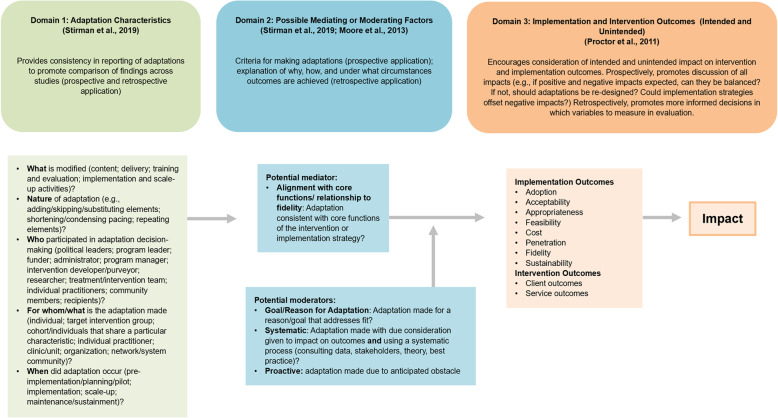
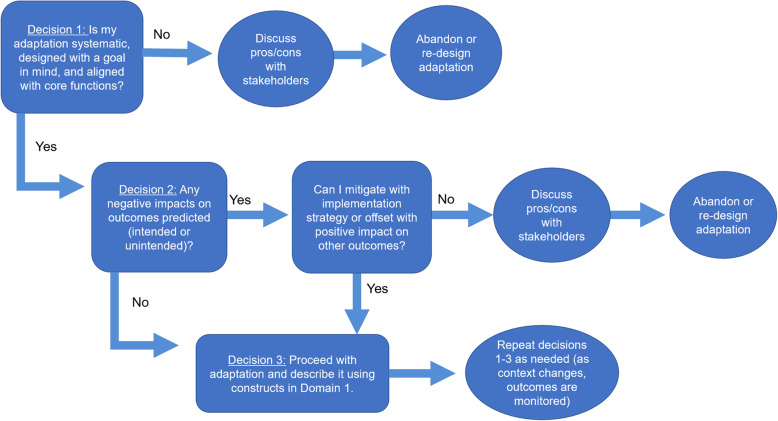
We reviewed, consolidated, and refined constructs from two adaptation frameworks and one intervention-implementation outcome framework. Using the consolidated and refined constructs, we coded qualitative descriptions of 14 adaptations made to an existing evidence-based intervention; the 14 adaptations were designed in prior research by a stakeholder panel using a modified Delphi approach. Each of the 14 adaptations had detailed descriptions, including the nature of the adaptation, who made it, and its goal and reason. Using coded data, we arranged constructs from existing frameworks into a model, the Model for Adaptation Design and Impact (MADI), that identifies adaptation characteristics, their intended and unintended impacts (i.e., ripple effects), and potential mediators and moderators of adaptations' impact on outcomes. We also developed a decision aid and website ( MADIguide.org ) to help implementation scientists apply MADI in their work.
Our model and associated decision aids build on existing frameworks by comprehensively characterizing adaptations, proposing how adaptations impact outcomes, and offering practical guidance for designing adaptations. MADI encourages researchers to think about potential causal pathways of adaptations (e.g., mediators and moderators) and adaptations' intended and unintended impacts on outcomes. MADI encourages practitioners to design adaptations in a way that anticipates intended and unintended impacts and leverages best practice from research.
实施科学正在从定性适应措施的好坏转变为理解适应措施及其影响。现有的适应分类框架在很大程度上是描述性的(例如,谁进行了适应措施),并且面向研究人员。它们无助于实践者在适应措施方面做出决策(例如,适应措施是否可能产生负面影响?是否应该采用?)。此外,它们缺乏考虑适应措施“连锁效应”的结构(即对结果的预期和非预期影响,认识到旨在对一个结果产生积极影响的适应措施可能对其他结果产生意外影响)。最后,它们没有指定适应措施与结果之间的关系,包括中介和调节关系。我们研究的目的是通过使用现有框架创建一个模型来促进对适应措施的预期和非预期影响的系统评估,该模型提出了结构之间的关系。
我们回顾、整合和完善了两个适应框架和一个干预实施结果框架中的结构。使用整合和完善的结构,我们对 14 项针对现有循证干预措施的适应措施进行了定性描述的编码;这 14 项适应措施是由利益相关者小组在之前的研究中使用改进的 Delphi 方法设计的。每一项适应措施都有详细的描述,包括适应措施的性质、实施者以及其目标和理由。使用编码数据,我们将现有框架中的结构安排到一个模型中,即适应设计和影响模型(MADI),该模型确定了适应措施的特征、其预期和非预期影响(即连锁效应)以及适应措施对结果影响的潜在中介和调节因素。我们还开发了一个决策辅助工具和网站(MADIguide.org),以帮助实施科学家在工作中应用 MADI。
我们的模型和相关的决策辅助工具通过全面描述适应措施、提出适应措施如何影响结果以及为设计适应措施提供实用指南,建立在现有框架的基础上。MADI 鼓励研究人员思考适应措施的潜在因果途径(例如,中介和调节因素)以及适应措施对结果的预期和非预期影响。MADI 鼓励实践者以预期和非预期影响的方式设计适应措施,并利用研究中的最佳实践。