Department of Medicine, Keck School of Medicine USC, United States.
Department of Preventive Medicine, Keck School of Medicine USC, United States.
EBioMedicine. 2020 Sep;59:102883. doi: 10.1016/j.ebiom.2020.102883. Epub 2020 Jul 17.
Past clinical trials of docosahexaenoic Acid (DHA) supplements for the prevention of Alzheimer's disease (AD) dementia have used lower doses and have been largely negative. We hypothesized that larger doses of DHA are needed for adequate brain bioavailability and that APOE4 is associated with reduced delivery of DHA and eicosapentaenoic acid (EPA) to the brain before the onset of cognitive impairment.
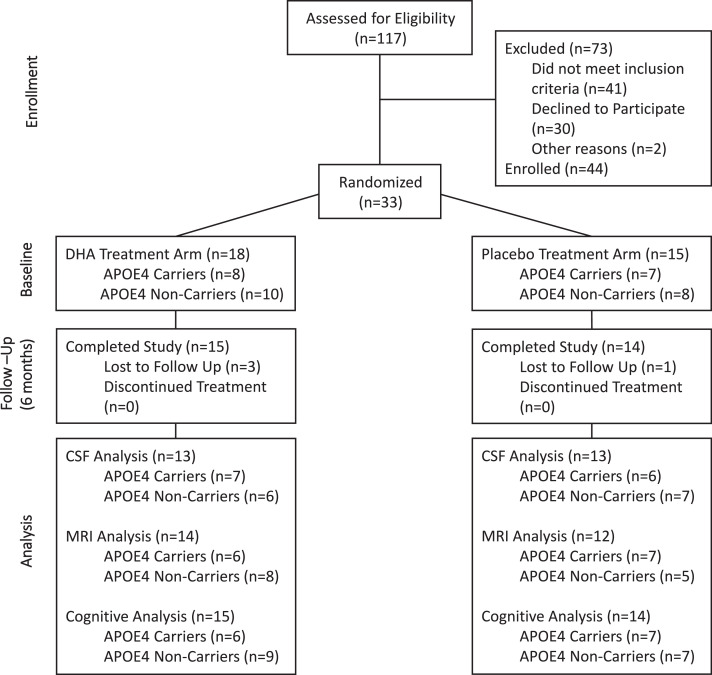
33 individuals were provided with a vitamin B complex (1 mg vitamin B12, 100 mg of vitamin B6 and 800 mcg of folic acid per day) and randomized to 2,152 mg of DHA per day or placebo over 6 months. 26 individuals completed both lumbar punctures and MRIs, and 29 completed cognitive assessments at baseline and 6 months. The primary outcome was the change in CSF DHA. Secondary outcomes included changes in CSF EPA levels, MRI hippocampal volume and entorhinal thickness; exploratory outcomes were measures of cognition.
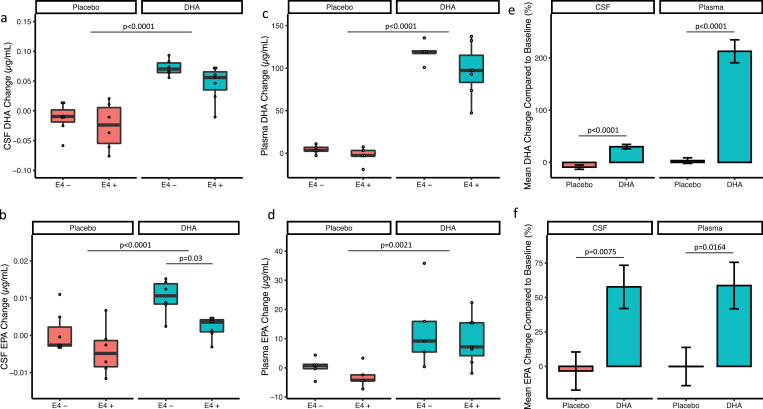
A 28% increase in CSF DHA and 43% increase in CSF EPA were observed in the DHA treatment arm compared to placebo (mean difference for DHA (95% CI): 0.08 µg/mL (0.05, 0.10), p<0.0001; mean difference for EPA: 0.008 µg/mL (0.004, 0.011), p<0.0001). The increase in CSF EPA in non-APOE4 carriers after supplementation was three times greater than APOE4 carriers. The change in brain volumes and cognitive scores did not differ between groups.
Dementia prevention trials using omega-3 supplementation doses equal or lower to 1 g per day may have reduced brain effects, particularly in APOE4 carriers.
NCT02541929.
HNY was supported by R01AG055770, R01AG054434, R01AG067063 from the National Institute of Aging and NIRG-15-361854 from the Alzheimer's Association, and MGH by the L. K. Whittier Foundation. This work was also supported by P50AG05142 (HCC) from the National Institutes of Health. Funders had no role in study design, data collection, data analysis, interpretation, or writing of the report.
过去针对二十二碳六烯酸 (DHA) 补充剂预防阿尔茨海默病 (AD) 痴呆的临床试验使用的剂量较低,且结果大多为阴性。我们假设,为了使 DHA 在大脑中达到足够的生物利用度,需要更高的剂量,并且 APOE4 会导致 DHA 和二十碳五烯酸 (EPA) 在认知障碍出现之前向大脑的输送减少。
33 名参与者每天服用复合维生素 B(1 毫克维生素 B12、100 毫克维生素 B6 和 800 微克叶酸),并随机分为每天服用 2152 毫克 DHA 或安慰剂,为期 6 个月。26 名参与者完成了腰椎穿刺和 MRI,29 名参与者在基线和 6 个月时完成了认知评估。主要结局是 CSF DHA 的变化。次要结局包括 CSF EPA 水平、MRI 海马体积和内嗅皮质厚度的变化;探索性结局是认知测量。
与安慰剂相比,DHA 治疗组 CSF DHA 增加了 28%,CSF EPA 增加了 43%(DHA 的平均差异(95%CI):0.08 µg/mL(0.05,0.10),p<0.0001;EPA 的平均差异:0.008 µg/mL(0.004,0.011),p<0.0001)。非 APOE4 携带者补充后 EPA 水平的增加是 APOE4 携带者的三倍。各组间脑容量和认知评分的变化无差异。
使用每天等于或低于 1 克的 ω-3 补充剂进行痴呆预防试验,可能会降低大脑的作用,尤其是在 APOE4 携带者中。
NCT02541929。
HNY 得到了美国国立卫生研究院的 R01AG055770、R01AG054434、R01AG067063 和 Alzheimer's Association 的 NIRG-15-361854 的支持,MGH 得到了 L.K.Whittier 基金会的支持。这项工作还得到了 P50AG05142(HCC)的支持。资助者在研究设计、数据收集、数据分析、解释或报告的撰写方面没有任何作用。