Malý Martin, Diederichs Kay, Dohnálek Jan, Kolenko Petr
Faculty of Nuclear Sciences and Physical Engineering, Czech Technical University in Prague, Břehová 7, Prague 11519, Czech Republic.
Institute of Biotechnology of the Czech Academy of Sciences, Biocev, Průmyslová 595, Vestec 25250, Czech Republic.
IUCrJ. 2020 Jun 10;7(Pt 4):681-692. doi: 10.1107/S2052252520005916. eCollection 2020 Jul 1.
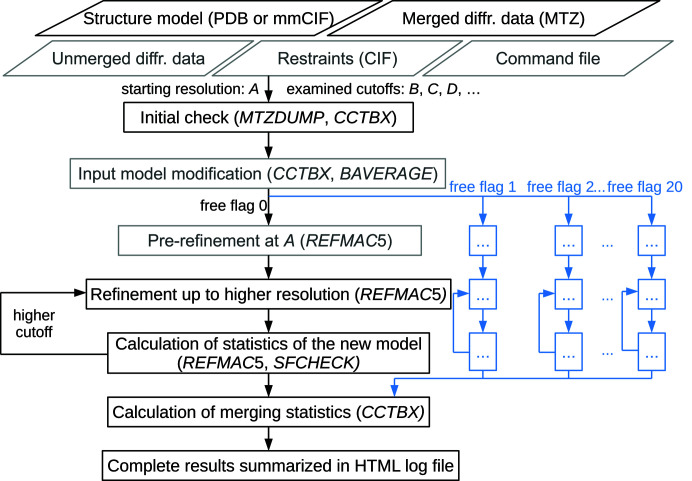
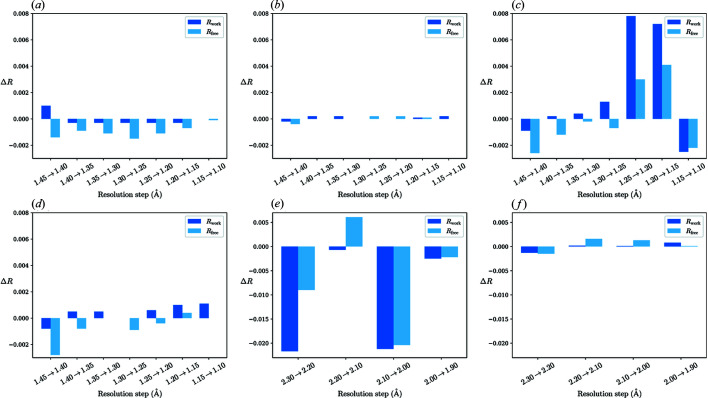
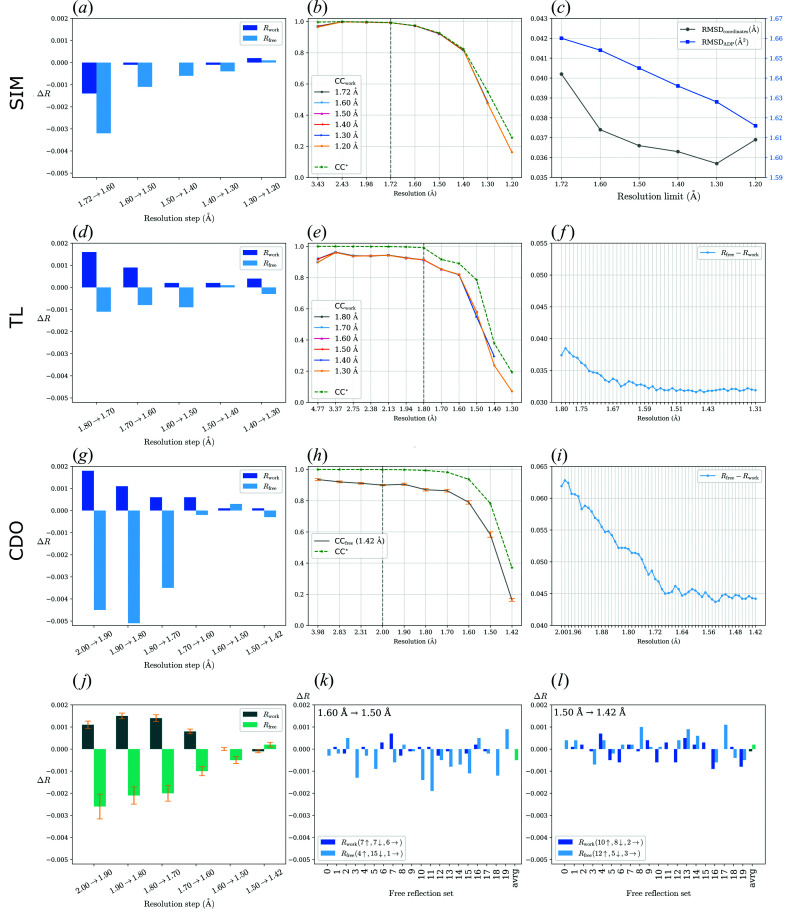
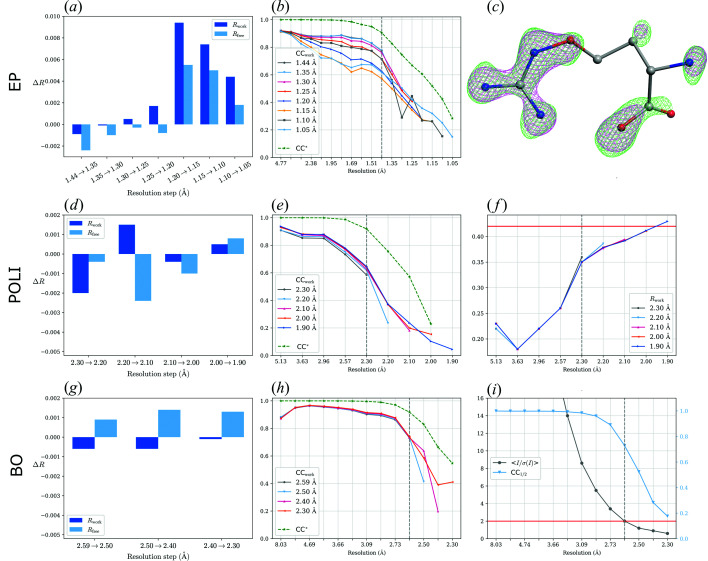
Crystallographic resolution is a key characteristic of diffraction data and represents one of the first decisions an experimenter has to make in data evaluation. Conservative approaches to the high-resolution cutoff determination are based on a number of criteria applied to the processed X-ray diffraction data only. However, high-resolution data that are weaker than arbitrary cutoffs can still result in the improvement of electron-density maps and refined structure models. Therefore, the impact of reflections from resolution shells higher than those previously used in conservative structure refinement should be analysed by the paired refinement protocol. For this purpose, a tool called was developed to provide automation of this protocol. As a new feature, a complete cross-validation procedure has also been implemented. Here, the design, usage and control of the program are described, and its application is demonstrated on six data sets. The results prove that the inclusion of high-resolution data beyond the conventional criteria can lead to more accurate structure models.
晶体学分辨率是衍射数据的一个关键特征,也是实验人员在数据评估时必须做出的首批决策之一。确定高分辨率截止值的保守方法仅基于应用于已处理X射线衍射数据的若干标准。然而,比任意截止值弱的高分辨率数据仍可改善电子密度图和精修的结构模型。因此,应通过配对精修方案分析来自高于保守结构精修中先前使用分辨率壳层的反射的影响。为此,开发了一个名为 的工具,以实现该方案的自动化。作为一项新功能,还实施了完整的交叉验证程序。本文描述了该程序的设计、用法和控制,并在六个数据集上展示了其应用。结果证明,纳入超出传统标准的高分辨率数据可得到更准确的结构模型。