Wang Ya-Kun, Ma Dongxin, Yuan Fanglong, Singh Kamalpreet, Pina Joao M, Johnston Andrew, Dong Yitong, Zhou Chun, Chen Bin, Sun Bin, Ebe Hinako, Fan James, Sun Meng-Jia, Gao Yuan, Lu Zheng-Hong, Voznyy Oleksandr, Liao Liang-Sheng, Sargent Edward H
Department of Electrical and Computer Engineering, University of Toronto, 10 King's College Road, Toronto, Ontario, M5S 3G4, Canada.
Institute of Functional Nano and Soft Materials (FUNSOM), Jiangsu Key Laboratory for Carbon-Based Functional Materials and Devices, Soochow University, 215123, Suzhou, Jiangsu, PR China.
Nat Commun. 2020 Jul 22;11(1):3674. doi: 10.1038/s41467-020-17482-0.
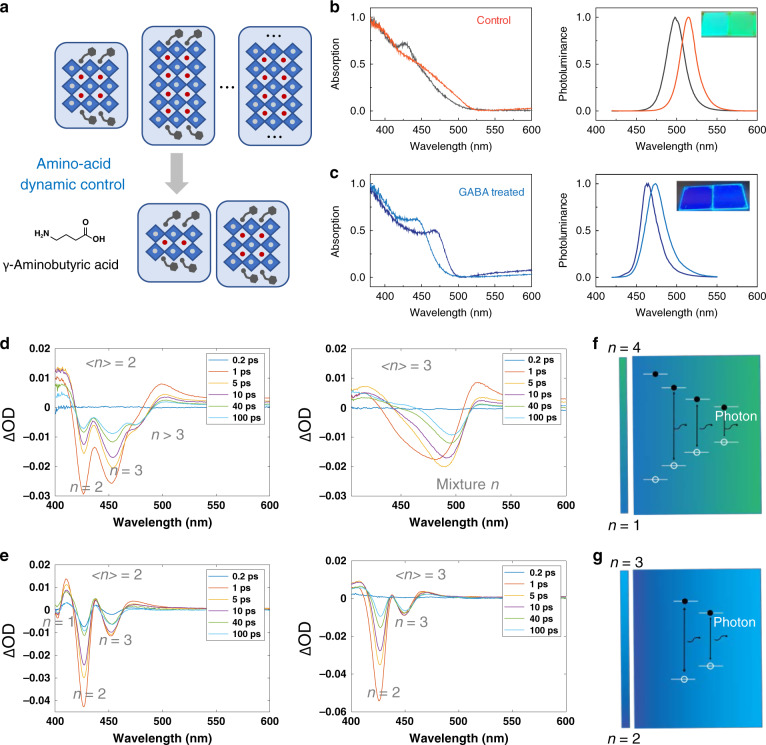
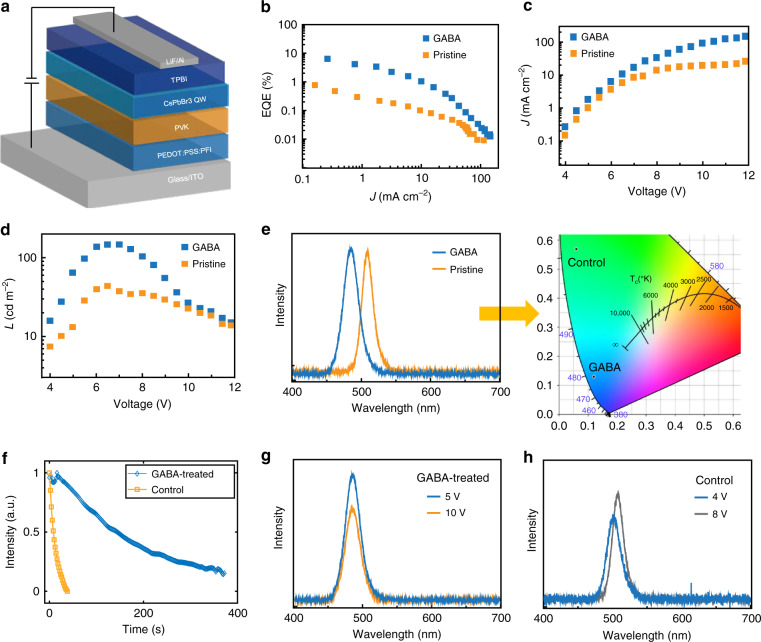
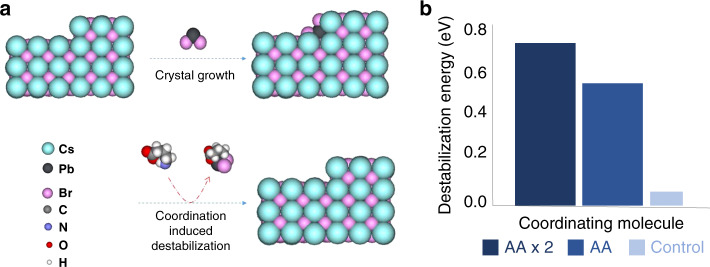
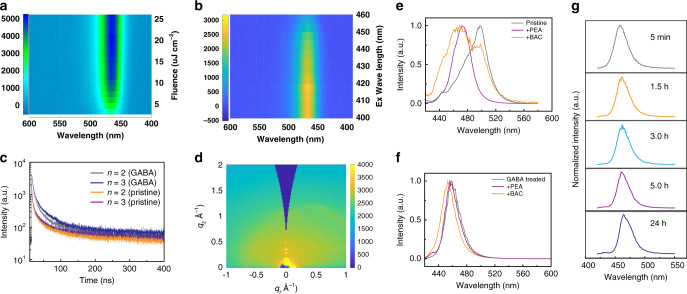
Metal halide perovskites have emerged as promising candidates for solution-processed blue light-emitting diodes (LEDs). However, halide phase segregation - and the resultant spectral shift - at LED operating voltages hinders their application. Here we report true-blue LEDs employing quasi-two-dimensional cesium lead bromide with a narrow size distribution of quantum wells, achieved through the incorporation of a chelating additive. Ultrafast transient absorption spectroscopy measurements reveal that the chelating agent helps to control the quantum well thickness distribution. Density functional theory calculations show that the chelating molecule destabilizes the lead species on the quantum well surface and that this in turn suppresses the growth of thicker quantum wells. Treatment with γ-aminobutyric acid passivates electronic traps and enables films to withstand 100 °C for 24 h without changes to their emission spectrum. LEDs incorporating γ-aminobutyric acid-treated perovskites exhibit blue emission with Commission Internationale de l'Éclairage coordinates of (0.12, 0.14) at an external quantum efficiency of 6.3%.
金属卤化物钙钛矿已成为溶液法制备蓝光发光二极管(LED)的有前景的候选材料。然而,在LED工作电压下卤化物相分离以及由此产生的光谱偏移阻碍了它们的应用。在此,我们报告了采用准二维溴化铯铅且量子阱尺寸分布狭窄的真蓝光LED,这是通过加入螯合添加剂实现的。超快瞬态吸收光谱测量表明,螯合剂有助于控制量子阱厚度分布。密度泛函理论计算表明,螯合分子会使量子阱表面的铅物种不稳定,进而抑制更厚量子阱的生长。用γ-氨基丁酸处理可钝化电子陷阱,并使薄膜能够在100°C下耐受24小时而发射光谱不变。掺入经γ-氨基丁酸处理的钙钛矿的LED在国际照明委员会坐标为(0.12, 0.14)时呈现蓝光发射,外部量子效率为6.3%。