African Institute of Biomedical Science and Technology (AiBST), Harare, Zimbabwe.
Department of Clinical Pharmacology, University of Zimbabwe (UZ), Harare, Zimbabwe.
Pharmacol Res Perspect. 2020 Aug;8(4):e00618. doi: 10.1002/prp2.618.
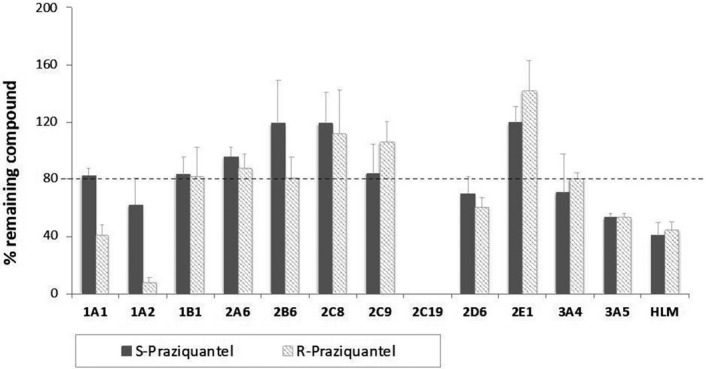
Racemic praziquantel (PZQ) is the drug of choice for the treatment of schistosomiasis. R-Praziquantel (R-PZQ) has been shown as the therapeutic form, whereas S-PZQ is less efficacious and responsible for the bitter taste of the tablet. This study aimed at investigating the metabolism of R- and S-PZQ as this could have implications on efficacy and safety of racemate and R-PZQ specific formulations under development. In vitro CYP reaction phenotyping assay using 10 recombinant CYP (rCYP) isoenzymes showed hepatic CYP1A2, 2C19, 2D6, 3A4, and 3A5 were the major enzymes involved in metabolism of PZQ. Enzyme kinetic studies were performed by substrate depletion and metabolite formation methods, by incubating PZQ and its R- or S-enantiomers in human liver microsomes (HLM) and the rCYP enzymes. The effect of selective CYP inhibitors on PZQ metabolism was assessed in HLM. CYP1A2, 2C19, and 3A4 exhibited different catalytic activity toward PZQ, R- and S-enantiomers. Metabolism of R-PZQ was mainly catalyzed by CYP1A2 and CYP2C19, whereas metabolism of S-PZQ was mainly by CYP2C19 and CYP3A4. Based on metabolic CL obtained through formation of hydroxylated metabolites, CYP3A4 was estimated to contribute 89.88% to metabolism of S-PZQ using SIMCYP IVIVE prediction. Reanalysis of samples from a human PZQ-ketoconazole (KTZ) drug-drug interaction pharmacokinetic study confirmed these findings in that KTZ, a potent inhibitor of CYP3A, selectively increased area under the curve of S-PZQ by 68% and that of R-PZQ by just 9%. Knowledge of enantioselective metabolism will enable better understanding of variable efficacy of PZQ in patients and the R-PZQ formulation under development.
消旋吡喹酮(PZQ)是治疗血吸虫病的首选药物。已证明 R-吡喹酮(R-PZQ)是治疗形式,而 S-PZQ 的疗效较低,并且是片剂苦味的原因。本研究旨在研究 R-和 S-PZQ 的代谢,因为这可能对正在开发的消旋体和 R-PZQ 特定配方的疗效和安全性产生影响。使用 10 种重组 CYP(rCYP)同工酶的体外 CYP 反应表型测定法表明,肝 CYP1A2、2C19、2D6、3A4 和 3A5 是 PZQ 代谢的主要酶。通过底物耗竭和代谢物形成方法进行酶动力学研究,在人肝微粒体(HLM)和 rCYP 酶中孵育 PZQ 及其 R-或 S-对映体。在 HLM 中评估了选择性 CYP 抑制剂对 PZQ 代谢的影响。CYP1A2、2C19 和 3A4 对 PZQ、R-和 S-对映体表现出不同的催化活性。R-PZQ 的代谢主要由 CYP1A2 和 CYP2C19 催化,而 S-PZQ 的代谢主要由 CYP2C19 和 CYP3A4 催化。基于通过形成羟化代谢物获得的代谢 CL,通过 SIMCYP IVIVE 预测估计 CYP3A4 对 S-PZQ 代谢的贡献为 89.88%。对来自人类 PZQ-酮康唑(KTZ)药物相互作用药代动力学研究的样品重新分析证实了这一发现,即 KTZ 是 CYP3A 的强效抑制剂,选择性地使 S-PZQ 的 AUC 增加了 68%,而 R-PZQ 的 AUC 仅增加了 9%。对手性选择性代谢的了解将使人们更好地了解患者中 PZQ 疗效的差异以及正在开发的 R-PZQ 配方。