Muhsin Mtumweni Ali, Wang Xinyao, Kabole Fatma Mohammed, Zilabumba January, Yang Kun
School of Medicine, Jiangnan University, Wuxi 214122, China.
Neglected Tropical Disease Control Programme, Ministry of Health, Mnazi Mmoja, Zanzibar 16108, Tanzania.
Trop Med Infect Dis. 2022 Nov 3;7(11):347. doi: 10.3390/tropicalmed7110347.
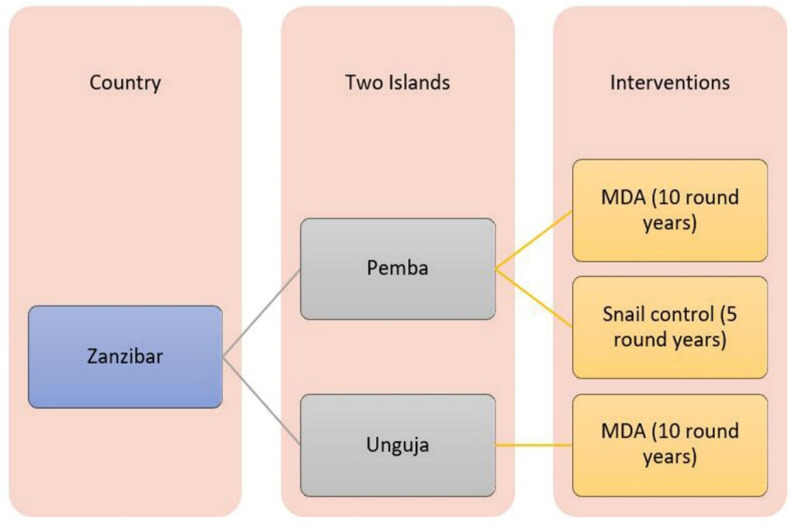
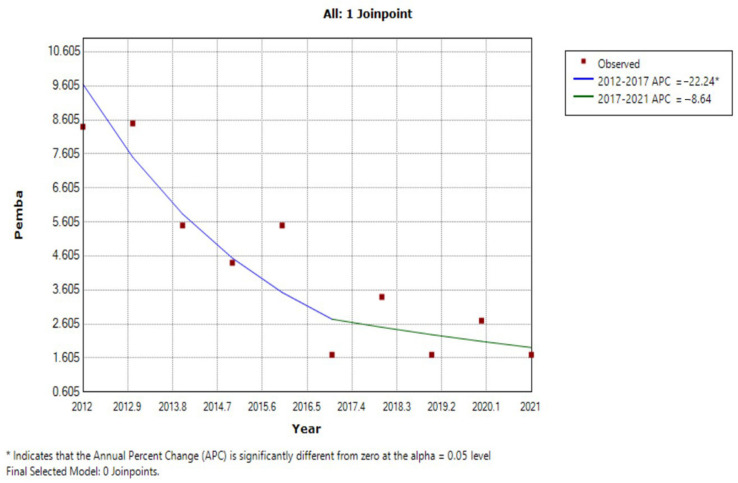
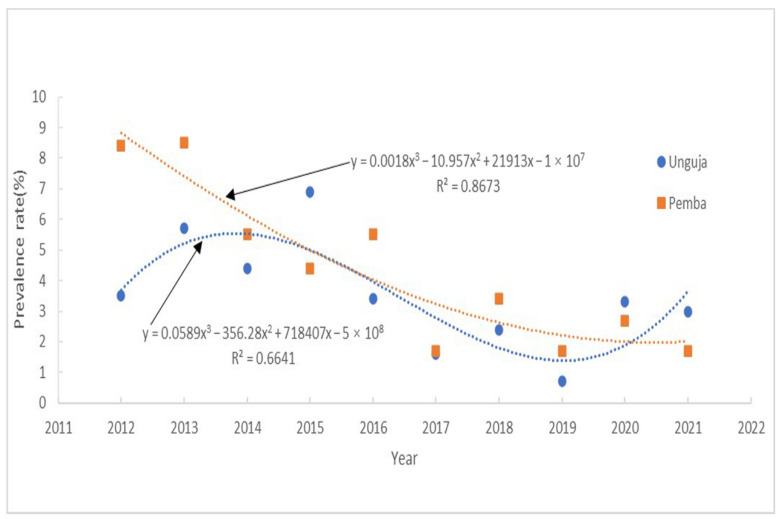
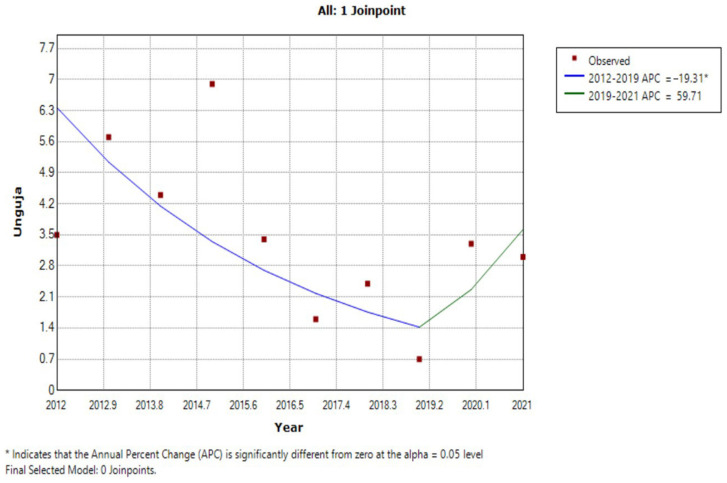
Schistosomiasis is a serious and neglected global tropical disease, affecting upwards of 230 million people, with more than 95% of infections concentrated in Africa. For many years, the main schistosomiasis control strategy in Africa focused on mass drug administration (MDA). The aim of this study was to compare the difference between MDA alone and alongside another intervention, namely snail control, by exploring effective measures for eliminating schistosomiasis. Retrospective data of human prevalence on Schistosoma haematobium and major control measures were collected from the China-Zanzibar-WHO Cooperation Project for Schistosomiasis Elimination (CZW) and the Zanzibar Elimination of Schistosomiasis Transmission (ZEST) project since 2012. The optimal order polynomial regression fitting model and joinpoint regression model (JRM) were used to analyze trends in schistosomiasis prevalence and the consistency of change points with strengthening of the control measures. In Unguja Island, the main control measure was MDA, and prevalence decreased to a nadir in 2019, and then rebounded. The R2 value of the optimal fitting model was 0.6641. There was a single JRM changepoint in 2019, the annual percent change (APC) was −19.3% (p < 0.05) from 2012 to 2019, and the APC was 59.7% (p > 0.05) from 2019 to 2021. In Pemba Island, the main control measures until 2016 was MDA, while integrated measures of MDA and snail control were implemented from 2017, the prevalence continuously decreased, and the R2 value was 0.8673. There was also a single JRM changepoint in 2017, the APC was −22.2% (p < 0.05) from 2012 to 2017, and was maintained at −8.6% (p > 0.05) from 2017 to 2021. Our data indicate that, while it is challenging to eliminate schistosomiasis by MDA alone, integrated measures, including both MDA and snail control, can prevent reinfection and help to eliminate the diseases in Africa.
血吸虫病是一种严重且被忽视的全球热带疾病,影响着超过2.3亿人,其中95%以上的感染集中在非洲。多年来,非洲主要的血吸虫病控制策略侧重于大规模药物治疗(MDA)。本研究的目的是通过探索消除血吸虫病的有效措施,比较单独使用MDA与联合另一种干预措施(即灭螺)之间的差异。自2012年以来,从中国 - 桑给巴尔 - 世卫组织血吸虫病消除合作项目(CZW)和桑给巴尔消除血吸虫病传播(ZEST)项目中收集了人类埃及血吸虫感染率及主要控制措施的回顾性数据。使用最优顺序多项式回归拟合模型和连接点回归模型(JRM)分析血吸虫病感染率的趋势以及随着控制措施加强变化点的一致性。在奔巴岛,主要控制措施直到2016年是MDA,而从2017年开始实施MDA与灭螺的综合措施,感染率持续下降,R2值为0.8673。2017年也有一个单一的JRM变化点,2012年至2017年的年变化百分比(APC)为−22.2%(p<0.05),2017年至2021年保持在−8.6%(p>0.05)。我们的数据表明,虽然仅通过MDA消除血吸虫病具有挑战性,但包括MDA和灭螺在内的综合措施可以预防再感染并有助于在非洲消除该疾病。 在安古贾岛,主要控制措施是MDA,感染率在2019年降至最低点,然后反弹。最优拟合模型的R2值为0.6641。2019年有一个单一的JRM变化点,2012年至2019年的年变化百分比(APC)为−19.3%(p<0.05),2019年至2021年的APC为59.7%(p>0.05)。