Gordon Catherine A, Kurscheid Johanna, Williams Gail M, Clements Archie C A, Li Yuesheng, Zhou Xiao-Nong, Utzinger Jürg, McManus Donald P, Gray Darren J
QIMR Berghofer Medical Research Institute, Herston, QLD 4006, Australia.
Department of Global Health, Research School of Population Health, Australian National University, Acton, ACT 2601, Australia.
Trop Med Infect Dis. 2019 Feb 26;4(1):40. doi: 10.3390/tropicalmed4010040.
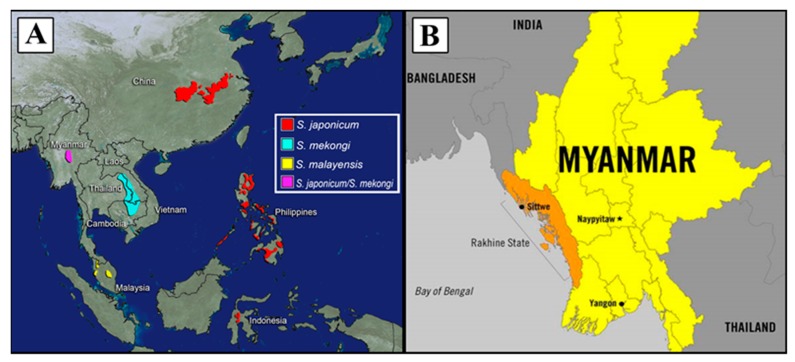
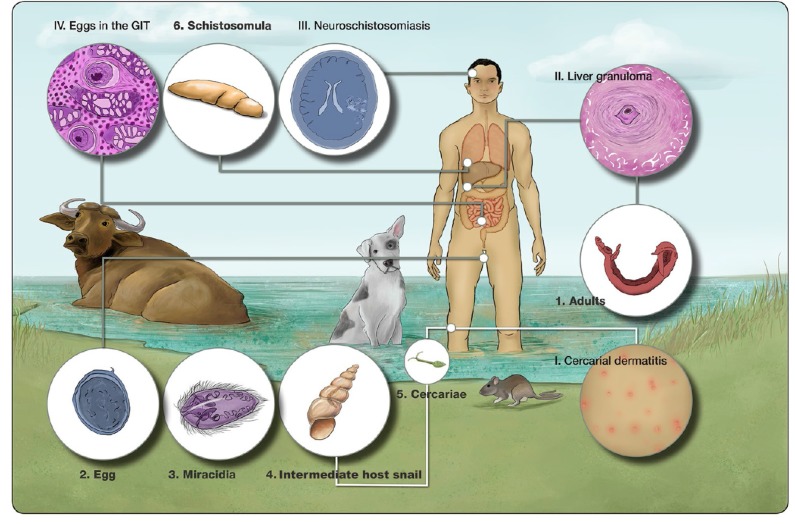
Schistosomiasis is an infectious disease caused by helminth parasites of the genus Worldwide, an estimated 250 million people are infected with these parasites with the majority of cases occurring in sub-Saharan Africa. Within Asia, three species of cause disease. is the most prevalent, followed by and . All three species are zoonotic, which causes concern for their control, as successful elimination not only requires management of the human definitive host, but also the animal reservoir hosts. With regard to Asian schistosomiasis, most of the published research has focused on with comparatively little attention paid to and even less focus on . In this review, we examine the three Asian schistosomes and their current status in their endemic countries: Cambodia, Lao People's Democratic Republic, Myanmar, and Thailand (); Malaysia (); and Indonesia, People's Republic of China, and the Philippines (). Prospects for control that could potentially lead to elimination are highlighted as these can inform researchers and disease control managers in other schistosomiasis-endemic areas, particularly in Africa and the Americas.
血吸虫病是一种由血吸虫属蠕虫寄生虫引起的传染病。在全球范围内,估计有2.5亿人感染这些寄生虫,大多数病例发生在撒哈拉以南非洲。在亚洲,有三种血吸虫会引发疾病。日本血吸虫最为常见,其次是湄公血吸虫和马来血吸虫。这三种血吸虫均为人畜共患,这给它们的防治带来了难题,因为要成功消除血吸虫病,不仅需要对人类终宿主进行管理,还需要对动物储存宿主进行管理。关于亚洲血吸虫病,大多数已发表的研究都集中在日本血吸虫上,对湄公血吸虫的关注相对较少,而对马来血吸虫的关注更少。在本综述中,我们研究了三种亚洲血吸虫及其在柬埔寨、老挝人民民主共和国、缅甸和泰国(东南亚地区);马来西亚(东南亚地区);以及印度尼西亚、中华人民共和国和菲律宾(东南亚地区)等流行国家的现状。文中强调了可能导致消除血吸虫病的控制前景,因为这些信息可为其他血吸虫病流行地区,特别是非洲和美洲的研究人员和疾病控制管理人员提供参考。