University of Paris, INSERM IAME, U1137, Team DesCID, Paris, France.
Médecine Intensive Réanimation, C.H.U de Grenoble-Alpes, Grenoble, France.
Crit Care. 2020 Jul 23;24(1):458. doi: 10.1186/s13054-020-03174-0.
Chlorhexidine-gluconate (CHG) impregnated dressings may prevent catheter-related bloodstream infections (CRBSI). Chlorhexidine-impregnated sponge dressings (sponge-dress) and gel dressings (gel-dress) have never been directly compared. We used the data collected for two randomized-controlled trials to perform a comparison between sponge-dress and gel-dress.
Adult critically ill patients who required short-term central venous or arterial catheter insertion were recruited. Our main analysis included only patients with CHG-impregnated dressings. The effect of gel-dress (versus sponge-dress) on major catheter-related infections (MCRI) and CRBSI was estimated using multivariate marginal Cox models. The comparative risks of dressing disruption and contact dermatitis were evaluated using logistic mix models for clustered data. An explanatory analysis compared gel-dress with standard dressings using either CHG skin disinfection or povidone iodine skin disinfection.
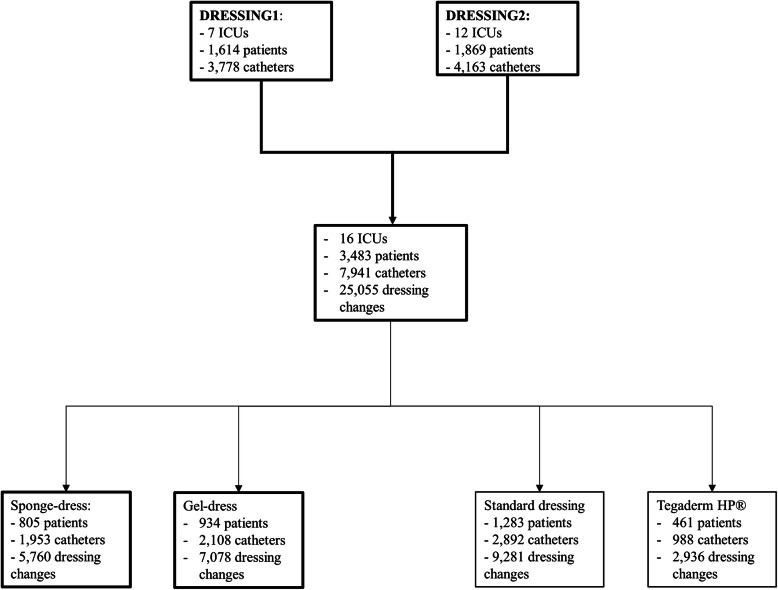
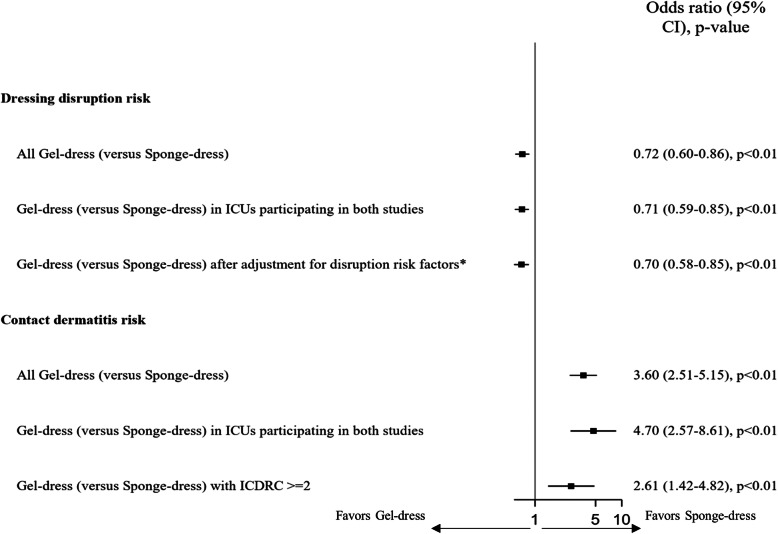
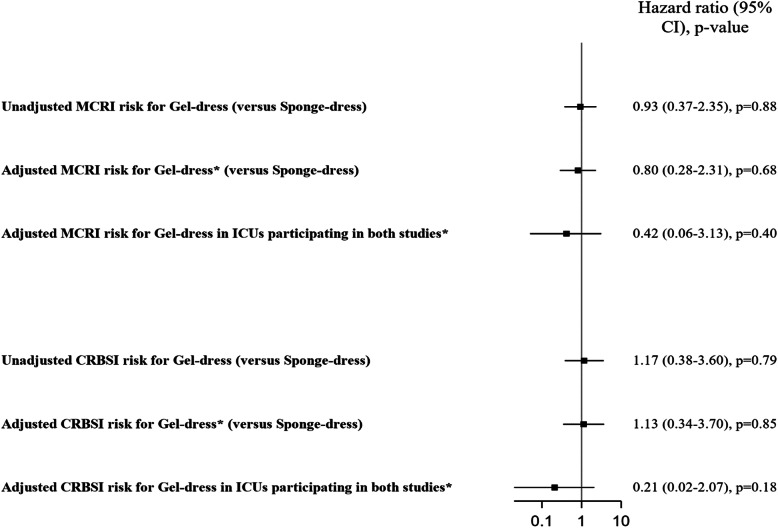
A total of 3483 patients and 7941 catheters were observed in 16 intensive care units. Sponge-dress and gel-dress were utilized for 1953 and 2108 catheters, respectively. After adjustment for confounders, gel-dress showed similar risk for MCRI compared to sponge-dress (HR 0.80, 95% CI 0.28-2.31, p = 0.68) and CRBSI (HR 1.13, 95% CI 0.34-3.70, p = 0.85), less dressing disruptions (OR 0.72, 95% CI 0.60-0.86, p < 0.001), and more contact dermatitis (OR 3.60, 95% CI 2.51-5.15, p < 0.01). However, gel-dress increased the risk of contact dermatitis only if CHG was used for skin antisepsis (OR 1.94, 95% CI 1.38-2.71, p < 0.01).
We described a similar infection risk for gel-dress and sponge-dress. Gel-dress showed fewer dressing disruptions. Concomitant use of CHG for skin disinfection and CHG-impregnated dressing may significantly increase contact dermatitis.
These studies were registered within ClinicalTrials.gov (numbers NCT01189682 and NCT00417235 ).
葡萄糖酸氯己定(CHG)浸渍敷料可能预防导管相关血流感染(CRBSI)。氯己定浸渍海绵敷料(海绵敷料)和凝胶敷料(凝胶敷料)从未直接比较过。我们使用为两项随机对照试验收集的数据进行了海绵敷料和凝胶敷料之间的比较。
招募需要短期中心静脉或动脉导管插入的成年危重症患者。我们的主要分析仅包括使用 CHG 浸渍敷料的患者。使用多变量边际 Cox 模型估计凝胶敷料(与海绵敷料相比)对主要导管相关感染(MCRI)和 CRBSI 的影响。使用用于聚类数据的逻辑混合模型评估敷料破裂和接触性皮炎的相对风险。解释性分析使用 CHG 皮肤消毒或聚维酮碘皮肤消毒比较了凝胶敷料与标准敷料。
在 16 个重症监护病房中观察到 3483 名患者和 7941 根导管。海绵敷料和凝胶敷料分别用于 1953 根和 2108 根导管。在调整混杂因素后,凝胶敷料与海绵敷料相比,MCRI 和 CRBSI 的风险相似(HR 0.80,95%CI 0.28-2.31,p=0.68),敷料破裂的风险较低(OR 0.72,95%CI 0.60-0.86,p<0.001),接触性皮炎的风险更高(OR 3.60,95%CI 2.51-5.15,p<0.01)。然而,如果使用 CHG 进行皮肤消毒,凝胶敷料会增加接触性皮炎的风险(OR 1.94,95%CI 1.38-2.71,p<0.01)。
我们描述了凝胶敷料和海绵敷料具有相似的感染风险。凝胶敷料显示出较少的敷料破裂。CHG 皮肤消毒和 CHG 浸渍敷料的同时使用可能会显著增加接触性皮炎。
这些研究在 ClinicalTrials.gov 注册(编号 NCT01189682 和 NCT00417235)。