Mitroiu M, Oude Rengerink K, Teerenstra S, Pétavy F, Roes K C B
Methodology Working Group, College ter Beoordeling van Geneesmiddelen, Graadt van Roggenweg 500, 3531 AH, Utrecht, The Netherlands.
Department of Biostatistics and Research Support, Clinical Trial Methodology, Julius Center for Health Sciences and Primary Care, University Medical Center Utrecht, University of Utrecht, Heidelberglaan 100, 3584 CX, Utrecht, The Netherlands.
Trials. 2020 Jul 23;21(1):671. doi: 10.1186/s13063-020-04546-1.
An estimand defines the target of estimation for a clinical trial through specification of the treatment, target population, variable, population-level summary and of the strategies for intercurrent events. A carefully defined estimand aligns the clinical trial design and analysis with the scientific question of interest and adequately accounts for so-called intercurrent events. The ICH E9(R1) addendum suggests five estimand strategies. We evaluated to what extent current practice in drug development and regulatory assessment fits in the estimand framework.
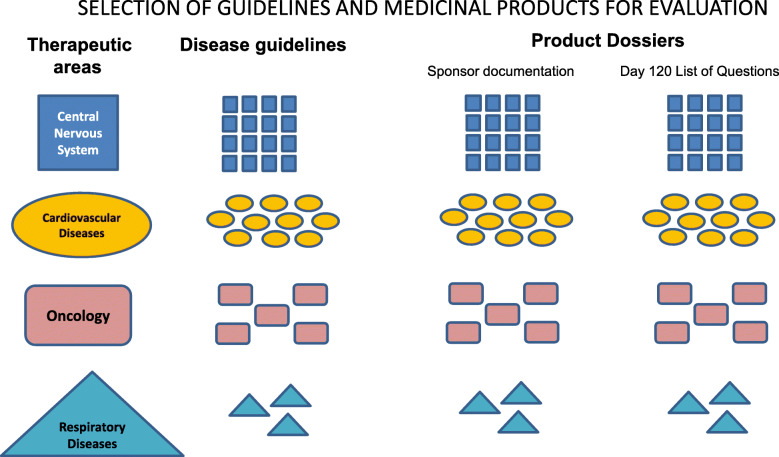
We systematically evaluated what estimands, especially what strategies for intercurrent events are advised in European Medicines Agency disease guidelines, used in sponsors' trials and additionally requested by the European Medicines Agency in assessment dossiers. We selected four therapeutic areas: nervous system, oncology, cardiovascular diseases and respiratory diseases. For each, we evaluated all disease guidelines with approved drugs, the dossiers of the most recently approved drugs matching the guidelines and corresponding regulatory questions.
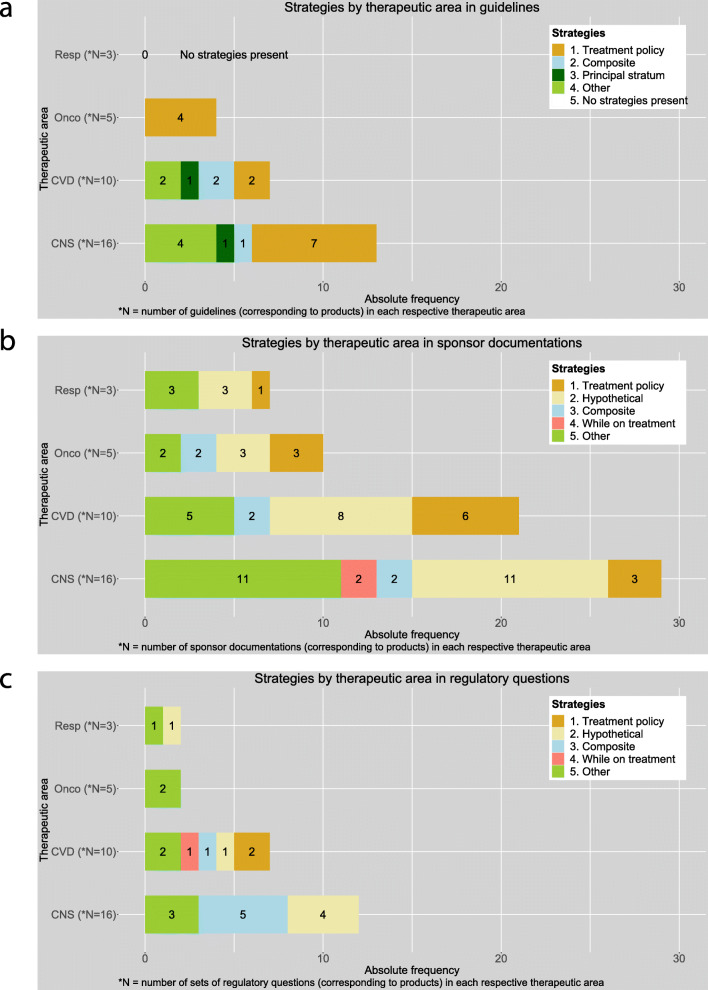
Strategies for intercurrent events were present in 18 (53%) of 34 guidelines, in all 34 sponsor documentations and in 15 (44%) of 34 sets of regulatory questions. Treatment policy was advised in 13 (38%) guidelines and was applied in 9 corresponding sponsor documentations. Of these 9, it was the sole strategy in 4 cases and accompanied by another strategy in 5 cases. Hypothetical strategy was not advised in guidelines. However, it was the leading strategy applied in 25 (74%) sponsor documentations. Composite strategy was advised in 3 (9%) guidelines and applied accompanied by another strategy in 2 corresponding sponsor documentations. While on treatment strategy was not advised in guidelines, but was applied in 2 sponsor documentations. Principal stratum strategy was advised in 2 guidelines but not applied in corresponding sponsor documentations. Of the regulatory questions, treatment policy was present in 2 cases (6%), hypothetical in 6 cases (18%), composite in 6 cases (18%) and while on treatment in 1 case (3%).
Estimand attributes are present in guidelines, sponsor documentations and regulatory questions, but not described as estimands. Treatment policy was most often advised in guidelines, but hypothetical was the leading strategy applied in sponsor documentations. Thus, results indicate not a full concordance between the regulatory target of estimation and what is actually estimated. The lack of concordance was mostly due to limitations in collection of intercurrent events data to enable a treatment policy strategy. There is, therefore, a need to better define estimands at the design stage and throughout the applications dossiers and assessment reports.
估计量通过对治疗、目标人群、变量、人群水平汇总以及并发事件策略的规范来定义临床试验的估计目标。精心定义的估计量使临床试验设计和分析与感兴趣的科学问题保持一致,并充分考虑所谓的并发事件。国际人用药品注册技术协调会(ICH)E9(R1)附录提出了五种估计量策略。我们评估了药物研发和监管评估中的当前实践在多大程度上符合估计量框架。
我们系统地评估了欧洲药品管理局疾病指南中建议的估计量,特别是并发事件的策略,这些策略在申办方的试验中使用,并且在欧洲药品管理局评估档案中被额外要求。我们选择了四个治疗领域:神经系统、肿瘤学、心血管疾病和呼吸系统疾病。对于每个领域,我们评估了所有有批准药物的疾病指南、与指南匹配的最新批准药物的档案以及相应的监管问题。
34项指南中的18项(53%)、所有34份申办方文件以及34套监管问题中的15项(44%)包含并发事件策略。13项(38%)指南中建议了治疗策略,9份相应的申办方文件中应用了该策略。在这9份文件中,4例中它是唯一的策略,5例中它与另一种策略同时使用。指南中未建议假设策略。然而,它是25份(74%)申办方文件中应用的主要策略。3项(9%)指南中建议了综合策略,2份相应的申办方文件中在应用时与另一种策略同时使用。虽然指南中未建议治疗中策略,但在2份申办方文件中应用了该策略。2项指南中建议了主要层策略,但在相应的申办方文件中未应用。在监管问题中,2例(6%)存在治疗策略,6例(18%)存在假设策略,6例(18%)存在综合策略,1例(3%)存在治疗中策略。
估计量属性存在于指南、申办方文件和监管问题中,但未被描述为估计量。指南中最常建议治疗策略,但假设策略是申办方文件中应用的主要策略。因此,结果表明监管估计目标与实际估计内容之间不完全一致。不一致主要是由于并发事件数据收集的局限性,无法采用治疗策略。因此,有必要在设计阶段以及整个申请档案和评估报告中更好地定义估计量。