Smith Arfon M, Niemeyer Kyle E, Katz Daniel S, Barba Lorena A, Githinji George, Gymrek Melissa, Huff Kathryn D, Madan Christopher R, Mayes Abigail Cabunoc, Moerman Kevin M, Prins Pjotr, Ram Karthik, Rokem Ariel, Teal Tracy K, Guimera Roman Valls, Vanderplas Jacob T
Data Science Mission Office, Space Telescope Science Institute, Baltimore, MD, United States of America.
School of Mechanical, Industrial, and Manufacturing Engineering, Oregon State University, Corvallis, OR, United States of America.
PeerJ Prepr. 2018;4:e147. doi: 10.7717/peerj-cs.147. Epub 2018 Feb 12.
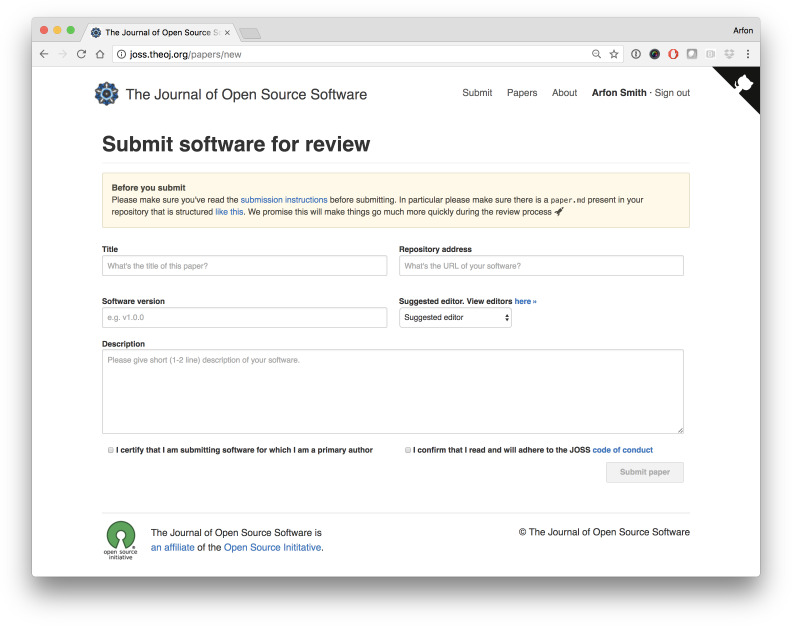
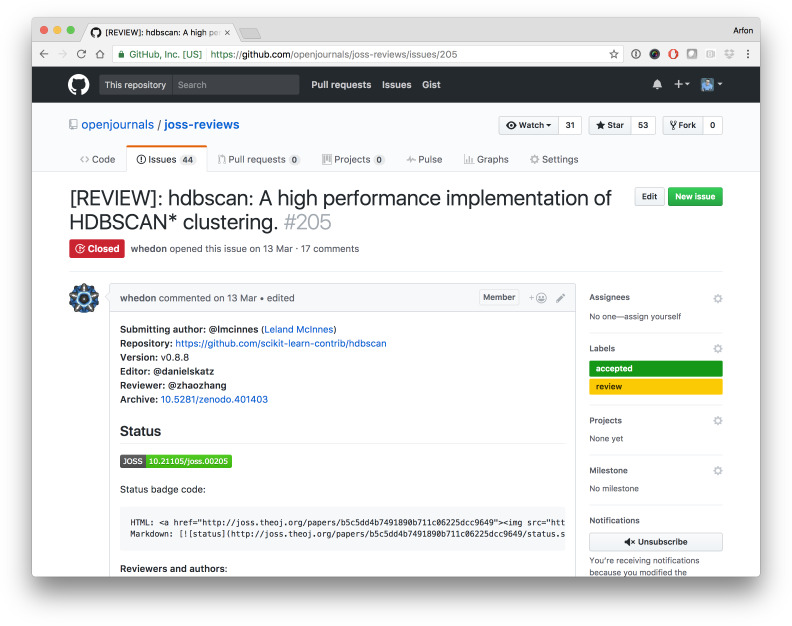
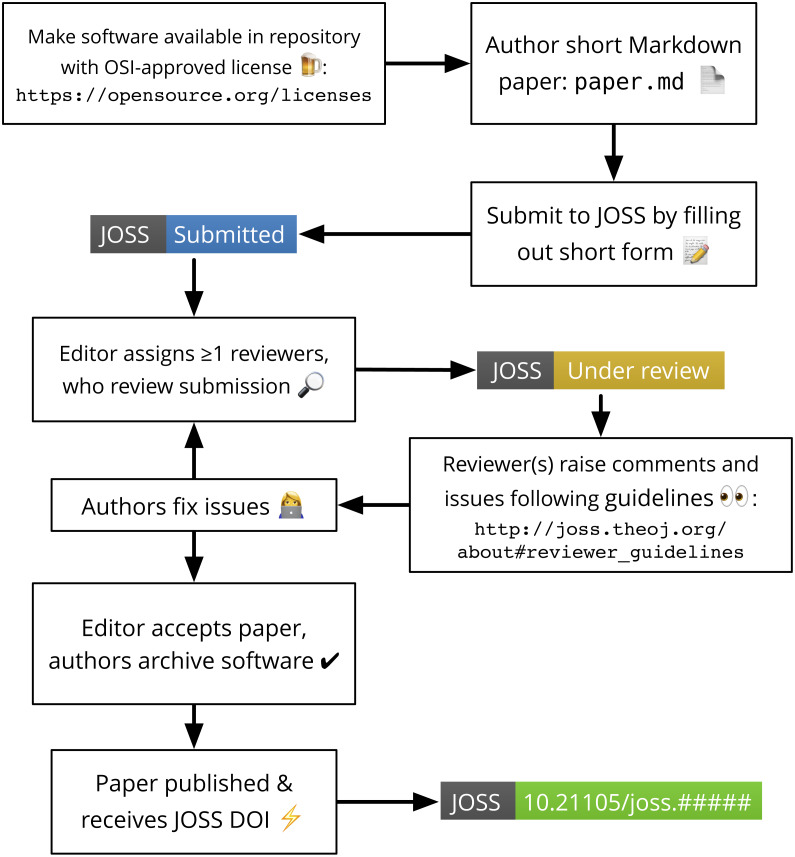
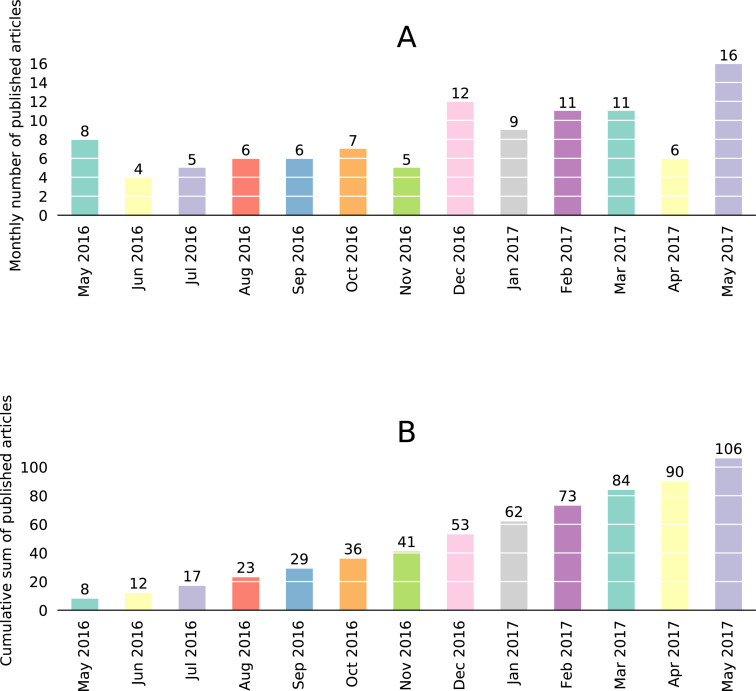
This article describes the motivation, design, and progress of the Journal of Open Source Software (JOSS). JOSS is a free and open-access journal that publishes articles describing research software. It has the dual goals of improving the quality of the software submitted and providing a mechanism for research software developers to receive credit. While designed to work within the current merit system of science, JOSS addresses the dearth of rewards for key contributions to science made in the form of software. JOSS publishes articles that encapsulate scholarship contained in the software itself, and its rigorous peer review targets the software components: functionality, documentation, tests, continuous integration, and the license. A JOSS article contains an abstract describing the purpose and functionality of the software, references, and a link to the software archive. The article is the entry point of a JOSS submission, which encompasses the full set of software artifacts. Submission and review proceed in the open, on GitHub. Editors, reviewers, and authors work collaboratively and openly. Unlike other journals, JOSS does not reject articles requiring major revision; while not yet accepted, articles remain visible and under review until the authors make adequate changes (or withdraw, if unable to meet requirements). Once an article is accepted, JOSS gives it a digital object identifier (DOI), deposits its metadata in Crossref, and the article can begin collecting citations on indexers like Google Scholar and other services. Authors retain copyright of their JOSS article, releasing it under a Creative Commons Attribution 4.0 International License. In its first year, starting in May 2016, JOSS published 111 articles, with more than 40 additional articles under review. JOSS is a sponsored project of the nonprofit organization NumFOCUS and is an affiliate of the Open Source Initiative (OSI).
本文介绍了《开源软件期刊》(JOSS)的创办动机、设计及进展情况。JOSS是一份免费的开放获取期刊,发表描述研究软件的文章。它有两个双重目标,一是提高所提交软件的质量,二是为研究软件开发人员提供获得认可的机制。虽然JOSS旨在现行科学评价体系内发挥作用,但它解决了以软件形式对科学做出的关键贡献缺乏奖励的问题。JOSS发表的文章涵盖了软件本身所包含的学术内容,其严格的同行评审针对软件组件:功能、文档、测试、持续集成及许可。一篇JOSS文章包含描述软件目的和功能的摘要、参考文献以及软件存档的链接。该文章是JOSS投稿的切入点,投稿包含全套软件工件。投稿和评审在GitHub上公开进行。编辑、评审人员和作者进行协作且公开透明地工作。与其他期刊不同,JOSS不会拒绝需要大幅修改的文章;在未被接受之前,文章一直可见并处于评审中,直到作者做出充分修改(或者如果无法满足要求则撤回)。一旦文章被接受,JOSS会为其赋予数字对象标识符(DOI),将其元数据存入CrossRef,并且该文章可以开始在谷歌学术等索引服务上获得引用。作者保留其JOSS文章的版权,根据知识共享署名4.0国际许可协议发布文章。从2016年5月开始的第一年,JOSS发表了111篇文章,另有40多篇文章正在评审中。JOSS是非营利组织NumFOCUS的一个赞助项目,也是开源倡议组织(OSI)的附属机构。