Levesque Crystal L, Akhtar Nadeem, Huynh Evanna, Walk Carrie, Wilcock Pete, Zhang Zhengxiao, Dyce Paul W, de Lange Cornelius F M, Khafipour Ehsan, Li Julang
Department of Animal Science, South Dakota State University, Brookings, SD.
Department of Animal Biosciences, University of Guelph, Guelph, Ontario, Canada.
Transl Anim Sci. 2018 May 18;2(2):184-194. doi: 10.1093/tas/txy019. eCollection 2018 Apr.
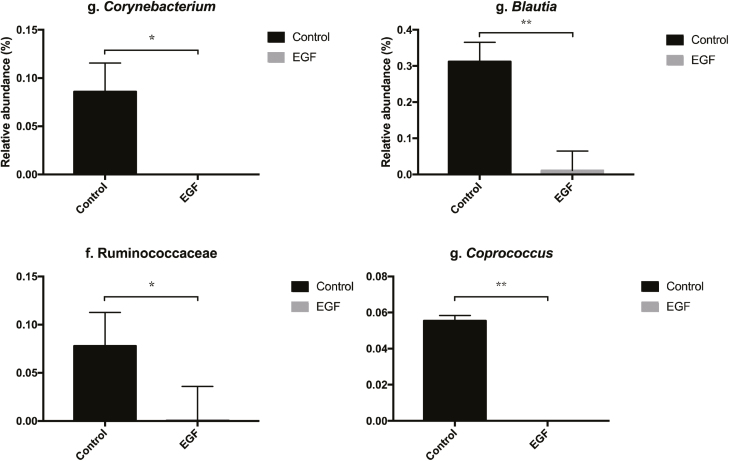
Weaning of pigs can lead to low-feed intake resulting in a lag in growth performance, reduced gut health, and diarrheal diseases. Epidermal growth factor (), the most abundant growth factor in milk, increased weaned pig BW gain and feed efficiency in our previous work. It is believed that intestinal microbiota plays an important role in gut health and pig growth, but limited data are available on the impact of feed additives, such as EGF, on the microbial communities of the intestines. The objective of the study was to investigate if the positive influence of EGF supplementation on weight gain and gut health was related to differences in intestinal microbiota. To examine the efficacy of EGF, a 21-d animal trial was performed using 72 pigs (two equal blocks of 36 pigs with three barrows and three gilts/pen). Pigs were assigned to one of two dietary treatments at weaning (20 ± 2 d of age; = 6 pens/treatment) balancing across treatment for litter, gender, and initial BW. Recombinant yeast supernatant containing EGF at 120 μg/kg BW/d and without EGF (control) was added to the feed for 21 d, followed by a common diet for 7 d. Pig performance was measured weekly and ileal digesta was collected at day 21 from six pigs/treatment for microbiome analysis. Pigs fed diets containing EGF fermentation supernatant had greater ( = 0.01) daily gain in week 3 and overall resulting in heavier ( = 0.029) BW at day 28, which was consistent to our previous finding. No difference in alpha-diversity (Chao1, Shanon, and Simpson indices) and beta-diversity (weighted and unweighted UniFrac distances) of ileal digesta microbiota between EGF supplemented and control pigs were observed. The relative abundances of bacterial taxa did not differ among treatment groups at the phylum level. The relative abundances of (0.0 vs. 0.9%), (0.003 vs. 0.26%), and (0.0 vs. 0.05%) genera, and Rumminococcaceae family (0.001 vs. 0.08%) were decreased ( < 0.05) in EGF group compared to control and were negatively correlated ( < 0.05, r > 0.60) with growth performance. Pathways related to detoxification and carbohydrate metabolism were differentially represented in the luminal bacterial populations. The improved growth of pigs supplemented with EGF supernatant produced by may be related to changes in functional capacity of the gut microbial populations. However, the impact on mucosa-associated or large intestinal communities is still unknown.
仔猪断奶会导致采食量低,进而造成生长性能滞后、肠道健康受损以及腹泻疾病。表皮生长因子(EGF)是牛奶中含量最丰富的生长因子,在我们之前的研究中,它提高了断奶仔猪的体重增加和饲料效率。人们认为肠道微生物群在肠道健康和仔猪生长中起着重要作用,但关于饲料添加剂(如EGF)对肠道微生物群落影响的数据有限。本研究的目的是调查补充EGF对体重增加和肠道健康的积极影响是否与肠道微生物群的差异有关。为了检验EGF的功效,进行了一项为期21天的动物试验,使用了72头猪(两个相等的组,每组36头猪,每栏三头公猪和三头母猪)。仔猪在断奶时(20±2日龄;每组6栏)被分配到两种日粮处理之一,在处理间平衡窝别、性别和初始体重。将含有120μg/kg体重/天EGF的重组酵母上清液和不含EGF的(对照)添加到饲料中21天,随后饲喂普通日粮7天。每周测量仔猪性能,并在第21天从每组6头猪中收集回肠消化物进行微生物组分析。饲喂含有EGF发酵上清液日粮的仔猪在第3周的日增重更高(P = 0.01),总体上在第28天体重更重(P = 0.029),这与我们之前的发现一致。在补充EGF的仔猪和对照仔猪之间,未观察到回肠消化物微生物群的α多样性(Chao1、Shanon和Simpson指数)和β多样性(加权和未加权UniFrac距离)存在差异。在门水平上,各处理组细菌类群的相对丰度没有差异。与对照组相比,EGF组中Akkermansia属(0.0%对0.9%)、Barnesiella属(0.003%对0.26%)和Turicibacter属(0.0%对0.05%)以及瘤胃球菌科(0.001%对0.08%)的相对丰度降低(P < 0.05),并且与生长性能呈负相关(P < 0.05,r > 0.60)。与解毒和碳水化合物代谢相关的途径在肠腔细菌群体中有不同的表现。补充由重组酵母产生的EGF上清液的仔猪生长改善可能与肠道微生物群体功能能力的变化有关。然而,对黏膜相关或大肠群落的影响仍然未知。