Department of Respiratory and Critical Care Medicine, Shandong Provincial Chest Hospital Affiliated to Shandong University, Jinan, Shandong 250013, P.R. China.
Department of Respiratory and Critical Care Medicine, Ren Ji Hospital, School of Medicine, Shanghai Jiao Tong University, Shanghai 200127, P.R. China.
Int J Oncol. 2020 Sep;57(3):756-766. doi: 10.3892/ijo.2020.5095. Epub 2020 Jul 7.
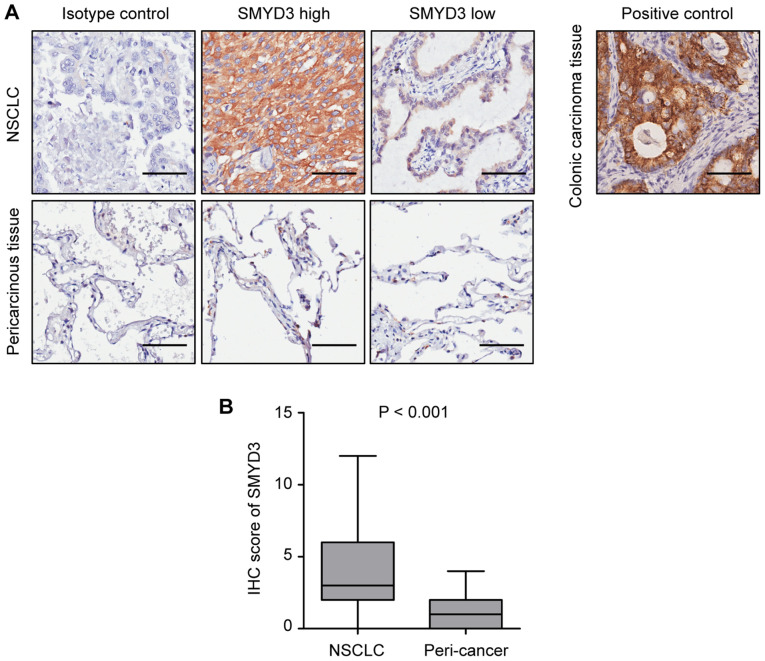
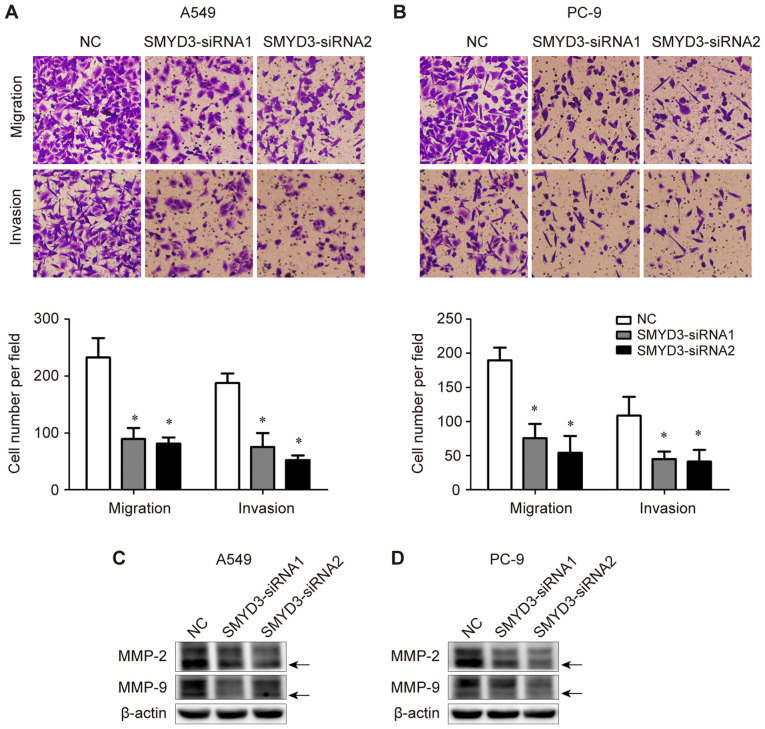
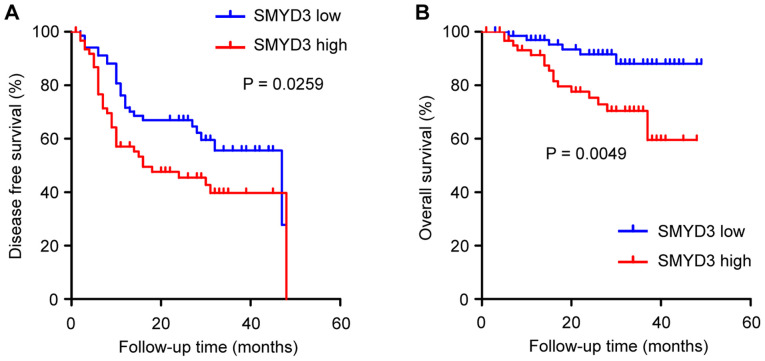
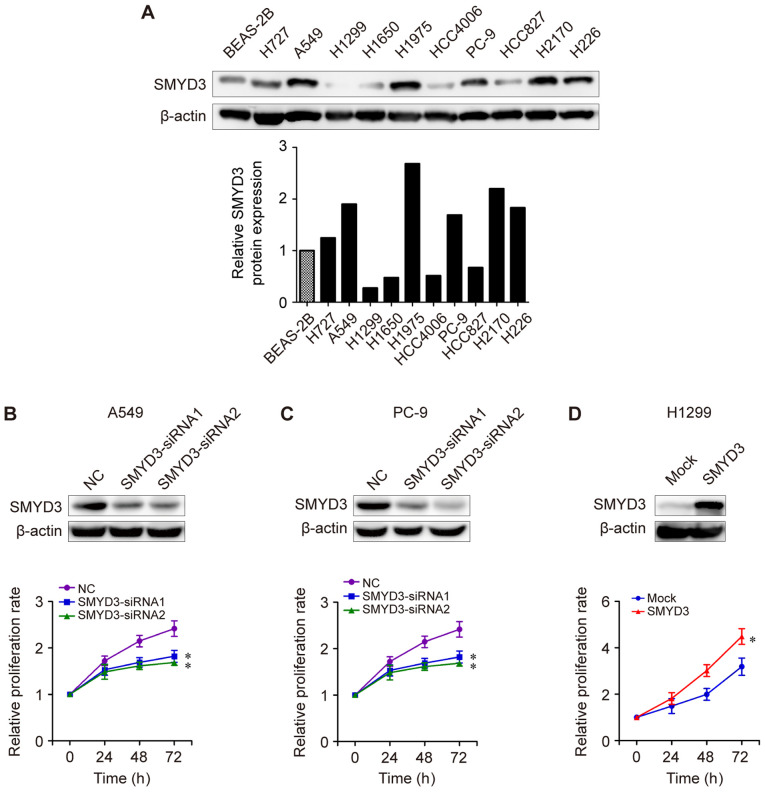
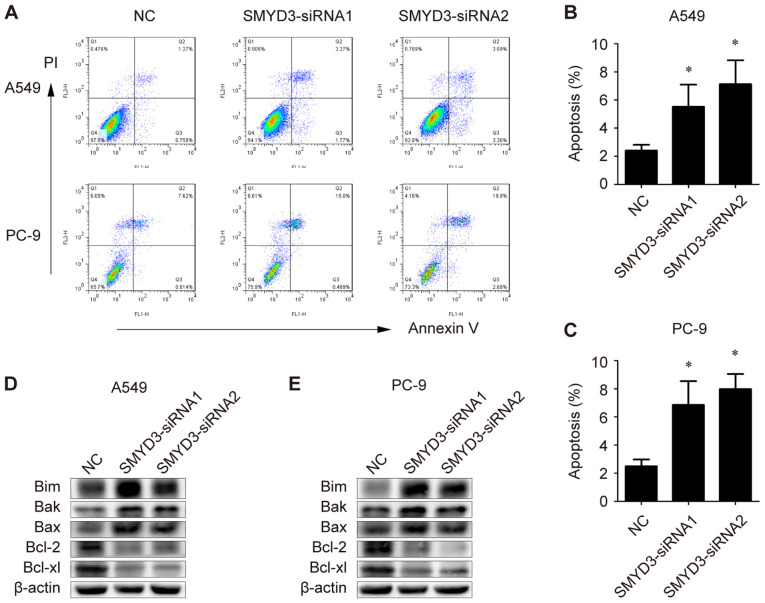
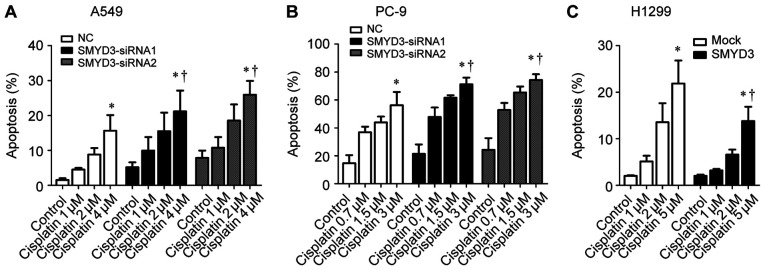
SET and MYND domain‑containing protein 3 (SMYD3) is a lysine methyltransferase, and its aberrant expression has been implicated in several malignancies. However, its clinical and biological roles in non‑small cell lung cancer (NSCLC) remain unclear. In the present study, it was revealed that SMYD3 was significantly upregulated in NSCLC tissues, as compared with paired adjacent normal tissues. A high SMYD3 expression was associated with aggressive clinicopathological characteristics, as well as poor disease‑free survival and overall survival (OS) in NSCLC patients. Multivariate analysis revealed that SMYD3 overexpression was an independent predictor of poor OS in NSCLC patients. In addition, SMYD3 knockdown inhibited cell proliferation, triggered apoptosis, and blocked migration and invasion in NSCLC cells in vitro, whereas stable SMYD3 overexpression promoted NSCLC cell proliferation. Furthermore, the SMYD3‑silenced NSCLC cells became more sensitive, whereas the SMYD3‑overexpressed NSCLC cells became more resistant to the apoptosis induced by cisplatin. Mechanistic analysis revealed that SMYD3 knockdown led to the upregulation of Bim, Bak and Bax, and the downregulation of Bcl‑2, Bcl‑xl, MMP‑2 and MMP‑9 in NSCLC cells. In combination, the present findings indicated that SMYD3 has oncogenic potential in the context of NSCLC, providing evidence that may be exploited for both prognostic and therapeutic purposes in the future.
SET 域和 MYND 结构域蛋白 3(SMYD3)是一种赖氨酸甲基转移酶,其异常表达与多种恶性肿瘤有关。然而,其在非小细胞肺癌(NSCLC)中的临床和生物学作用尚不清楚。在本研究中,与配对的相邻正常组织相比,SMYD3 在 NSCLC 组织中显著上调。高 SMYD3 表达与侵袭性临床病理特征以及 NSCLC 患者无病生存和总生存(OS)不良相关。多因素分析显示,SMYD3 过表达是 NSCLC 患者 OS 不良的独立预测因子。此外,SMYD3 敲低抑制了 NSCLC 细胞的体外增殖,触发了细胞凋亡,并阻断了迁移和侵袭,而稳定的 SMYD3 过表达促进了 NSCLC 细胞的增殖。此外,沉默 SMYD3 的 NSCLC 细胞对顺铂诱导的细胞凋亡更敏感,而过表达 SMYD3 的 NSCLC 细胞则更耐受。机制分析表明,SMYD3 敲低导致 NSCLC 细胞中 Bim、Bak 和 Bax 的上调以及 Bcl-2、Bcl-xl、MMP-2 和 MMP-9 的下调。总之,这些发现表明 SMYD3 在 NSCLC 中具有致癌潜能,为未来的预后和治疗目的提供了证据。