Yang Liu, Jin Mingli, Jeong Kwang Won
Collaborative Innovation Center for Chinese Medicine and Respiratory Diseases Co-Constructed by Henan Province & Education Ministry of P.R. China, Henan University of Chinese Medicine, Zhengzhou 450046, China.
Gachon Research Institute of Pharmaceutical Sciences, College of Pharmacy, Gachon University, 191 Hambakmoero, Yeonsu-gu, Incheon 21936, Korea.
Biology (Basel). 2021 Jun 25;10(7):581. doi: 10.3390/biology10070581.
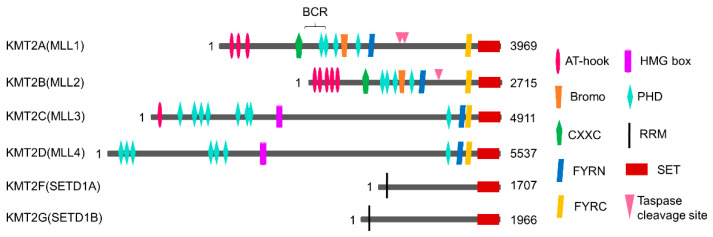
The KMT2 (MLL) family of proteins, including the major histone H3K4 methyltransferase found in mammals, exists as large complexes with common subunit proteins and exhibits enzymatic activity. SMYD, another H3K4 methyltransferase, and SET7/9 proteins catalyze the methylation of several non-histone targets, in addition to histone H3K4 residues. Despite these structural and functional commonalities, H3K4 methyltransferase proteins have specificity for their target genes and play a role in the development of various cancers as well as in drug resistance. In this review, we examine the overall role of histone H3K4 methyltransferase in the development of various cancers and in the progression of drug resistance. Compounds that inhibit protein-protein interactions between KMT2 family proteins and their common subunits or the activity of SMYD and SET7/9 are continuously being developed for the treatment of acute leukemia, triple-negative breast cancer, and castration-resistant prostate cancer. These H3K4 methyltransferase inhibitors, either alone or in combination with other drugs, are expected to play a role in overcoming drug resistance in leukemia and various solid cancers.
KMT2(MLL)蛋白家族,包括在哺乳动物中发现的主要组蛋白H3K4甲基转移酶,以与常见亚基蛋白形成的大复合物形式存在,并具有酶活性。另一种H3K4甲基转移酶SMYD以及SET7/9蛋白,除了催化组蛋白H3K4残基的甲基化外,还催化几种非组蛋白靶标的甲基化。尽管存在这些结构和功能上的共性,但H3K4甲基转移酶蛋白对其靶基因具有特异性,并在各种癌症的发生发展以及耐药性中发挥作用。在本综述中,我们研究了组蛋白H3K4甲基转移酶在各种癌症发生发展和耐药性进展中的总体作用。用于治疗急性白血病、三阴性乳腺癌和去势抵抗性前列腺癌的化合物正在不断开发,这些化合物可抑制KMT2家族蛋白与其常见亚基之间的蛋白质-蛋白质相互作用,或抑制SMYD和SET7/9的活性。这些H3K4甲基转移酶抑制剂,单独使用或与其他药物联合使用,有望在克服白血病和各种实体癌的耐药性方面发挥作用。