Department of Critical Care Medicine, Fujian Provincial Hospital, Shengli Clinical Medical College, Fujian Medical University, Fuzhou, China.
Department of Cardiology, Fujian Provincial Hospital, Shengli Clinical Medical College, Fujian Medical University, Fuzhou, China.
J Med Virol. 2021 Feb;93(2):934-944. doi: 10.1002/jmv.26346. Epub 2020 Aug 2.
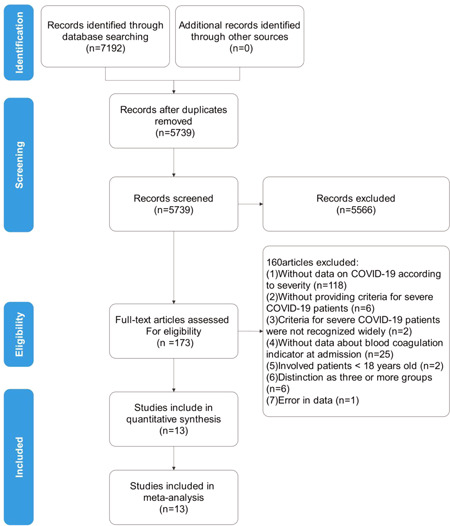
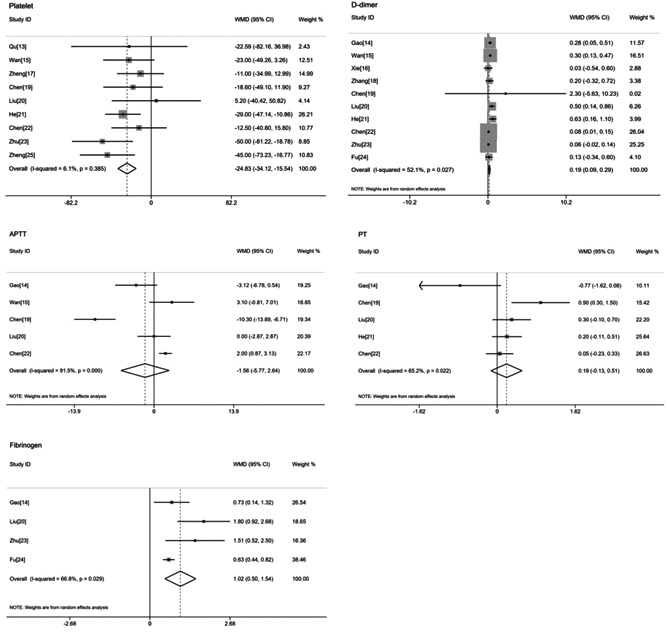
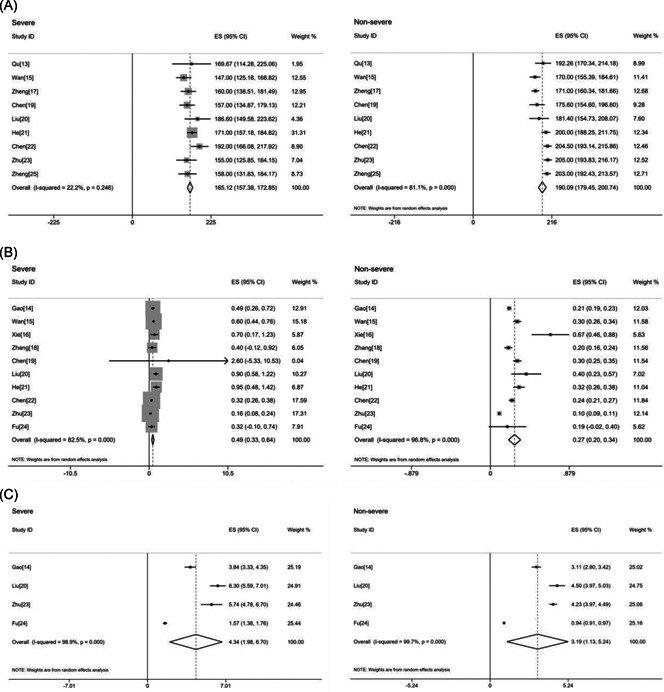
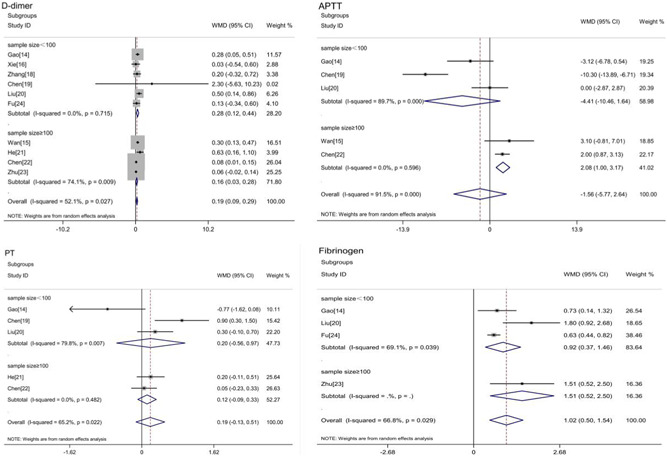
The outbreak of 2019 novel coronavirus disease (COVID-19) has posed a grave threat to the global public health. The COVID-19-induced infection is closely related to coagulation dysfunction in the affected patients. This paper attempts to conduct a meta-analysis and systematically review the blood coagulation indicators in patients with severe COVID-19. A meta-analysis of eligible studies was performed to compare the blood coagulation indicators in patients with severe and nonsevere COVID-19. PubMed, Embase, Web of Science, and the Cochrane Library were searched for studies published between 1 December 2019 and 7 May 2020. A total of 13 studies with 1341 adult patients were enrolled in this analysis. Platelet (weighted mean difference [WMD] = -24.83, 95% confidence interval [CI]: -34.12 to -15.54; P < .001), d-dimer (WMD = 0.19, 95% CI: 0.09-0.29; P < .001), and fibrinogen (WMD = 1.02, 95% CI: 0.50-1.54; P < .001) were significantly associated with the severity in patients with COVID-19. The meta-analysis revealed that no correlation was evident between an increased severity risk of COVID-19 and activated partial thromboplastin time (WMD = -1.56, 95% CI: -5.77 to 2.64; P = .468) or prothrombin time (WMD = 0.19, 95% CI: -0.13 to 0.51; P = .243). The single arm meta-analysis showed that compared with the nonsevere group, the severe group had a lower pooled platelet (165.12 [95% CI: 157.38-172.85] vs 190.09 [95% CI: 179.45-200.74]), higher d-dimer (0.49 [95% CI: 0.33-0.64] vs 0.27 [95% CI: 0.20-0.34]), and higher fibrinogen (4.34 [95% CI: 1.98-6.70] vs 3.19 [95% CI: 1.13-5.24]). Coagulation dysfunction is closely related to the severity of patients with COVID-19, in which low platelet, high d-dimer, and fibrinogen upon admission may serve as risk indicators for increased aggression of the disease. These findings are of great clinical value for timely and effective treatment of the COVID-19 cases.
2019 年新型冠状病毒病(COVID-19)的爆发对全球公共卫生构成了严重威胁。COVID-19 引起的感染与受影响患者的凝血功能障碍密切相关。本文试图进行荟萃分析和系统评价严重 COVID-19 患者的凝血指标。对 2019 年 12 月 1 日至 2020 年 5 月 7 日期间发表的研究进行了荟萃分析,以比较严重和非严重 COVID-19 患者的凝血指标。检索了 PubMed、Embase、Web of Science 和 Cochrane Library 以获取研究。共纳入了 13 项共纳入 1341 例成年患者的研究。血小板(加权均数差 [WMD] = -24.83,95%置信区间 [CI]:-34.12 至-15.54;P <.001)、D-二聚体(WMD = 0.19,95%CI:0.09-0.29;P <.001)和纤维蛋白原(WMD = 1.02,95%CI:0.50-1.54;P <.001)与 COVID-19 患者的严重程度显著相关。荟萃分析显示,COVID-19 严重程度增加的风险与活化部分凝血活酶时间(WMD = -1.56,95%CI:-5.77 至 2.64;P =.468)或凝血酶原时间(WMD = 0.19,95%CI:-0.13 至 0.51;P =.243)无相关性。单臂荟萃分析显示,与非严重组相比,严重组的血小板(165.12 [95%CI:157.38-172.85] 与 190.09 [95%CI:179.45-200.74])更低,D-二聚体(0.49 [95%CI:0.33-0.64] 与 0.27 [95%CI:0.20-0.34])更高,纤维蛋白原(4.34 [95%CI:1.98-6.70] 与 3.19 [95%CI:1.13-5.24])更高。凝血功能障碍与 COVID-19 患者的严重程度密切相关,入院时血小板降低、D-二聚体升高和纤维蛋白原升高可能是疾病侵袭性增加的风险指标。这些发现对 COVID-19 病例的及时有效治疗具有重要的临床价值。