Nolan Niamh, Valdivieso Katherine, Mani Rekha, Yang Joshua Y C, Sarwal Reuben D, Katzenbach Phoebe, Chalasani Kavita, Hongo Donna, Lugtu Gladys, Mark Corinne, Chen Edna, Nijor Reggie, Savoca David, Wexler David S, Whitson Todd, Huang Shih-Jwo, Lu Lucy H, Zawada Robert J X, Hytopoulos Evangelos, Sarwal Minnie M
NephroSant Inc., 150 North Hill Drive, Brisbane, CA 94005, USA.
Department of Surgery, University of California San Francisco, San Francisco, CA 94143, USA.
J Clin Med. 2020 Jul 22;9(8):2325. doi: 10.3390/jcm9082325.
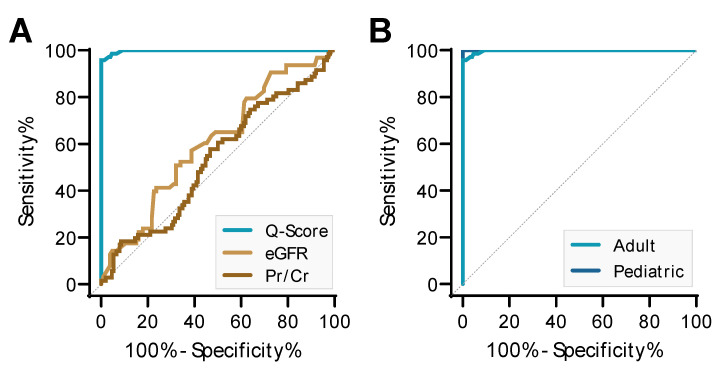
In this clinical validation study, we developed and validated a urinary Q-Score generated from the quantitative test QSant, formerly known as QiSant, for the detection of biopsy-confirmed acute rejection in kidney transplants. Using a cohort of 223 distinct urine samples collected from three independent sites and from both adult and pediatric renal transplant patients, we examined the diagnostic utility of the urinary Q-Score for detection of acute rejection in renal allografts. Statistical models based upon the measurements of the six QSant biomarkers (cell-free DNA, methylated-cell-free DNA, clusterin, CXCL10, creatinine, and total protein) generated a renal transplant Q-Score that reliably differentiated stable allografts from acute rejections in both adult and pediatric renal transplant patients. The composite Q-Score was able to detect both T cell-mediated rejection and antibody-mediated rejection patients and differentiate them from stable non-rejecting patients with a receiver-operator characteristic curve area under the curve of 99.8% and an accuracy of 98.2%. Q-Scores < 32 indicated the absence of active rejection and Q-Scores ≥ 32 indicated an increased risk of active rejection. At the Q-Score cutoff of 32, the overall sensitivity was 95.8% and specificity was 99.3%. At a prevalence of 25%, positive and negative predictive values for active rejection were 98.0% and 98.6%, respectively. The Q-Score also detected subclinical rejection in patients without an elevated serum creatinine level but identified by a protocol biopsy. This study confirms that QSant is an accurate and quantitative measurement suitable for routine monitoring of renal allograft status.
在这项临床验证研究中,我们开发并验证了一种尿Q评分,它由定量检测QSant(原名为QiSant)生成,用于检测经活检证实的肾移植急性排斥反应。我们使用从三个独立地点以及成年和儿科肾移植患者收集的223份不同尿液样本组成的队列,检验了尿Q评分在检测肾移植急性排斥反应中的诊断效用。基于六种QSant生物标志物(游离DNA、甲基化游离DNA、簇集蛋白、CXCL10、肌酐和总蛋白)测量值的统计模型生成了一个肾移植Q评分,该评分能够可靠地区分成年和儿科肾移植患者的稳定移植肾与急性排斥反应。综合Q评分能够检测出T细胞介导的排斥反应和抗体介导的排斥反应患者,并将他们与稳定的非排斥患者区分开来,受试者操作特征曲线下面积为99.8%,准确率为98.2%。Q评分<32表明无活动性排斥反应,Q评分≥32表明活动性排斥反应风险增加。在Q评分临界值为32时,总体敏感性为95.8%,特异性为99.3%。在患病率为25%时,活动性排斥反应的阳性预测值和阴性预测值分别为98.0%和98.6%。Q评分还检测出了血清肌酐水平未升高但经方案活检确定的亚临床排斥反应患者。这项研究证实,QSant是一种准确的定量测量方法,适用于肾移植状态的常规监测。