Navas-Gómez Kelly, Valero Manuel F
Energy, Materials and Environment Group, Faculty of Engineering, Universidad de La Sabana, Chía 140013, Colombia.
Materials (Basel). 2020 Jul 22;13(15):3250. doi: 10.3390/ma13153250.
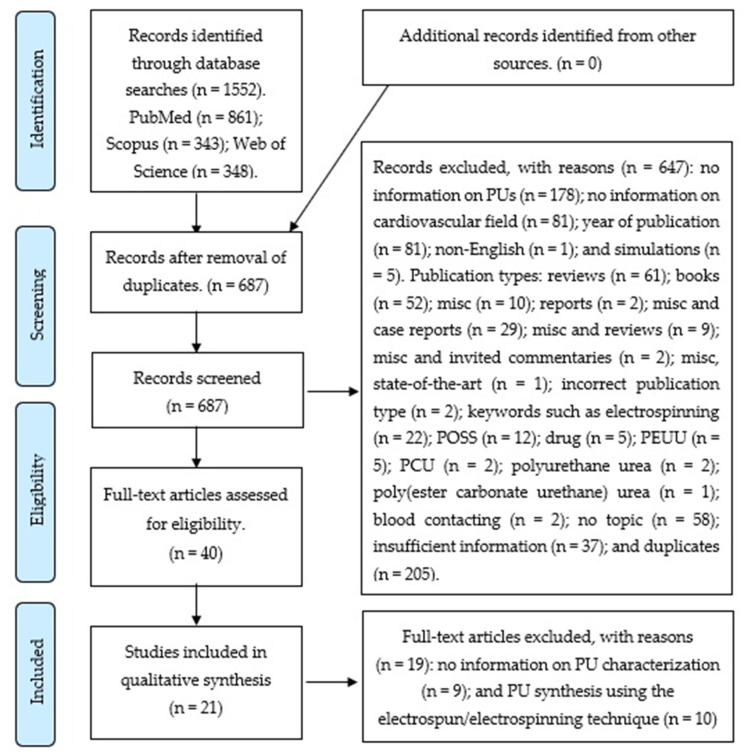
We conducted a systematic review in accordance with the Preferred Reporting Items for Systematic Reviews and Meta-Analyses (PRISMA) statement to ascertain why polyurethanes (PUs) have been used in the manufacture and design of cardiovascular devices. A complete database search was performed with PubMed, Scopus, and Web of Science as the information sources. The search period ranged from 1 January 2005 to 31 December 2019. We recovered 1552 articles in the first stage. After the duplicate selection and extraction procedures, a total of 21 papers were included in the analysis. We concluded that polyurethanes are being applied in medical devices because they have the capability to tolerate contractile forces that originate during the cardiac cycle without undergoing plastic deformation or failure, and the capability to imitate the behaviors of different tissues. Studies have reported that polyurethanes cause severe problems when applied in blood-contacting devices that are implanted for long periods. However, the chemical compositions and surface characteristics of polyurethanes can be modified to improve their mechanical properties, blood compatibility, and endothelial cell adhesion, and to reduce their protein adhesion. These modifications enable the use of polyurethanes in the manufacture and design of cardiovascular devices.
我们按照系统评价与Meta分析的首选报告项目(PRISMA)声明进行了一项系统评价,以确定聚氨酯(PU)为何被用于心血管装置的制造和设计。以PubMed、Scopus和Web of Science作为信息来源进行了全面的数据库检索。检索时间段为2005年1月1日至2019年12月31日。在第一阶段我们检索到1552篇文章。经过重复文献筛选和提取程序后,共有21篇论文纳入分析。我们得出结论,聚氨酯被应用于医疗装置是因为它们有能力耐受心动周期中产生的收缩力而不发生塑性变形或失效,并且有能力模拟不同组织的行为。研究报告称,聚氨酯应用于长期植入的血液接触装置时会引发严重问题。然而,聚氨酯的化学成分和表面特性可以进行改性,以改善其机械性能、血液相容性和内皮细胞黏附,并减少其蛋白质黏附。这些改性使得聚氨酯能够用于心血管装置的制造和设计。