Schittny Dominik, Yañez Orlando, Neumann Peter
Institute of Bee Health, Vetsuisse Faculty, University of Bern, 3097 Bern, Switzerland.
Agroscope, Swiss Bee Research Center, 3097 Bern, Switzerland.
Vet Sci. 2020 Jul 21;7(3):96. doi: 10.3390/vetsci7030096.
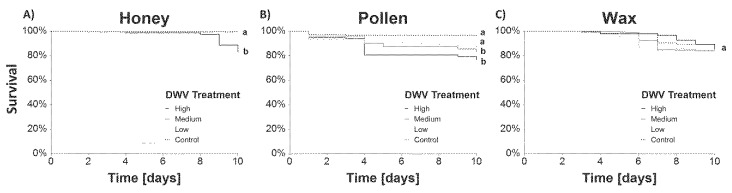
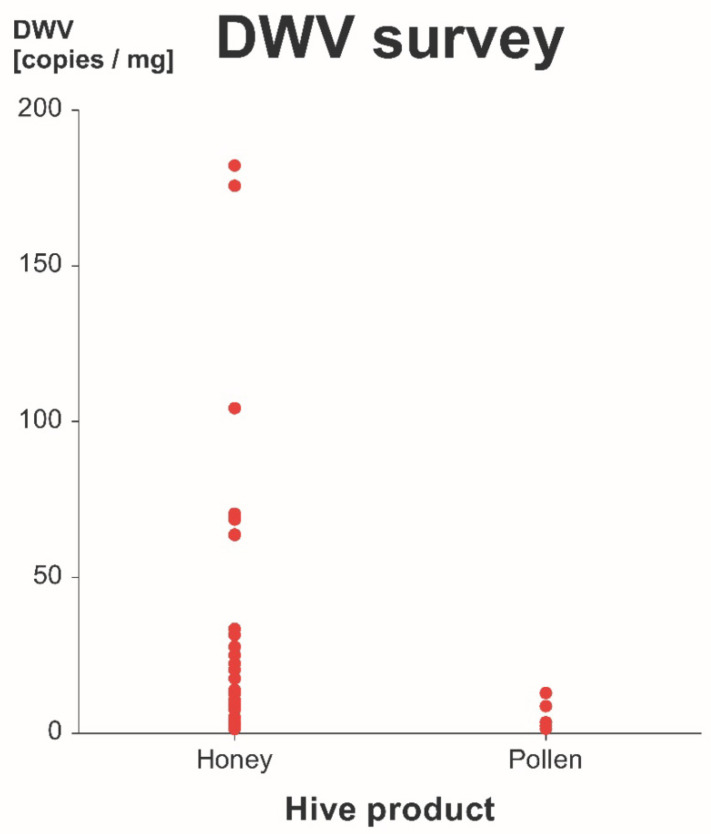
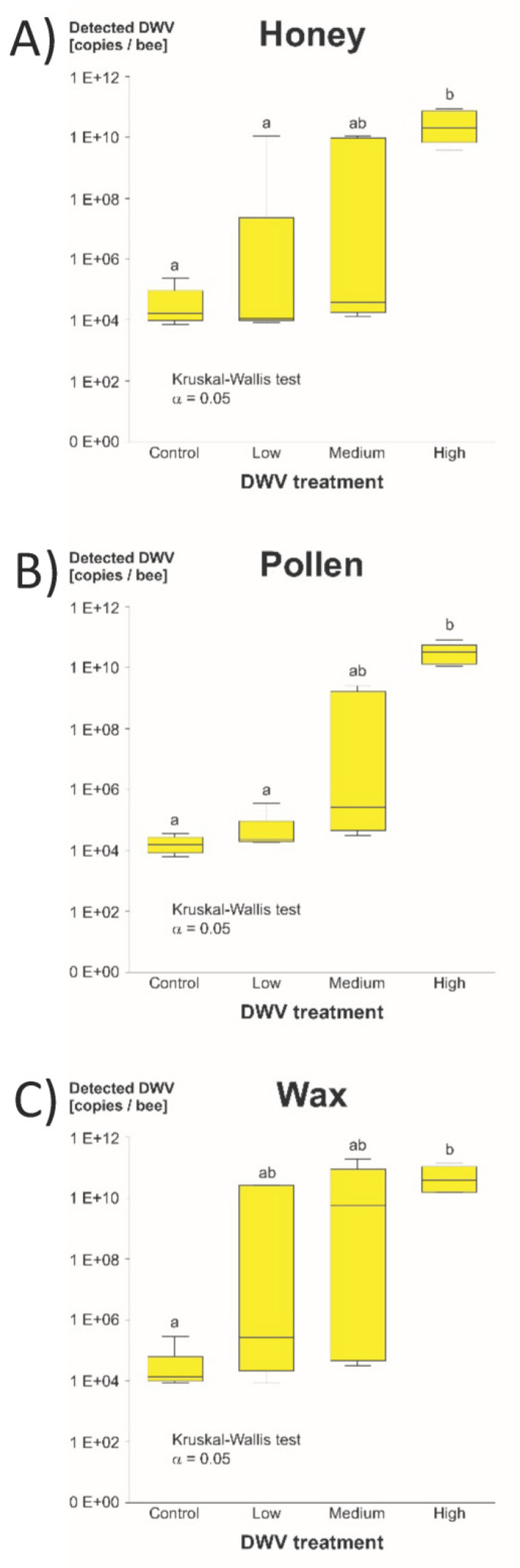
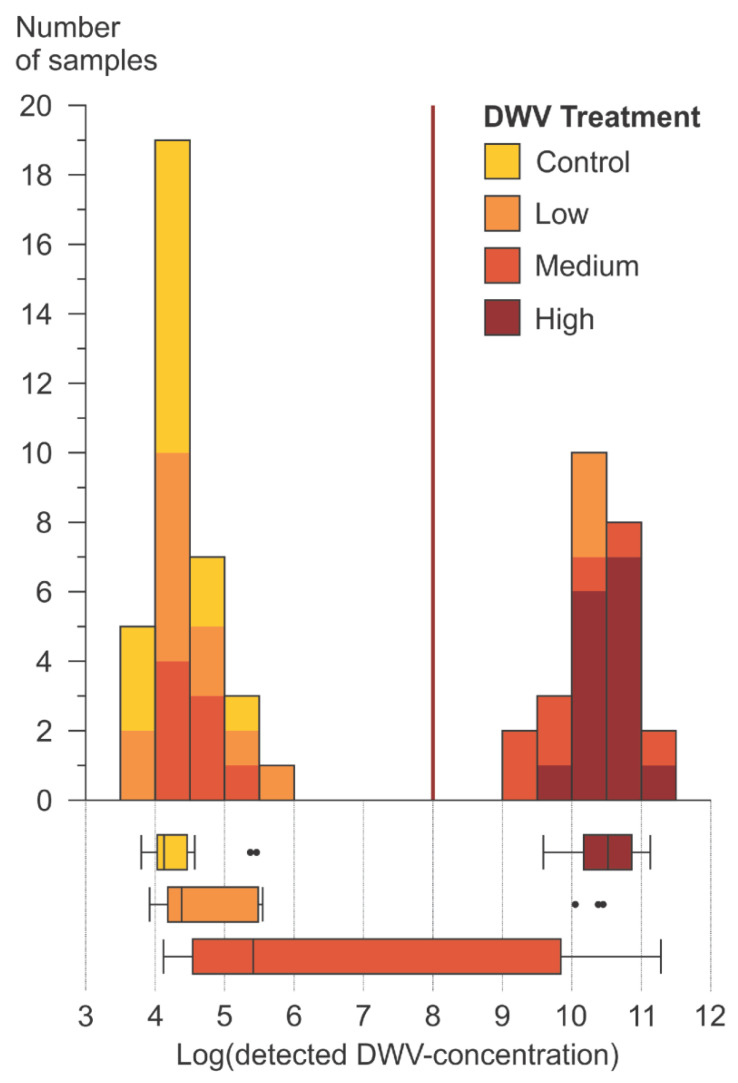
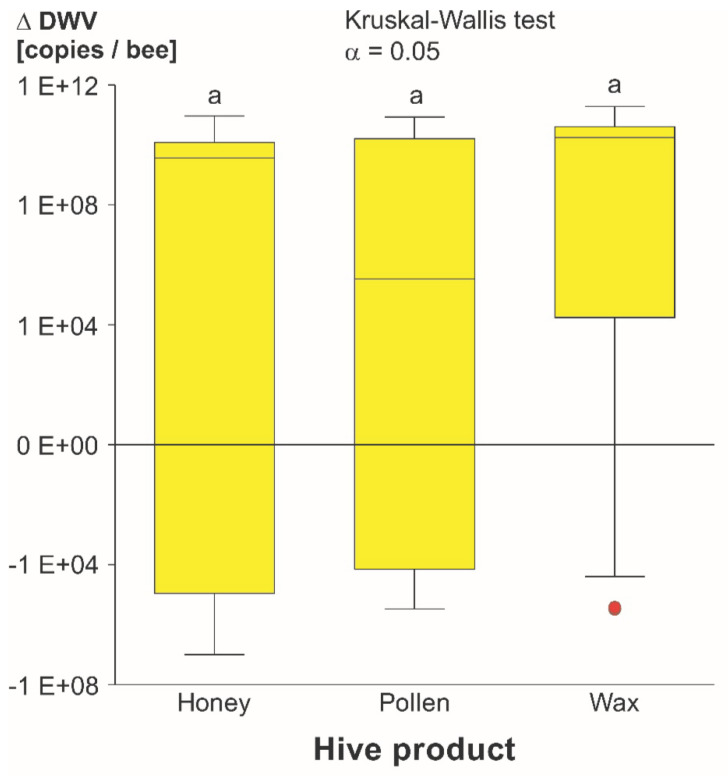
The global trade of honey bee hive products has raised concern about pathogen transmission. However, the efficacy of hive products as virus vehicles is poorly understood. Here, we investigated the transmission capacity of hive products for Deformed wing virus genotype A (DWV-A) in a fully-crossed hoarding cage experiment and estimated the transmission risk by screening commercial products. Western honey bee workers were provided with honey, pollen and wax either contaminated with high (2 × 10), medium (1.7 × 10), low (~8 × 10) or zero (control) DWV-A genome copies. For 10 days, mortality was monitored. Then, virus titers were quantified in bee heads and 38 commercial products using RT-qPCR. For honey and pollen, a positive association between DWV-A concentration and mortality was observed. High concentrations always resulted in infections, medium ones in 47% of cases and low ones in 20% of cases. No significant difference was observed between the tested products. In commercial honey and pollen, 7.7 × 10-1.8 × 10 and 1.4 × 10-1.3 × 10 DWV-A copies per gram were found, respectively. The results show that DWV-A transmission via hive products is feasible. The risk of introducing novel viruses and/or strains should be considered in trade regulations by including virus analyses for health certificates of hive products.
蜜蜂蜂箱产品的全球贸易引发了人们对病原体传播的担忧。然而,人们对蜂箱产品作为病毒载体的效力了解甚少。在此,我们在一项完全交叉的贮藏笼实验中研究了蜂箱产品对变形翅病毒A基因型(DWV-A)的传播能力,并通过筛选商业产品来估计传播风险。为西方蜜蜂工蜂提供分别被高(约2×10)、中(约1.7×10)、低(约8×10)或零(对照)DWV-A基因组拷贝污染的蜂蜜、花粉和蜂蜡。持续10天监测死亡率。然后,使用逆转录定量聚合酶链反应(RT-qPCR)对蜜蜂头部和38种商业产品中的病毒滴度进行定量。对于蜂蜜和花粉,观察到DWV-A浓度与死亡率之间呈正相关。高浓度总是导致感染,中等浓度在47%的情况下导致感染,低浓度在20%的情况下导致感染。在所测试的产品之间未观察到显著差异。在商业蜂蜜和花粉中,每克分别发现7.7×10 - 1.8×10和1.4×10 - 1.3×10个DWV-A拷贝。结果表明,通过蜂箱产品传播DWV-A是可行的。在贸易法规中应考虑引入新病毒和/或毒株的风险,包括对蜂箱产品健康证书进行病毒分析。