Hirai Keiji, Imamura Shigeki, Hirai Aizan, Ookawara Susumu, Morishita Yoshiyuki
Division of Nephrology, First Department of Integrated Medicine, Saitama Medical Center, Jichi Medical University, 1-847 Amanuma-cho, Omiya-ku, Saitama-shi, Saitama-ken 330-8503, Japan.
Department of Internal Medicine, Chiba Cerebral and Cardiovascular Center, 575 Tsurumai, Ichihara-shi, Chiba-ken 290-0512, Japan.
J Clin Med. 2020 Jul 16;9(7):2256. doi: 10.3390/jcm9072256.
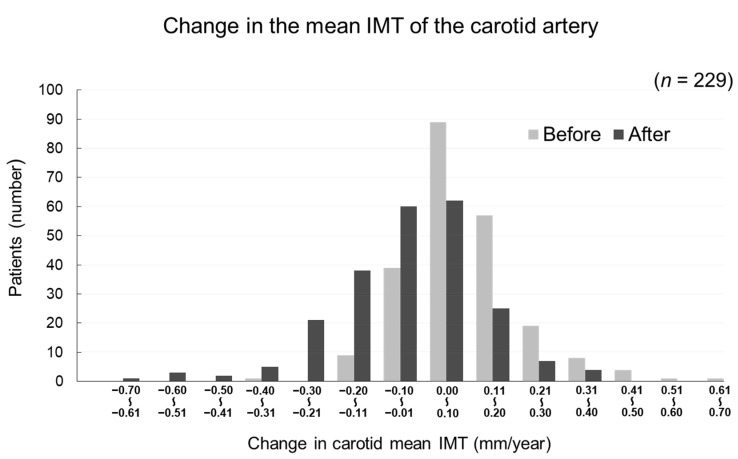
We determined the effects of evolocumab, a fully human monoclonal antibody targeting proprotein convertase subtilisin/kexin type 9, on carotid intima-media thickness (IMT) and the factors associated with the change in carotid IMT in patients taking a statin. The change in carotid mean and maximum IMT before and after the initiation of evolocumab treatment was retrospectively analyzed in 229 statin-treated patients. The changes in clinical parameters, including serum lipid concentrations, were also evaluated. Evolocumab significantly reduced the increase in carotid mean and maximum IMT (0.09 ± 0.13 mm/year to -0.04 ± 0.16 mm/year, < 0.001 and 0.17 ± 0.38 mm/year to 0.08 ± 0.47 mm/year, = 0.02). Evolocumab reduced serum total cholesterol, low-density lipoprotein-cholesterol, triglyceride, and lipoprotein (a) concentrations (each < 0.001), and increased serum high-density lipoprotein (HDL)-cholesterol concentrations ( = 0.01). Multiple linear regression analysis revealed that the change in HDL-cholesterol (standard coefficient () = -0.120, = 0.04) and carotid mean IMT ( = -0.467, < 0.001) were independently correlated with the change in carotid mean IMT during the administration of evolocumab, whereas the change in HDL-cholesterol ( = -0.208, = 0.002) and log-triglyceride ( = -0.167, = 0.01) independently correlated with the change in carotid maximum IMT. Evolocumab reduced the increase in carotid IMT in patients taking a statin. These results suggest that evolocumab is protective against carotid atherosclerosis in patients undergoing statin therapy.
我们确定了一种靶向前蛋白转化酶枯草溶菌素/克新9型的全人单克隆抗体依洛尤单抗对服用他汀类药物患者颈动脉内膜中层厚度(IMT)的影响以及与颈动脉IMT变化相关的因素。对229例接受他汀类药物治疗的患者进行回顾性分析,比较依洛尤单抗治疗开始前后颈动脉平均IMT和最大IMT的变化。还评估了包括血脂浓度在内的临床参数变化。依洛尤单抗显著降低了颈动脉平均IMT和最大IMT的增加幅度(从0.09±0.13毫米/年降至-0.04±0.16毫米/年,<0.001;从0.17±0.38毫米/年降至0.08±0.47毫米/年,=0.02)。依洛尤单抗降低了血清总胆固醇、低密度脂蛋白胆固醇、甘油三酯和脂蛋白(a)的浓度(均<0.001),并提高了血清高密度脂蛋白(HDL)胆固醇浓度(=0.01)。多元线性回归分析显示,HDL胆固醇的变化(标准系数()=-0.120,=0.04)和颈动脉平均IMT(=-0.467,<0.001)与依洛尤单抗给药期间颈动脉平均IMT的变化独立相关,而HDL胆固醇的变化(=-0.208,=0.002)和对数甘油三酯(=-0.167,=0.01)与颈动脉最大IMT的变化独立相关。依洛尤单抗减少了服用他汀类药物患者颈动脉IMT的增加。这些结果表明,依洛尤单抗对接受他汀类治疗的患者的颈动脉粥样硬化具有保护作用。