Walter Melanie, Vogelgesang Janna R, Rubel Franz, Brugger Katharina
Unit for Veterinary Public Health and Epidemiology, University of Veterinary Medicine Vienna, 1210 Vienna, Austria.
Microorganisms. 2020 Jul 17;8(7):1065. doi: 10.3390/microorganisms8071065.
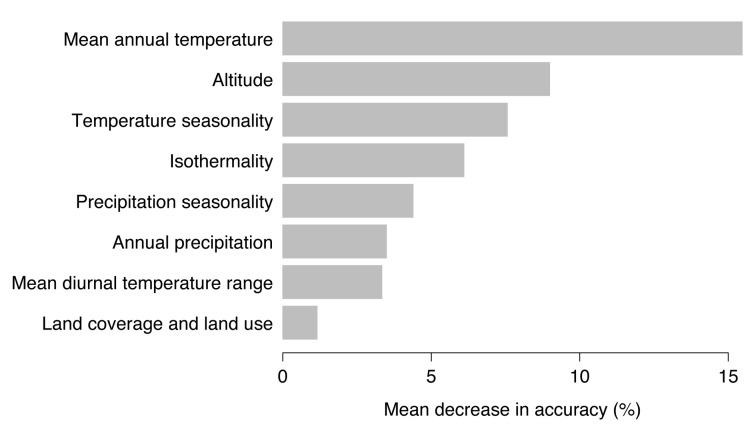
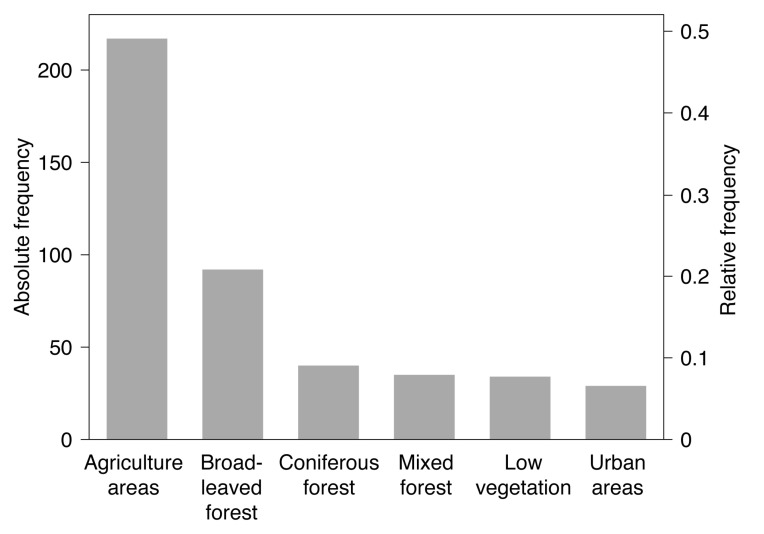
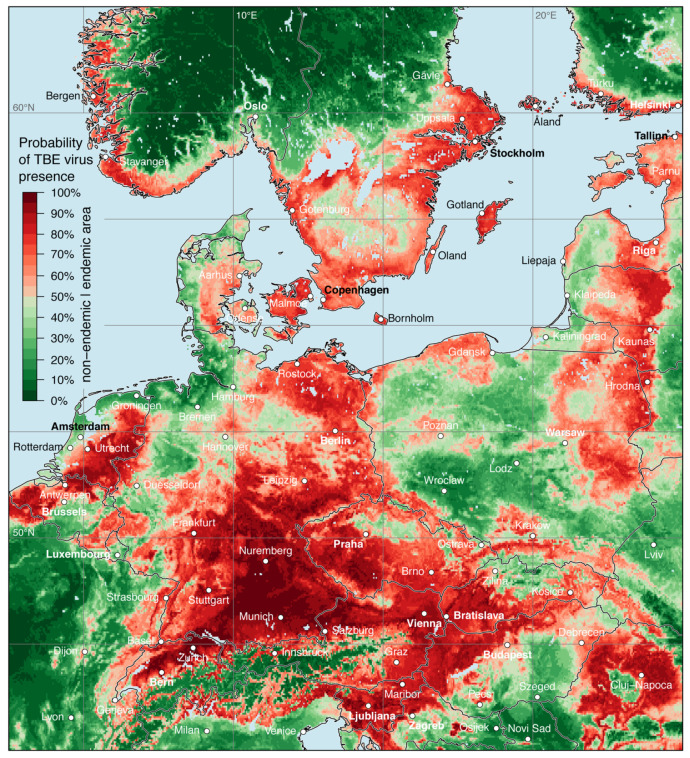
Tick-borne encephalitis (TBE) is the most common viral tick-borne disease in Europe causing thousands of human infections every year. Available risk maps in Europe are solely based on human incidences, but often underestimate areas with TBE virus circulation as shown by several autochthonous cases detected outside known risk areas. A dataset of more than 1300 georeferenced TBE virus detections in ticks and mammals except for humans was compiled and used to estimate the probability of TBE virus presence in Europe. For this, a random forests model was implemented using temperature- and precipitation-dependent bioclimatic variables of the WorldClim dataset, altitude, as well as land cover of the ESA GlobCover dataset. The highest probabilities of TBE virus presence were identified in Central Europe, in the south of the Nordic countries, and in the Baltic countries. The model performance was evaluated by an out-of-bag error (OOB) of 0.174 and a high area under the curve value (AUC) of 0.905. The TBE virus presence maps may subsequently be used to estimate the risk of TBE virus infections in humans and can support decision-makers to identify TBE risk areas and to encourage people to take appropriate actions against tick bites and TBE virus infections.
蜱传脑炎(TBE)是欧洲最常见的病毒性蜱传疾病,每年导致数千人感染。欧洲现有的风险地图仅基于人类发病率,但正如在已知风险区域之外检测到的几例本地病例所示,这些地图往往低估了蜱传脑炎病毒传播的区域。我们汇编了一个包含1300多个除人类外蜱类和哺乳动物中蜱传脑炎病毒地理参考检测数据的数据集,并用于估计欧洲蜱传脑炎病毒存在的概率。为此,我们使用了WorldClim数据集的温度和降水相关生物气候变量、海拔以及ESA GlobCover数据集的土地覆盖数据,实施了一个随机森林模型。蜱传脑炎病毒存在概率最高的区域位于中欧、北欧国家南部和波罗的海国家。通过袋外误差(OOB)为0.174和曲线下面积值(AUC)为0.905来评估模型性能。蜱传脑炎病毒存在地图随后可用于估计人类感染蜱传脑炎病毒的风险,并可支持决策者识别蜱传脑炎风险区域,鼓励人们采取适当措施预防蜱叮咬和蜱传脑炎病毒感染。