Institute of Pharmacy, Pharmacognosy, University of Innsbruck, Innrain 80-82, Innsbruck 6020, Austria.
Department of Ocean Sciences, School of Marine Resources and Environment, Tokyo University of Marine Science and Technology, Japan 4-5-7 Konan, Minato-ku, Tokyo 108-8477, Japan.
Molecules. 2020 Jul 17;25(14):3273. doi: 10.3390/molecules25143273.
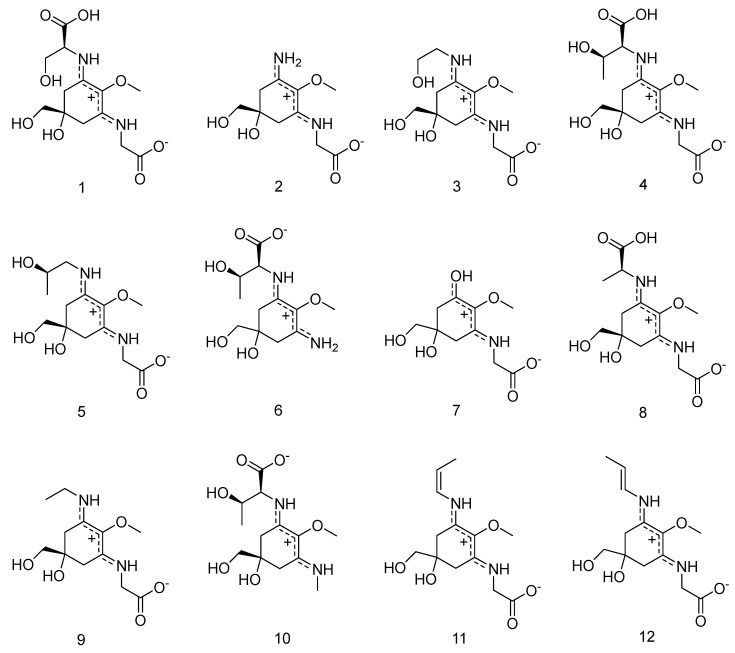
This study presents a chemotaxonomic investigation of the genus through the quantitation of the major mycosporine-like amino acids (MAAs). The presence of some cryptic species had been suggested in the / complex and MAA-profiling in respective samples revealed different chemotypes within this species complex. Another possibly polyphyletic species is ; previous molecular phylogenetic analyses showed four genetic lineages within this species, one of which was recently distinguished as a new species. Phytochemical profiling of those samples used for DNA analyses revealed four different chemotypes, corresponding to the above four lineages and it supports the re-circumscription of the other three lineages. Therefore, mycosporine-like amino acids are considered as suitable chemotaxonomic markers for the reassessment of the classification of . The determination of the MAA patterns in these algae was possible after developing and validating a suitable high-performance liquid chromatography-diode array detector (HPLC-DAD) method.
本研究通过定量测定主要的菌藻类氨基酸(MAAs)对进行了化学分类学研究。在/复合体中存在一些隐种,而在各自的样本中 MAAs 分析显示出该种复合体中的不同化学型。另一种可能是多系的物种是;先前的分子系统发育分析显示该物种内有四个遗传谱系,其中一个最近被区分出来作为一个新种。对用于 DNA 分析的那些样本的植物化学分析揭示了四个不同的化学型,与上述四个谱系相对应,这支持了其他三个谱系的重新划定。因此,菌藻类氨基酸被认为是重新评估分类的合适的化学分类学标记。在开发和验证合适的高效液相色谱-二极管阵列检测器(HPLC-DAD)方法后,这些藻类的 MAAs 模式得以确定。