Department of Civil and Environmental Engineering, University of Illinois at Urbana-Champaign, 205 N. Mathews Ave, Urbana, IL, 61801, USA.
Bioproduction Research Institute, National Institute of Advanced Industrial Science and Technology, Tsukuba, Japan.
Microbiome. 2020 Jul 24;8(1):111. doi: 10.1186/s40168-020-00885-y.
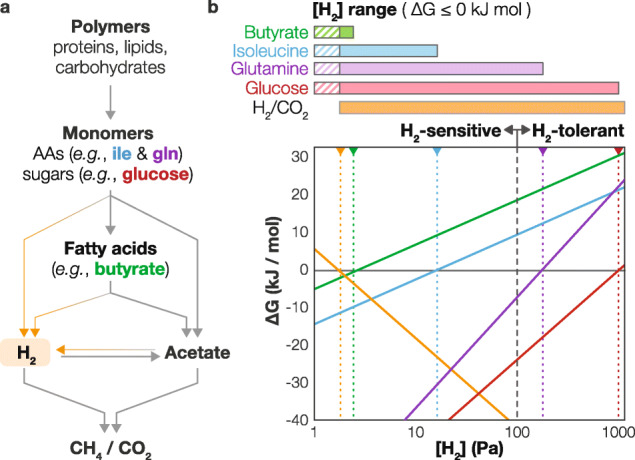
Current understanding of the carbon cycle in methanogenic environments involves trophic interactions such as interspecies H transfer between organotrophs and methanogens. However, many metabolic processes are thermodynamically sensitive to H accumulation and can be inhibited by H produced from co-occurring metabolisms. Strategies for driving thermodynamically competing metabolisms in methanogenic environments remain unexplored.
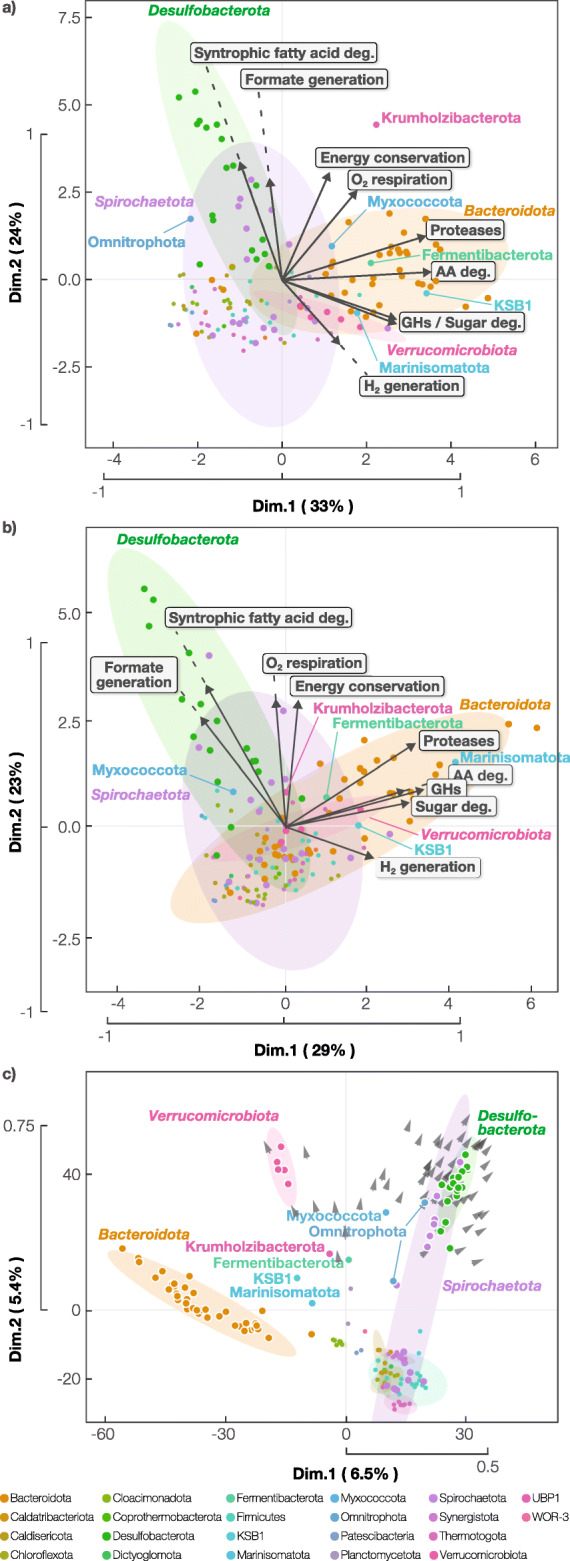
To uncover how anaerobes combat this H conflict in situ, we employ metagenomics and metatranscriptomics to revisit a model ecosystem that has inspired many foundational discoveries in anaerobic ecology-methanogenic bioreactors. Through analysis of 17 anaerobic digesters, we recovered 1343 high-quality metagenome-assembled genomes and corresponding gene expression profiles for uncultured lineages spanning 66 phyla and reconstructed their metabolic capacities. We discovered that diverse uncultured populations can drive H-sensitive metabolisms through (i) metabolic coupling with concurrent H-tolerant catabolism, (ii) forgoing H generation in favor of interspecies transfer of formate and electrons (cytochrome- and pili-mediated) to avoid thermodynamic conflict, and (iii) integration of low-concentration O metabolism as an ancillary thermodynamics-enhancing electron sink. Archaeal populations support these processes through unique methanogenic metabolisms-highly favorable H oxidation driven by methyl-reducing methanogenesis and tripartite uptake of formate, electrons, and acetate.
Integration of omics and eco-thermodynamics revealed overlooked behavior and interactions of uncultured organisms, including coupling favorable and unfavorable metabolisms, shifting from H to formate transfer, respiring low-concentration O, performing direct interspecies electron transfer, and interacting with high H-affinity methanogenesis. These findings shed light on how microorganisms overcome a critical obstacle in methanogenic carbon cycles we had hitherto disregarded and provide foundational insight into anaerobic microbial ecology. Video Abstract.
目前对产甲烷环境中碳循环的认识涉及种间 H 转移等营养相互作用,这种转移发生在有机营养物和产甲烷菌之间。然而,许多代谢过程对 H 积累非常敏感,并且会受到来自共存代谢物产生的 H 的抑制。在产甲烷环境中驱动热力学竞争代谢的策略仍未得到探索。
为了揭示厌氧菌如何在原位应对这种 H 冲突,我们采用宏基因组学和宏转录组学来重新研究一个模型生态系统,该系统激发了厌氧生态学中许多基础发现——产甲烷生物反应器。通过对 17 个厌氧消化器的分析,我们回收了 1343 个高质量的宏基因组组装基因组和相应的未培养谱系的基因表达谱,这些谱系跨越 66 个门,重建了它们的代谢能力。我们发现,多样化的未培养种群可以通过以下方式驱动 H 敏感代谢:(i)与同时耐受 H 的分解代谢进行代谢偶联;(ii)为了避免热力学冲突而放弃 H 的产生,转而进行细胞色素和菌毛介导的(formate 和电子)种间转移;(iii)整合低浓度 O 代谢作为辅助热力学增强电子汇。古菌种群通过独特的产甲烷代谢来支持这些过程,这些代谢过程高度有利于 H 的氧化,由甲基还原产甲烷作用和三组分(formate、电子和 acetate)摄取驱动。
组学和生态热力学的整合揭示了未培养生物的被忽视的行为和相互作用,包括偶联有利和不利代谢、从 H 转移到 formate 转移、呼吸低浓度 O、进行直接种间电子转移以及与高 H 亲和力的产甲烷作用相互作用。这些发现揭示了微生物如何克服我们迄今忽视的产甲烷碳循环中的一个关键障碍,并为厌氧微生物生态学提供了基础见解。