Department of Family Science, University of Maryland Prevention Research Center, School of Public Health, University of Maryland, College Park, Maryland.
College of Nursing, Pennsylvania State University, University Park, Pennsylvania.
Am J Prev Med. 2020 Sep;59(3):428-436. doi: 10.1016/j.amepre.2020.04.012. Epub 2020 Jul 23.
Sexual orientation‒related disparities in alcohol use disorder are well-established. Yet, the degree to which sexual orientation differences in alcohol use disorder vary across the life course is poorly understood. There is also a limited understanding of how exposure to minority stressors and their relationship with alcohol use disorder vary as a function of age.
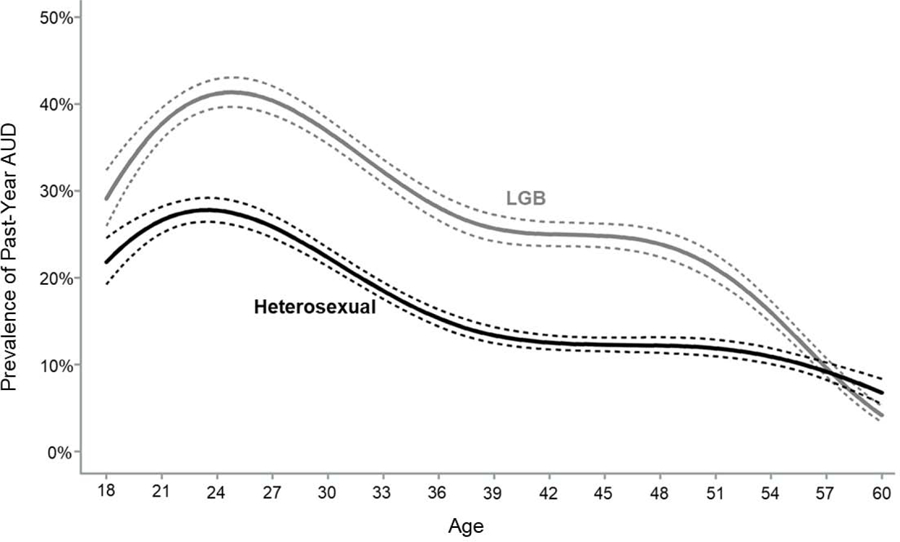
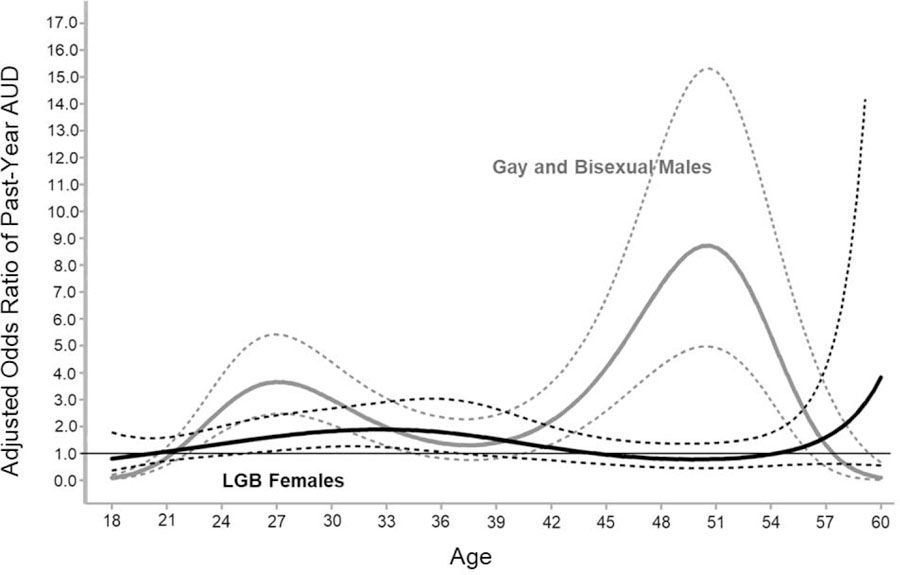
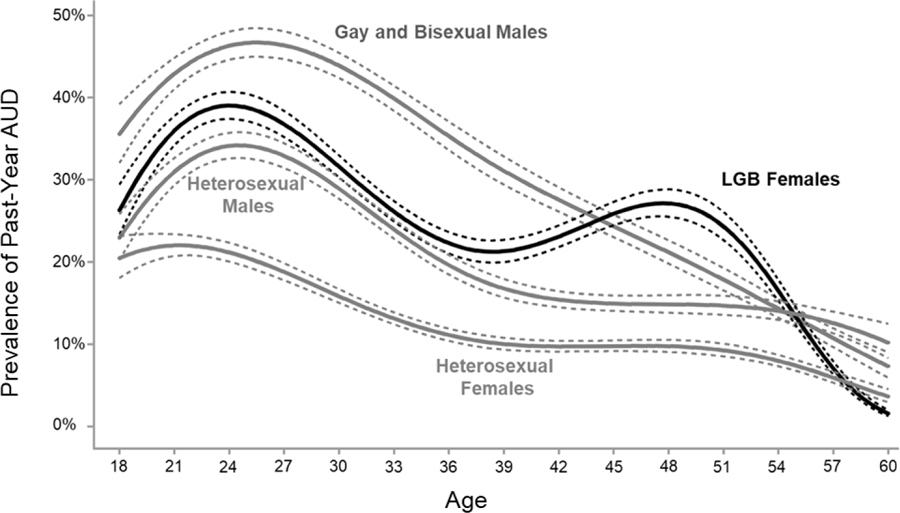
Using nationally representative data collected in 2012-2013, authors used sex-stratified time-varying effect models to estimate age-specific prevalence rates of alcohol use disorder among heterosexual and sexual minority adults aged 18-60 years (N=28,090). Among sexual minority adults (n=1,050), authors also assessed age-specific associations between exposure to lesbian, gay, and bisexual‒related discrimination and alcohol use disorder. Analyses were conducted in 2019.
Gay and bisexual male participants aged 18-45 years demonstrated the highest prevalence rates of alcohol use disorder (e.g., >45% at age 25 years), whereas lesbian, gay, and bisexual female participants were most likely to meet the criteria for alcohol use disorder between ages 45 and 55 years. Sexual minority adults who experienced discrimination in the past year had greater odds of alcohol use disorder between ages 23 and 34 years and again from ages 42 to 53 years; the association between discrimination and alcohol use disorder was strongest among sexual minority men.
Sexual orientation-related disparities in alcohol use disorder are dynamic across the life course and point to critical times for screening and intervention. Developmental perspectives of sexual minority health inequities demand focused research attention as findings will help to identify strategies for promoting sexual minority health at distinct points in the life course.
性取向与酒精使用障碍之间的差异是众所周知的。然而,性取向对酒精使用障碍的影响在整个生命周期中存在差异的程度仍知之甚少。对于少数群体应激源的暴露及其与酒精使用障碍的关系如何随年龄而变化,也缺乏了解。
作者使用 2012-2013 年收集的具有全国代表性的数据,采用性别分层时变效应模型,估计了 18-60 岁的异性恋和性少数群体成年人中酒精使用障碍的特定年龄流行率(N=28090)。在性少数群体成年人(n=1050)中,作者还评估了同性恋、双性恋和双性恋相关歧视的暴露与酒精使用障碍之间的特定年龄相关性。分析于 2019 年进行。
18-45 岁的男同性恋和双性恋男性参与者表现出最高的酒精使用障碍流行率(例如,25 岁时超过 45%),而女同性恋、男同性恋和双性恋女性参与者最有可能在 45 岁至 55 岁之间符合酒精使用障碍的标准。在过去一年中经历过歧视的性少数成年人在 23 岁至 34 岁和 42 岁至 53 岁之间更有可能患有酒精使用障碍;歧视与酒精使用障碍之间的关联在性少数男性中最强。
酒精使用障碍与性取向相关的差异在整个生命周期中是动态的,这表明需要进行筛查和干预的关键时期。性少数群体健康不平等的发展观点需要引起研究的关注,因为这些发现将有助于确定在生命历程中的不同阶段促进性少数群体健康的策略。