Xu Yilan, Zhao Manna, Han Yuying, Zhang Heng
Neurodegeneration and Neuroregeneration Laboratory, Department of Basic Medicine, School of Medicine, Shaoxing University, Shaoxing, China.
Front Neurosci. 2020 Jun 30;14:660. doi: 10.3389/fnins.2020.00660. eCollection 2020.
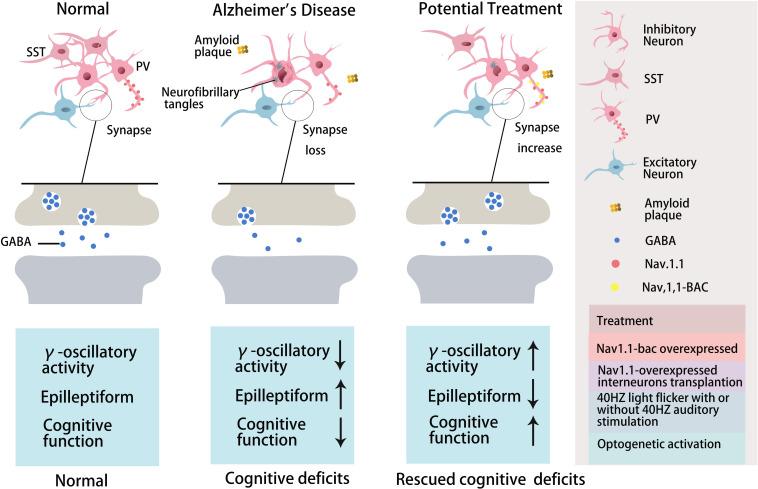
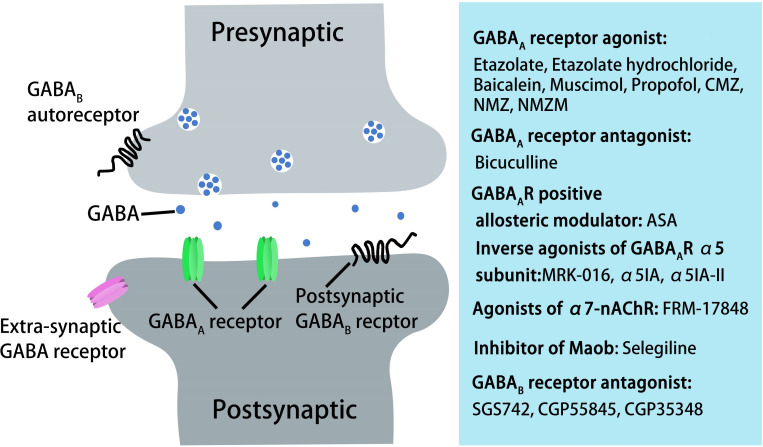
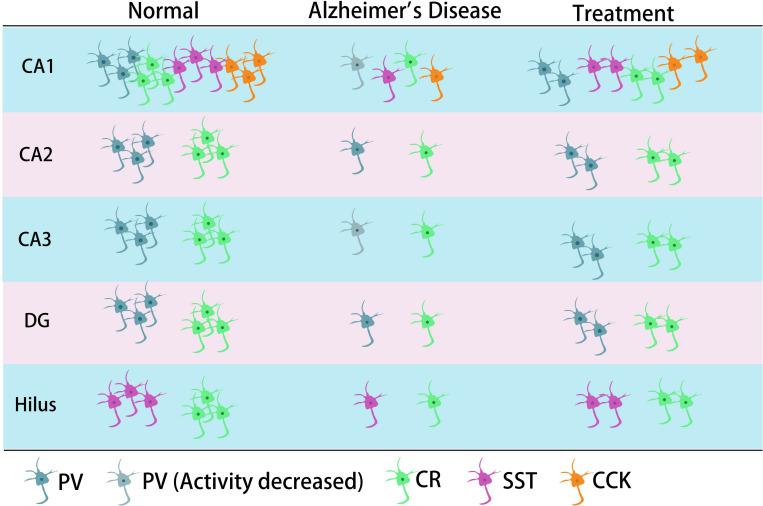
Alzheimer's disease (AD) is a neurodegenerative disorder characterized clinically by severe cognitive deficits and pathologically by amyloid plaques, neuronal loss, and neurofibrillary tangles. Abnormal amyloid β-protein (Aβ) deposition in the brain is often thought of as a major initiating factor in AD neuropathology. However, gamma-aminobutyric acid (GABA) inhibitory interneurons are resistant to Aβ deposition, and Aβ decreases synaptic glutamatergic transmission to decrease neural network activity. Furthermore, there is now evidence suggesting that neural network activity is aberrantly increased in AD patients and animal models due to functional deficits in and decreased activity of GABA inhibitory interneurons, contributing to cognitive deficits. Here we describe the roles played by excitatory neurons and GABA inhibitory interneurons in Aβ-induced cognitive deficits and how altered GABA interneurons regulate AD neuropathology. We also comprehensively review recent studies on how GABA interneurons and GABA receptors can be exploited for therapeutic benefit. GABA interneurons are an emerging therapeutic target in AD, with further clinical trials urgently warranted.
阿尔茨海默病(AD)是一种神经退行性疾病,临床上以严重的认知缺陷为特征,病理上以淀粉样斑块、神经元丢失和神经原纤维缠结为特征。大脑中异常的淀粉样β蛋白(Aβ)沉积通常被认为是AD神经病理学的主要起始因素。然而,γ-氨基丁酸(GABA)抑制性中间神经元对Aβ沉积具有抗性,并且Aβ会降低突触谷氨酸能传递,从而降低神经网络活动。此外,现在有证据表明,由于GABA抑制性中间神经元的功能缺陷和活性降低,AD患者和动物模型中的神经网络活动异常增加,导致认知缺陷。在这里,我们描述了兴奋性神经元和GABA抑制性中间神经元在Aβ诱导的认知缺陷中所起的作用,以及改变的GABA中间神经元如何调节AD神经病理学。我们还全面回顾了最近关于如何利用GABA中间神经元和GABA受体获得治疗益处的研究。GABA中间神经元是AD中一个新兴的治疗靶点,迫切需要进一步的临床试验。