Department of Brain and Cognitive Engineering, Korea University, Seoul, Korea.
Department of Physiology, Anatomy and Genetics, University of Oxford, Oxford, UK.
Brain Struct Funct. 2020 Apr;225(3):935-954. doi: 10.1007/s00429-020-02044-3. Epub 2020 Feb 27.
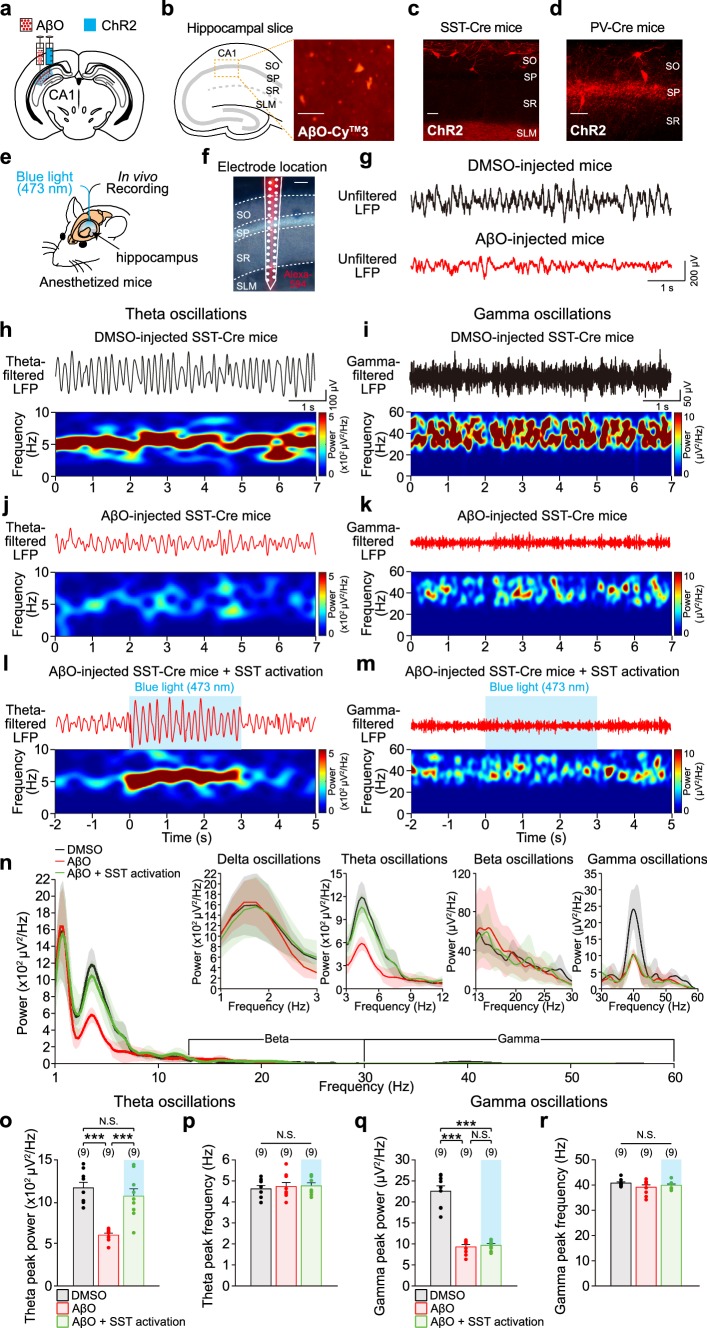
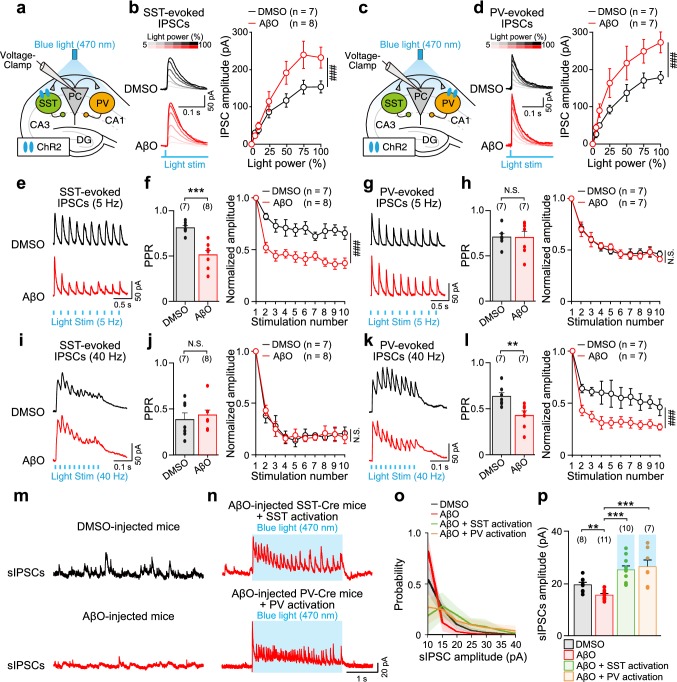
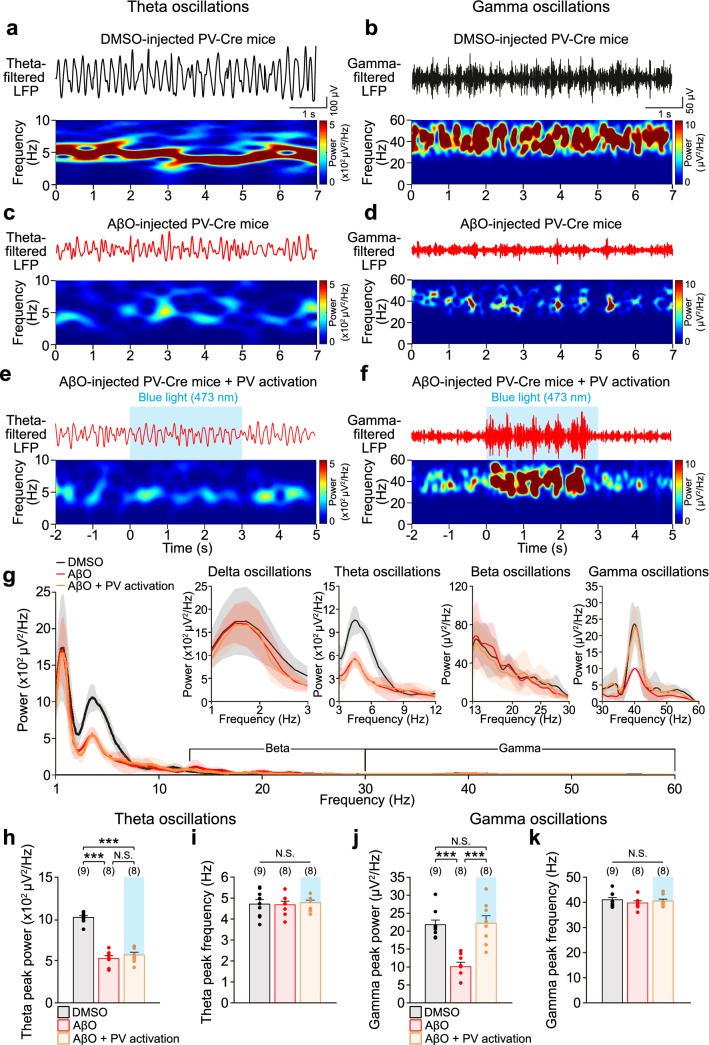
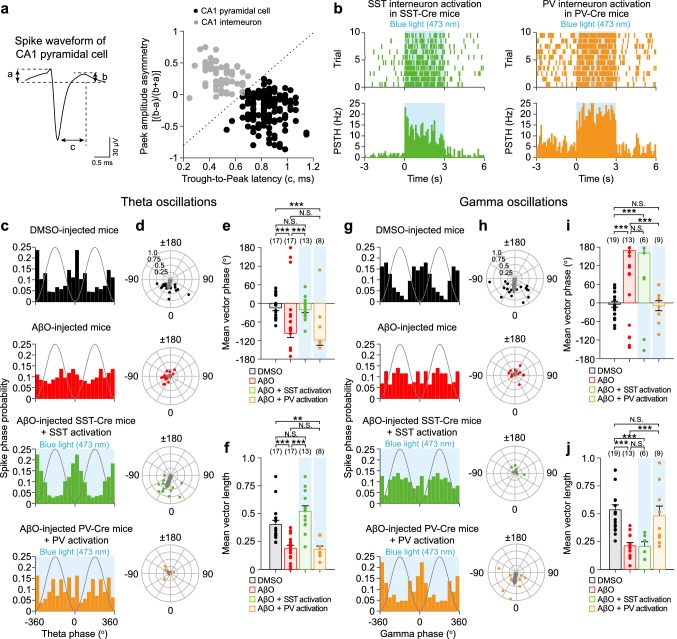
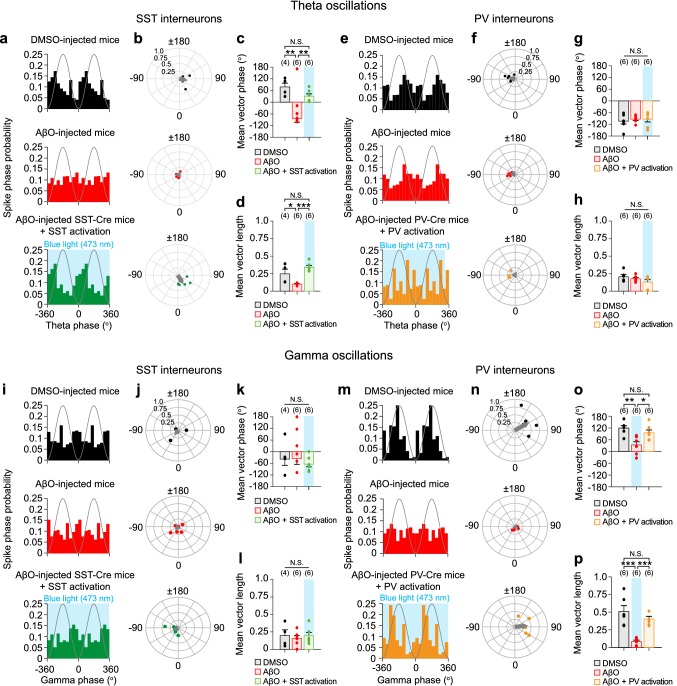
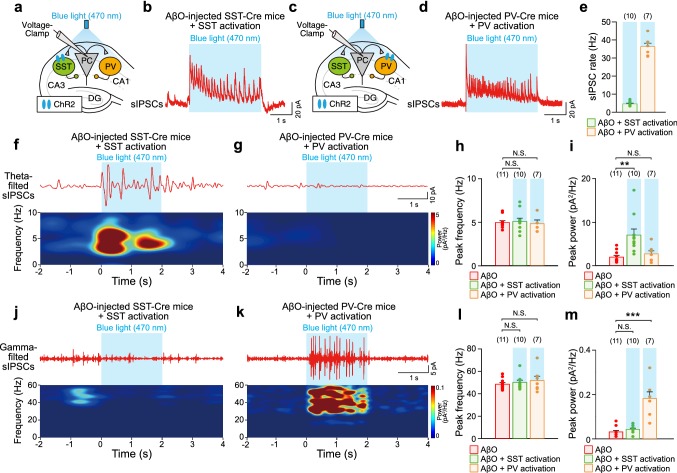
Accumulation of amyloid β oligomers (AβO) in Alzheimer's disease (AD) impairs hippocampal theta and gamma oscillations. These oscillations are important in memory functions and depend on distinct subtypes of hippocampal interneurons such as somatostatin-positive (SST) and parvalbumin-positive (PV) interneurons. Here, we investigated whether AβO causes dysfunctions in SST and PV interneurons by optogenetically manipulating them during theta and gamma oscillations in vivo in AβO-injected SST-Cre or PV-Cre mice. Hippocampal in vivo multi-electrode recordings revealed that optogenetic activation of channelrhodopsin-2 (ChR2)-expressing SST and PV interneurons in AβO-injected mice selectively restored AβO-induced reduction of the peak power of theta and gamma oscillations, respectively, and resynchronized CA1 pyramidal cell (PC) spikes. Moreover, SST and PV interneuron spike phases were resynchronized relative to theta and gamma oscillations, respectively. Whole-cell voltage-clamp recordings in CA1 PC in ex vivo hippocampal slices from AβO-injected mice revealed that optogenetic activation of SST and PV interneurons enhanced spontaneous inhibitory postsynaptic currents (IPSCs) selectively at theta and gamma frequencies, respectively. Furthermore, analyses of the stimulus-response curve, paired-pulse ratio, and short-term plasticity of SST and PV interneuron-evoked IPSCs ex vivo showed that AβO increased the initial GABA release probability to depress SST/PV interneuron's inhibitory input to CA1 PC selectively at theta and gamma frequencies, respectively. Our results reveal frequency-specific and interneuron subtype-specific presynaptic dysfunctions of SST and PV interneurons' input to CA1 PC as the synaptic mechanisms underlying AβO-induced impairments of hippocampal network oscillations and identify them as potential therapeutic targets for restoring hippocampal network oscillations in early AD.
淀粉样β寡聚体 (AβO) 在阿尔茨海默病 (AD) 中的积累损害了海马体的θ和γ振荡。这些振荡在记忆功能中很重要,并且依赖于海马体中间神经元的不同亚型,例如生长抑素阳性 (SST) 和钙调蛋白结合蛋白阳性 (PV) 中间神经元。在这里,我们通过在 AβO 注射的 SST-Cre 或 PV-Cre 小鼠体内进行体内θ和γ振荡期间光遗传学操纵这些中间神经元,来研究 AβO 是否导致 SST 和 PV 中间神经元功能障碍。海马体体内多电极记录显示,在 AβO 注射小鼠中,光遗传学激活表达通道视紫红质-2 (ChR2) 的 SST 和 PV 中间神经元,分别选择性地恢复了 AβO 诱导的θ和γ振荡峰值功率的降低,并使 CA1 锥体神经元 (PC) 尖峰重新同步。此外,SST 和 PV 中间神经元的尖峰相位相对于θ和γ振荡分别重新同步。在从 AβO 注射小鼠中取出的海马体切片的体外全细胞电压钳记录中,发现 SST 和 PV 中间神经元的光遗传学激活分别选择性地增强了θ和γ频率的自发抑制性突触后电流 (IPSCs)。此外,对 SST 和 PV 中间神经元诱发的 IPSC 的刺激-反应曲线、成对脉冲比和短期可塑性的分析表明,AβO 增加了初始 GABA 释放概率,从而选择性地在θ和γ频率下抑制 SST/PV 中间神经元对 CA1 PC 的抑制性输入。我们的研究结果揭示了 SST 和 PV 中间神经元对 CA1 PC 输入的频率特异性和中间神经元亚型特异性的突触前功能障碍,这是 AβO 诱导海马体网络振荡损伤的突触机制,并将其确定为恢复早期 AD 中海马体网络振荡的潜在治疗靶点。