McLachlan Kaitlyn, Zhou Dongming, Little Graham, Rasmussen Carmen, Pei Jacqueline, Andrew Gail, Reynolds James N, Beaulieu Christian
Department of Psychology, College of Social & Applied Human Sciences, University of Guelph, Guelph, ON, Canada.
Department of Zoology, Kunming Medical University, Kunming, Yunnan, China.
Front Hum Neurosci. 2020 Jun 30;14:223. doi: 10.3389/fnhum.2020.00223. eCollection 2020.
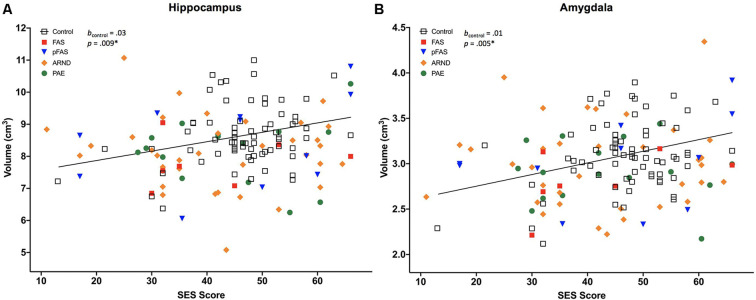
Individuals with prenatal alcohol exposure (PAE) exhibit neurological deficits associated with brain injury including smaller brain volumes. Additional risk factors such as lower socioeconomic status (SES) may also have an impact on brain development for this population. This study examined how brain volumes are related to SES in both neurotypically developing children and adolescents, and those with PAE. 3D T1-weighted MPRAGE images were acquired from 69 participants with PAE (13.0 ± 3.2 years, range 7.1-18.8 years, 49% female) and 70 neurotypical controls (12.4 ± 2.9 years, range 7.0-18.5 years, 60% female) from four scanning sites in Canada. SES scores calculated using Hollingshead's Four-Factor Index of Social Status from current caregiver placement were not significantly different between groups, though more children with PAE had lower SES scores compared to controls. Psychometric data comprised 14 cognitive measures, including executive functioning, attention and working memory, memory, math/numerical ability, and word reading. All cognitive scores were significantly worse in children with PAE compared to controls, though SES was not correlated with cognitive scores in either group after correction for multiple comparisons. All 13 brain volumes were smaller in children with PAE compared to children in the control group. Higher SES was associated with larger hippocampus and amygdala volumes in controls, but there were no such associations in children with PAE. Direct evaluation of the interaction between SES and diagnostic group did not show a significant differential impact of SES on these structures. These findings support previous links between SES and brain volumes in neurotypically developing children, but the lack of such a relationship with SES in children with PAE may be due to the markedly smaller brain volumes resulting from the initial brain injury and postpartum brain development, regardless of later SES.
有产前酒精暴露(PAE)的个体表现出与脑损伤相关的神经功能缺陷,包括脑容量较小。其他风险因素,如较低的社会经济地位(SES),也可能对这一人群的大脑发育产生影响。本研究调查了在神经发育正常的儿童和青少年以及有PAE的儿童和青少年中,脑容量与SES之间的关系。从加拿大四个扫描地点的69名有PAE的参与者(13.0±3.2岁,范围7.1 - 18.8岁,49%为女性)和70名神经发育正常的对照者(12.4±2.9岁,范围7.0 - 18.5岁,60%为女性)获取了三维T1加权MPRAGE图像。根据当前照顾者安置情况使用霍林斯黑德社会地位四因素指数计算的SES得分在两组之间没有显著差异,尽管与对照组相比,更多有PAE的儿童SES得分较低。心理测量数据包括14项认知测量,包括执行功能、注意力和工作记忆、记忆、数学/数字能力以及单词阅读。与对照组相比,有PAE的儿童所有认知得分均显著更差,尽管在进行多重比较校正后,SES与两组中的认知得分均无相关性。与对照组儿童相比,有PAE的儿童所有13个脑容量均较小。在对照组中,较高的SES与较大的海马体和杏仁核体积相关,但在有PAE的儿童中没有此类关联。对SES与诊断组之间相互作用的直接评估未显示SES对这些结构有显著的差异影响。这些发现支持了神经发育正常的儿童中SES与脑容量之间先前的联系,但有PAE的儿童中缺乏这种与SES的关系可能是由于最初的脑损伤和产后脑发育导致脑容量明显较小,而与后期的SES无关。