Cappai Maria Grazia, Dimauro Corrado, Biggio Giovanni Paolo, Cherchi Raffaele, Accioni Francesca, Pudda Flavia, Boatto Gianpiero, Pinna Walter
Research Unit for Animal Nutrition, Department of Veterinary Medicine, University of Sassari, Sassari, Italy, Italy.
Department of Agriculture, University of Sassari, Sassari, Italy.
PeerJ. 2020 Jul 8;8:e9297. doi: 10.7717/peerj.9297. eCollection 2020.
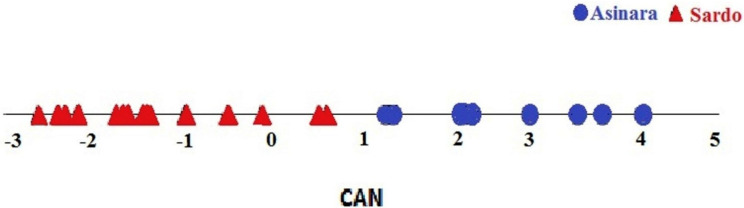
This study pointed to explore if variations in circulating levels of metabolites in the blood stream of no. 25 feral donkeys occur in view of the different coat color between specimens of Asinara (albino, no. 8) vs. Sardo (dun-grey, no. 17) breed. All individuals involved in this investigation are living in the nature, at Mediterranean latitudes and roam in the same areas all over the National Park of Capo Caccia, where they feed on spontaneous vegetation sources. The study was conducted during the positive photoperiod of the boreal hemisphere (peak in the month of June, 2019) to maximize the effect of exposure to the natural sun radiation and thus elicit the coping ability of albino (Asinara) in comparison with pigmented donkeys (Sardo). The biochemical profile of all donkeys was used in a Discriminant Analysis (DA) to explore if circulating levels of metabolites could point to metabolic markers for breed assignment of individuals following a canonical discriminant analysis (CANDISC). The biochemical investigation included also the determination of the circulating Vitamin E (alpha tocopherol, α-TOH), as an essential biologically active compound involved in antioxidant mechanisms, and its respective status (circulating α-TOH to total triglycerides and total cholesterol ratio). In the CANDISC, the distance between the two breeds was not significant. However, it pointed to different metabolites (UREA, total protein, total triglycerides, Zn) capable of describing biochemical patterns on each respective breed (Asinara vs. Sardo). The multivariate analysis DA carried out using 22 metabolites correctly assigned individuals to the two breeds in the 100% of cases. In view of such metabolic background, circulating α-TOH found in the bloodstream of Asinara vs. Sardo donkeys under free grazing conditions turned out to reach similar values (2.114 vs. 1.872 µg/ml, respectively, = 0.676). It is worth noting that significant differences were observed as to circulating lactate dehydrogenase (LDH, = 0.022) levels, in association with increased creatine phosphokinase (CPK, = 0.076), both above the upper limit of the physiological range reported in other donkey breeds, and found in the totality of Asinara (albino) donkeys solely, still apparently clinically healthy.
本研究旨在探讨鉴于阿西纳拉(白化,8号)与撒丁(暗灰色,17号)品种样本之间毛色不同,25只野生驴血液中代谢物循环水平是否存在差异。参与本调查的所有个体都生活在自然环境中,处于地中海纬度,在卡波卡恰国家公园的同一区域内游荡,以自然植被为食。研究在北半球的光照期进行(2019年6月达到峰值),以最大限度地发挥自然太阳辐射的影响,从而引出白化驴(阿西纳拉)与有色驴(撒丁)相比的应对能力。所有驴的生化特征用于判别分析(DA),以探讨代谢物的循环水平是否能根据典型判别分析(CANDISC)为个体品种归属指明代谢标志物。生化研究还包括测定循环维生素E(α-生育酚,α-TOH),它是参与抗氧化机制的一种必需生物活性化合物,以及其各自的状态(循环α-TOH与总甘油三酯和总胆固醇的比率)。在CANDISC中,两个品种之间的距离不显著。然而,它指出了不同的代谢物(尿素、总蛋白、总甘油三酯、锌)能够描述每个相应品种(阿西纳拉与撒丁)的生化模式。使用22种代谢物进行的多变量分析DA在100%的情况下将个体正确归为两个品种。鉴于这种代谢背景,在自由放牧条件下,阿西纳拉驴与撒丁驴血液中发现的循环α-TOH结果达到相似值(分别为2.114和1.872μg/ml,P = 0.676)。值得注意的是,观察到循环乳酸脱氢酶(LDH,P = 0.022)水平存在显著差异,同时肌酸磷酸激酶(CPK,P = 0.076)升高,两者均高于其他驴品种报告的生理范围上限,且仅在所有阿西纳拉(白化)驴中发现,这些驴显然仍处于临床健康状态。