Valle Emanuela, Raspa Federica, Giribaldi Marzia, Barbero Raffaella, Bergagna Stefania, Antoniazzi Sara, Mc Lean Amy K, Minero Michela, Cavallarin Laura
Department of Veterinary Science, University of Turin , Grugliasco (Torino) , Italy.
ISPA-CNR, Institute of Sciences of Food Production , Grugliasco , Italy.
PeerJ. 2017 Mar 28;5:e3001. doi: 10.7717/peerj.3001. eCollection 2017.
The breeding of lactating donkeys is increasing in Western Europe; with it the evaluation of body condition is growing in importance since it is considered a key principle for their welfare. However, assessment of body condition is a complex task, since several factors are involved. The aim of the present study is to investigate which animal-based indicators are the most reliable to describe the body condition of lactating donkeys. For this purpose, new animal-based indicators, which are easy to measure in field conditions (including body measurements, fatty neck score (FNS), dental score), are recorded and their relationship with BCS (a proxy measure for overall adiposity) was assessed. The ones that reveal an association with the BCS are included in an integrated principal component analysis to understand which are the most related to BCS.
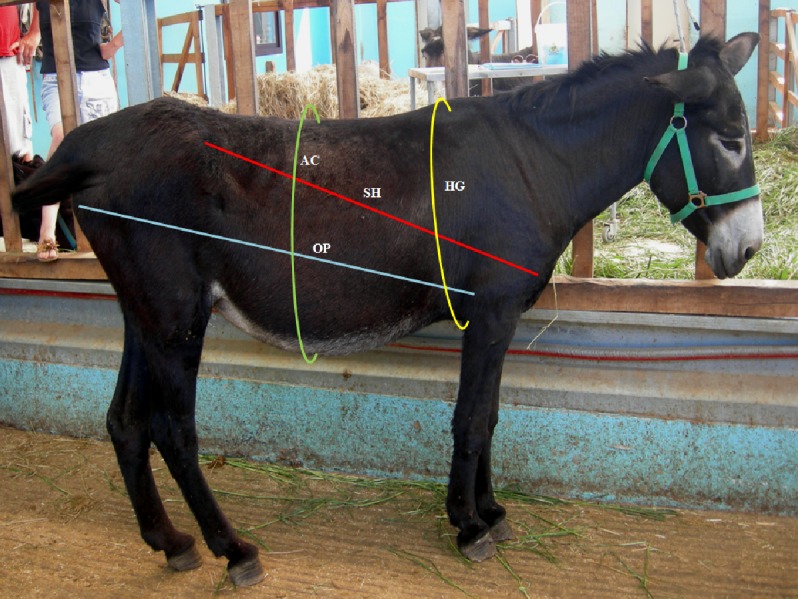
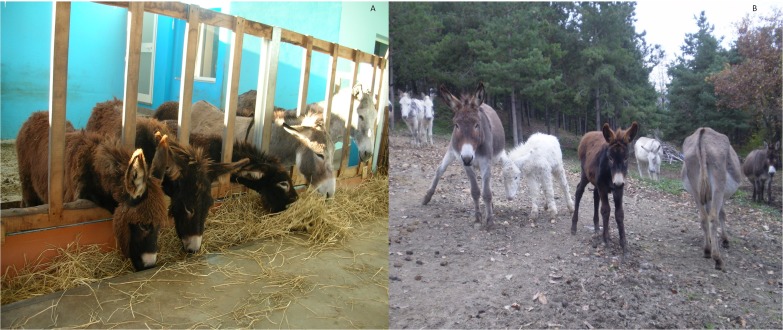
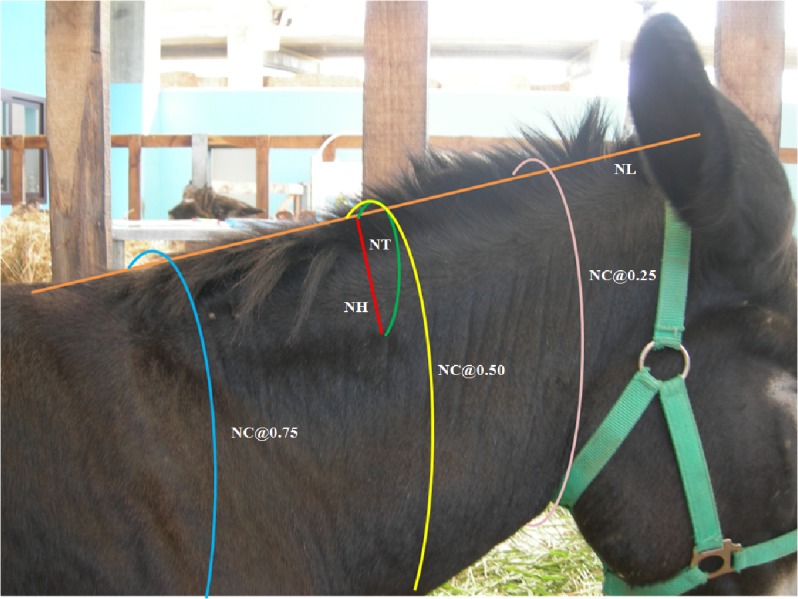
Fifty-three healthy lactating donkeys of various breeds, including 7 Martina Franca, 10 Ragusano, 2 Romagnolo and 34 crossbreeds, were evaluated. The animal-based indicators that were recorded were: length (OP, olecranon tuber-pinbone and SH, shoulder-hip), heart girth (HG), abdominal circumference (AC), neck length (NL), neck height (NH) and neck thickness (NT) at 0.50 and neck circumference (NC) at 0.25, 0.50 and 0.75, body condition score (BCS) and fatty neck score (FNS). The owners' evaluation of the BCS was also considered. A dental assessment was performed and the month of lactation and age of each animal was recorded.
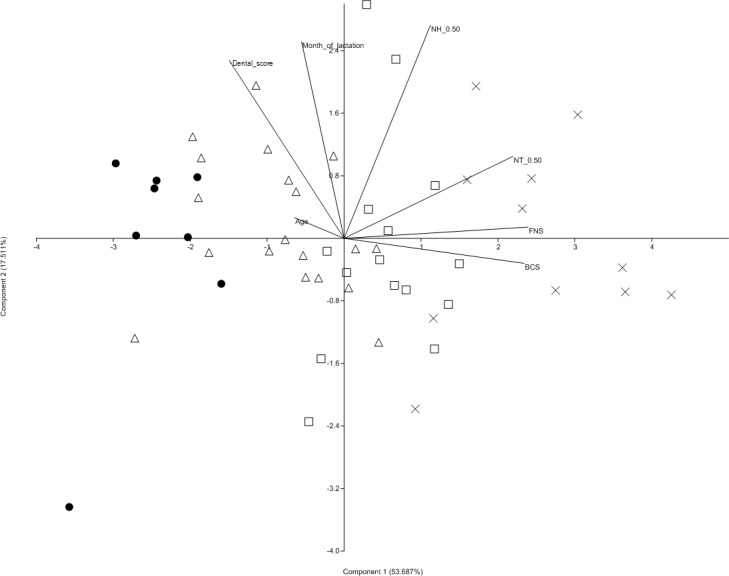
No correlation was found between BCS and the other morphometric body measurements. On the contrary the FNS was correlated with the morphometric measurements of the neck (positive correlation to 0.50 NH and 0.50 NT, 0.50 NC, 0.75 mean NC, and negative correlation to the mean NC:NH and mean NC:NT, 0.50 NC:NT and 0.50 NC:NH ratios). A significant inverse relationship was identified between BCS and dental score. A Principal Component analysis (PCA) separated the BCS classes on the first principal component (PC1). PC1 revealed a meaningful positive correlation between the BCS and the neck measurements (NT, NH and FNS), with high positive loadings, while a negative correlation was found for dental abnormalities. The owners' evaluation of BCS was different from the expert evaluator' assessment, since they tended to give higher score that was slightly but significantly correlated to AC.
A new scoring system, called Fatty Neck Score (FNS), has been proposed for the judgement of the adiposity status of donkey neck. The results suggest that caregivers might use the proposed animal based indicators (BCS, FNS and dental scores) together as a tool for the evaluation of the body condition of lactating donkeys. Our findings highlight that caregivers need to be trained in order to be able to properly record these indicators. Ultimately use of these indicators may help to improve the welfare of lactating donkeys.
在西欧,泌乳期母驴的养殖数量不断增加;随着这一情况,体况评估的重要性日益凸显,因为它被视为保障母驴福利的关键原则。然而,体况评估是一项复杂的任务,因为涉及多个因素。本研究的目的是调查哪些基于动物的指标最能可靠地描述泌乳期母驴的体况。为此,记录了易于在野外条件下测量的新的基于动物的指标(包括身体测量、颈部脂肪评分(FNS)、牙齿评分),并评估了它们与体况评分(BCS,整体肥胖程度的替代指标)之间的关系。与BCS显示出关联的指标被纳入综合主成分分析,以了解哪些指标与BCS最相关。
对53头健康的不同品种泌乳期母驴进行了评估,其中包括7头马尔蒂纳弗兰卡驴、10头拉古萨诺驴、2头罗马尼奥洛驴和34头杂交驴。记录的基于动物的指标包括:体长(OP,尺骨结节 - 坐骨结节和SH,肩 - 臀)、胸围(HG)、腹围(AC)、颈部长度(NL)、颈部高度(NH)、颈部0.50处厚度(NT)以及颈部0.25、0.50和0.75处周长(NC)、体况评分(BCS)和颈部脂肪评分(FNS)。还考虑了主人对BCS的评估。进行了牙齿评估,并记录了每头动物的泌乳月份和年龄。
未发现BCS与其他身体形态测量指标之间存在相关性。相反,FNS与颈部的形态测量指标相关(与0.50 NH、0.50 NT、0.50 NC、0.75平均NC呈正相关,与平均NC:NH、平均NC:NT、0.50 NC:NT和0.50 NC:NH比值呈负相关)。在BCS与牙齿评分之间发现了显著的负相关关系。主成分分析(PCA)在第一主成分(PC1)上分离了BCS类别。PC1显示BCS与颈部测量指标(NT、NH和FNS)之间存在有意义的正相关,具有较高的正负荷,而牙齿异常则呈负相关。主人对BCS的评估与专家评估不同,因为他们倾向于给出更高的分数,且与AC呈轻微但显著的相关性。
提出了一种新的评分系统,称为颈部脂肪评分(FNS),用于判断驴颈部的肥胖状况。结果表明,护理人员可以将提议的基于动物的指标(BCS、FNS和牙齿评分)一起用作评估泌乳期母驴体况的工具。我们的研究结果强调,护理人员需要接受培训,以便能够正确记录这些指标。最终,使用这些指标可能有助于改善泌乳期母驴的福利。