Tait Sabrina, Baldassarre Antonella, Masotti Andrea, Calura Enrica, Martini Paolo, Varì Rosaria, Scazzocchio Beatrice, Gessani Sandra, Del Cornò Manuela
Center for Gender-Specific Medicine, Istituto Superiore di Sanità, Rome, Italy.
Bambino Gesù Children's Hospital-IRCCS, Research Laboratories, Rome, Italy.
Front Oncol. 2020 Jul 2;10:1089. doi: 10.3389/fonc.2020.01089. eCollection 2020.
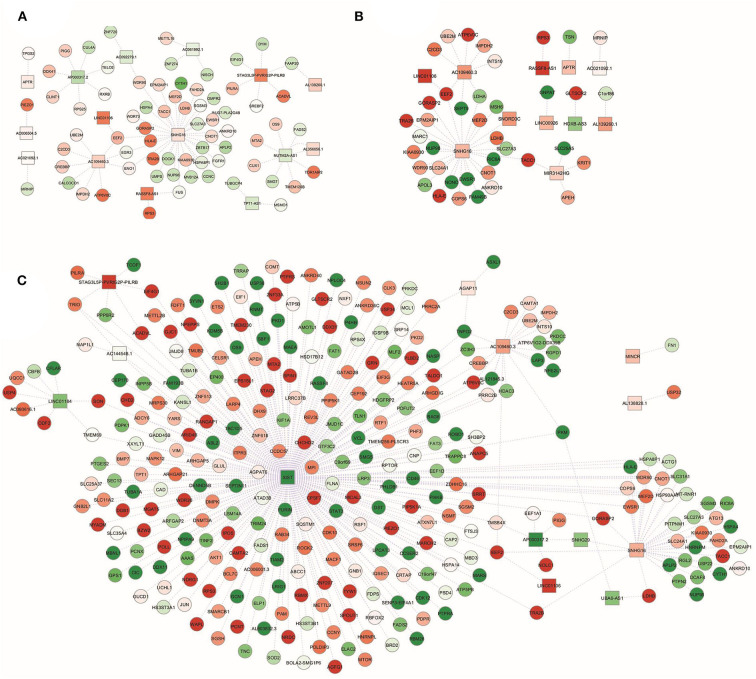
Obesity, and the obesity-associated inflammation, represents a major risk factor for the development of chronic diseases, including colorectal cancer (CRC). Dysfunctional visceral adipose tissue (AT) is now recognized as key player in obesity-associated morbidities, although the biological processes underpinning the increased CRC risk in obese subjects are still a matter of debate. Recent findings have pointed to specific alterations in the expression pattern of non-coding RNAs (ncRNAs), such as microRNAs (miRNAs), and long non-coding RNAs (lncRNAs), as mechanisms underlying dysfunctional adipocyte phenotype in obesity. Nevertheless, the regulatory networks and interrelated processes relevant for adipocyte functions, that may contribute to a tumor-promoting microenvironment, are poorly known yet. To this end, based on RNA sequencing data, we identified lncRNAs and miRNAs, which are aberrantly expressed in visceral adipocytes from obese and CRC subjects, as compared to healthy lean control, and validated a panel of modulated ncRNAs by real-time qPCR. Furthermore, by combining the differentially expressed lncRNA and miRNA profiles with the transcriptome analysis dataset of adipocytes from lean and obese subjects affected or not by CRC, lncRNA-miRNA-mRNA adipocyte networks were defined for obese and CRC subjects. This analysis highlighted several ncRNAs modulation that are common to both obesity and CRC or unique of each disorder. Functional enrichment analysis of network-related mRNA targets, revealed dysregulated pathways associated with metabolic processes, lipid and energy metabolism, inflammation, and cancer. Moreover, adipocytes from obese subjects affected by CRC exhibited a higher complexity, in terms of number of genes, lncRNAs, miRNAs, and biological processes found to be dysregulated, providing evidence that the transcriptional and post-transcriptional program of adipocytes from CRC patients is deeply affected by obesity. Overall, this study adds further evidence for a central role of visceral adipocyte dysfunctions in the obesity-cancer relationship.
肥胖以及与肥胖相关的炎症是包括结直肠癌(CRC)在内的慢性疾病发展的主要危险因素。功能失调的内脏脂肪组织(AT)现在被认为是肥胖相关疾病的关键因素,尽管肥胖个体患CRC风险增加背后的生物学过程仍存在争议。最近的研究发现,非编码RNA(ncRNA),如微小RNA(miRNA)和长链非编码RNA(lncRNA)的表达模式的特定改变,是肥胖中脂肪细胞功能失调表型的潜在机制。然而,与脂肪细胞功能相关的、可能促成肿瘤促进微环境的调控网络和相互关联的过程,目前仍知之甚少。为此,基于RNA测序数据,我们鉴定了与健康瘦对照相比,在肥胖和CRC患者的内脏脂肪细胞中异常表达的lncRNA和miRNA,并通过实时定量PCR验证了一组被调节的ncRNA。此外,通过将差异表达的lncRNA和miRNA谱与受或未受CRC影响的瘦和肥胖个体的脂肪细胞转录组分析数据集相结合,为肥胖和CRC患者定义了lncRNA-miRNA-mRNA脂肪细胞网络。该分析突出了肥胖和CRC共有的几种ncRNA调节,或每种疾病特有的调节。对网络相关mRNA靶标的功能富集分析揭示了与代谢过程、脂质和能量代谢、炎症和癌症相关的失调途径。此外,受CRC影响的肥胖个体的脂肪细胞在基因、lncRNA、miRNA数量以及发现失调的生物学过程方面表现出更高的复杂性,这表明CRC患者脂肪细胞的转录和转录后程序受到肥胖的深刻影响。总体而言,本研究进一步证明了内脏脂肪细胞功能失调在肥胖与癌症关系中的核心作用。