Asahi Ryoma, Yuguchi Satoshi, Kamo Tomohiko, Azami Masato, Ogihara Hirofumi, Asano Satoshi
School of Health Sciences, Japan University of Health Sciences, Satte City, Saitama, Japan.
Saitama Spine Center, JMA Higashi Saitama General Hospital, Satte City, Saitama, Japan.
Osteoporos Sarcopenia. 2020 Jun;6(2):59-64. doi: 10.1016/j.afos.2020.05.003. Epub 2020 Jun 14.
Height loss is associated with vertebral fracture risk and osteoporosis. We assumed that height loss may indicate the risk of falls because the presence of osteoporosis is significantly associated with sarcopenia development. We studied the association of height loss with falls and sarcopenia.
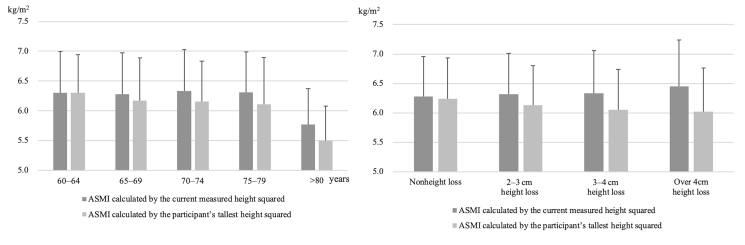
This study included 610 community-dwelling women. We measured the height, weight, appendicular skeletal muscle mass index (ASMI), grip strength, and gait speed. Additionally, we recorded the individual's tallest height, and the presence or absence of single or multiple falls during the preceding 12 months. The participants were classified into nonheight loss, 2- to 3-cm height loss, 3- to 4-cm height loss, and over 4-cm height loss groups. The association of height loss with falls and sarcopenia were examined using multiple logistic regression analysis.
We found that 3- to 4-cm height loss and over 4-cm height loss were significantly associated with falls (odds ratio [OR], 1.637; 95% confidence interval [CI], 1.023-2.619; P = 0.04), (OR, 1.742, 95% CI, 1.054-2.877; P = 0.03), respectively. Additionally, over 4-cm height loss was significantly associated with sarcopenia for ASMI calculated by participant's tallest recalled height squared (OR, 2.676; 95% CI, 1.122-6.284; P = 0.026).
We found that the risk of falls was advanced at 3- to 4-cm height loss and over 4-cm height loss, and sarcopenia started at over 4-cm height loss. Height loss may be a useful indicator of the risk of falls and sarcopenia.
身高降低与椎体骨折风险及骨质疏松症相关。我们假定身高降低可能预示跌倒风险,因为骨质疏松症的存在与肌肉减少症的发生显著相关。我们研究了身高降低与跌倒及肌肉减少症之间的关联。
本研究纳入610名社区居住女性。我们测量了身高、体重、四肢骨骼肌质量指数(ASMI)、握力和步速。此外,我们记录了个体的最高身高,以及过去12个月内是否发生过单次或多次跌倒。参与者被分为无身高降低组、身高降低2至3厘米组、身高降低3至4厘米组和身高降低超过4厘米组。使用多因素逻辑回归分析检验身高降低与跌倒及肌肉减少症之间的关联。
我们发现,身高降低3至4厘米和超过4厘米与跌倒显著相关(比值比[OR]分别为1.637;95%置信区间[CI]为1.023 - 2.619;P = 0.04),(OR为1.742,95% CI为1.054 - 2.877;P = 0.03)。此外,对于根据参与者回忆的最高身高平方计算的ASMI,身高降低超过4厘米与肌肉减少症显著相关(OR为2.676;95% CI为1.122 - 6.284;P = 0.026)。
我们发现,身高降低3至4厘米和超过4厘米时跌倒风险增加,身高降低超过4厘米时出现肌肉减少症。身高降低可能是跌倒和肌肉减少症风险的有用指标。