
利用机器学习分析阿尔茨海默病神经影像学 (ADNI) 数据库,发现廉价、非侵入性的生物标志物可预测阿尔茨海默病的转化。
Inexpensive, non-invasive biomarkers predict Alzheimer transition using machine learning analysis of the Alzheimer's Disease Neuroimaging (ADNI) database.
机构信息
Department of Computer Sciences, Courant Institute of Mathematical Sciences, New York University, New York, New York, United States of America.
Fordham University Lincoln Center Campus, New York, New York, United States of America.
出版信息
PLoS One. 2020 Jul 27;15(7):e0235663. doi: 10.1371/journal.pone.0235663. eCollection 2020.
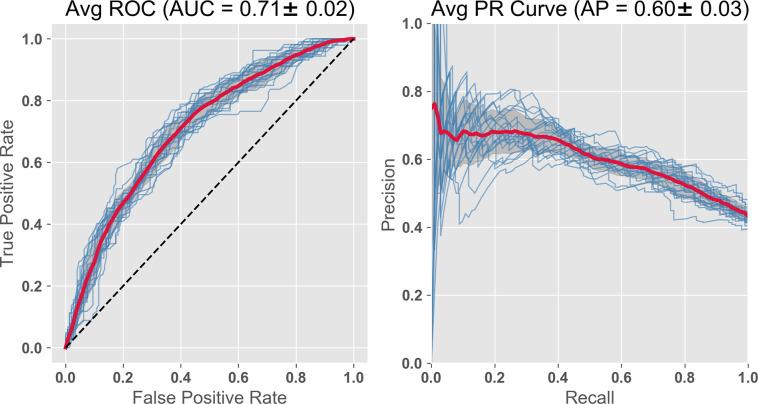
The Alzheimer's Disease Neuroimaging (ADNI) database is an expansive undertaking by government, academia, and industry to pool resources and data on subjects at various stage of symptomatic severity due to Alzheimer's disease. As expected, magnetic resonance imaging is a major component of the project. Full brain images are obtained at every 6-month visit. A range of cognitive tests studying executive function and memory are employed less frequently. Two blood draws (baseline, 6 months) provide samples to measure concentrations of approximately 145 plasma biomarkers. In addition, other diagnostic measurements are performed including PET imaging, cerebral spinal fluid measurements of amyloid-beta and tau peptides, as well as genetic tests, demographics, and vital signs. ADNI data is available upon review of an application. There have been numerous reports of how various processes evolve during AD progression, including alterations in metabolic and neuroendocrine activity, cell survival, and cognitive behavior. Lacking an analytic model at the onset, we leveraged recent advances in machine learning, which allow us to deal with large, non-linear systems with many variables. Of particular note was examining how well binary predictions of future disease states could be learned from simple, non-invasive measurements like those dependent on blood samples. Such measurements make relatively little demands on the time and effort of medical staff or patient. We report findings with recall/precision/area under the receiver operator curve after application of CART, Random Forest, Gradient Boosting, and Support Vector Machines, Our results show (i) Random Forests and Gradient Boosting work very well with such data, (ii) Prediction quality when applied to relatively easily obtained measurements (Cognitive scores, Genetic Risk and plasma biomarkers) achieve results that are competitive with magnetic resonance techniques. This is by no means an exhaustive study, but instead an exploration of the plausibility of defining a series of relatively inexpensive, broad population based tests.
阿尔茨海默病神经影像学(ADNI)数据库是政府、学术界和工业界的一项广泛努力,旨在汇集资源和数据,研究处于不同症状严重程度的阿尔茨海默病患者。正如预期的那样,磁共振成像(MRI)是该项目的主要组成部分。在每 6 个月的访视中都会获得全脑图像。较少使用一系列研究执行功能和记忆的认知测试。两次采血(基线、6 个月)提供样本,以测量约 145 种血浆生物标志物的浓度。此外,还进行了其他诊断测量,包括正电子发射断层扫描(PET)成像、脑脊液中淀粉样蛋白-β和 tau 肽的测量,以及基因测试、人口统计学和生命体征。在审查申请后可以获得 ADNI 数据。已经有许多关于 AD 进展过程中各种过程如何演变的报告,包括代谢和神经内分泌活动、细胞存活和认知行为的改变。由于缺乏发病时的分析模型,我们利用了机器学习的最新进展,这些进展使我们能够处理具有许多变量的大型非线性系统。特别值得注意的是,研究从简单的非侵入性测量(如依赖于血液样本的测量)中学习未来疾病状态的二进制预测的效果如何。这些测量对医务人员或患者的时间和精力要求相对较低。我们报告了应用 CART、随机森林、梯度提升和支持向量机后的召回率/精确率/接收者操作特征曲线下面积的发现。我们的结果表明:(i)随机森林和梯度提升在这种数据上效果非常好;(ii)应用于相对容易获得的测量(认知评分、遗传风险和血浆生物标志物)的预测质量可达到与磁共振技术相媲美的结果。这绝不是一项详尽的研究,而是对定义一系列相对便宜、广泛的人群基础测试的可行性进行的探索。




 Zotero 插件