Kareya Mukul Suresh, Mariam Iqra, Shaikh Kashif Mohd, Nesamma Asha Arumugam, Jutur Pannaga Pavan
Omics of Algae Group, Industrial Biotechnology, International Centre for Genetic Engineering and Biotechnology, New Delhi, India.
Front Plant Sci. 2020 Jul 3;11:981. doi: 10.3389/fpls.2020.00981. eCollection 2020.
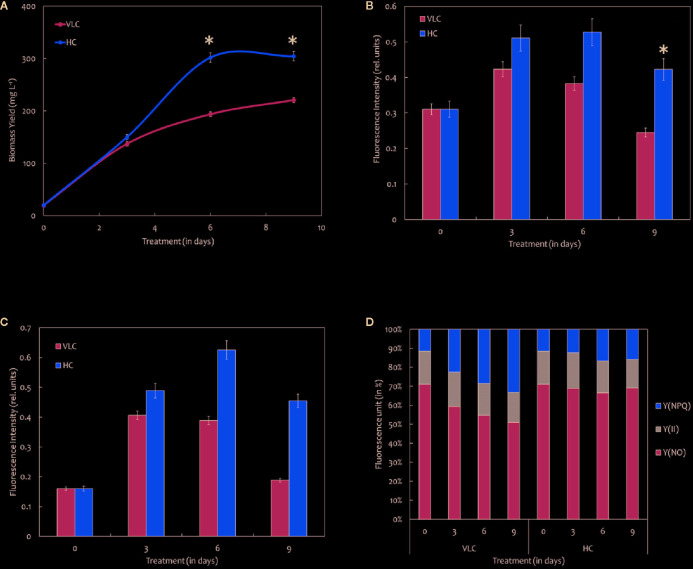
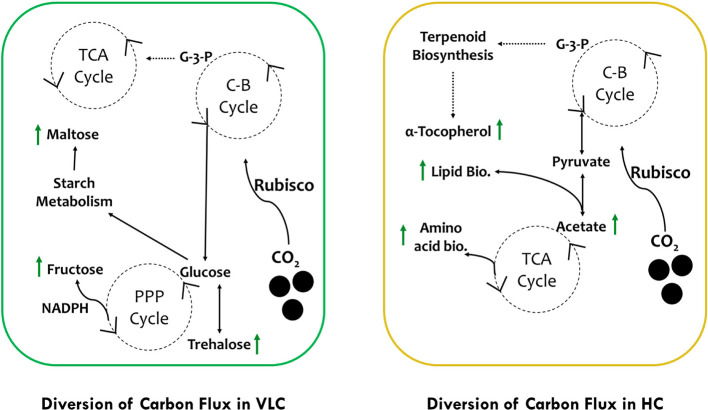
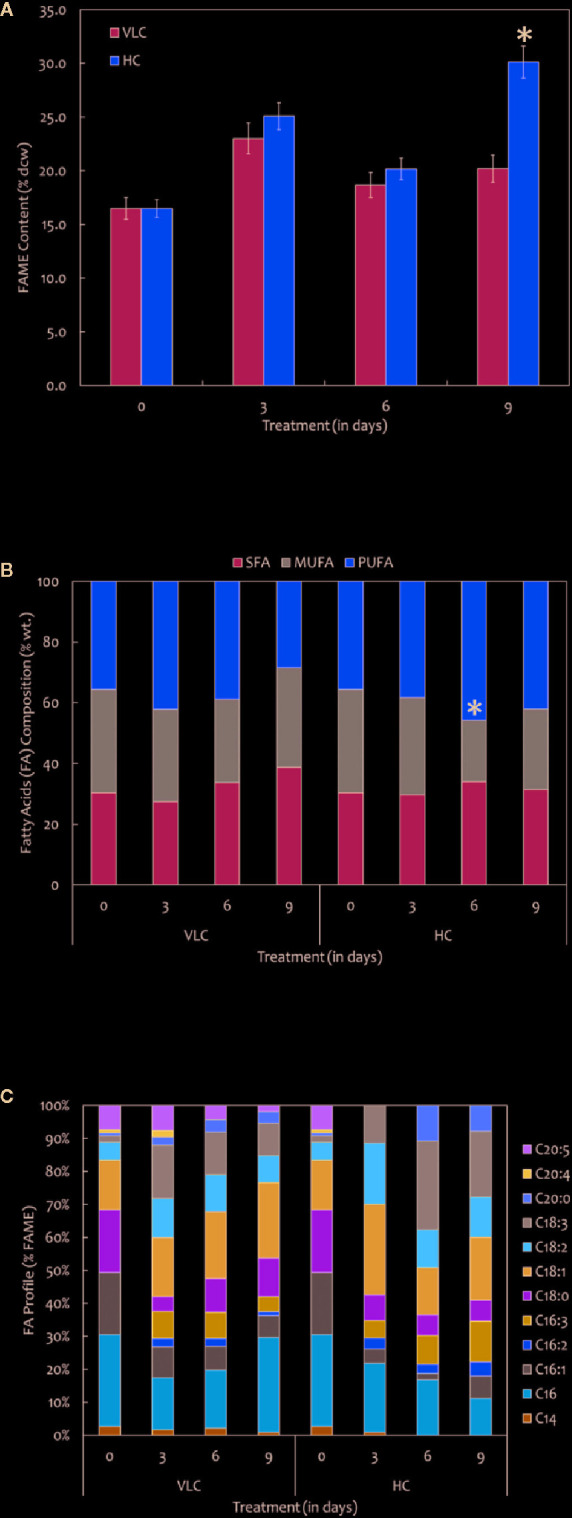
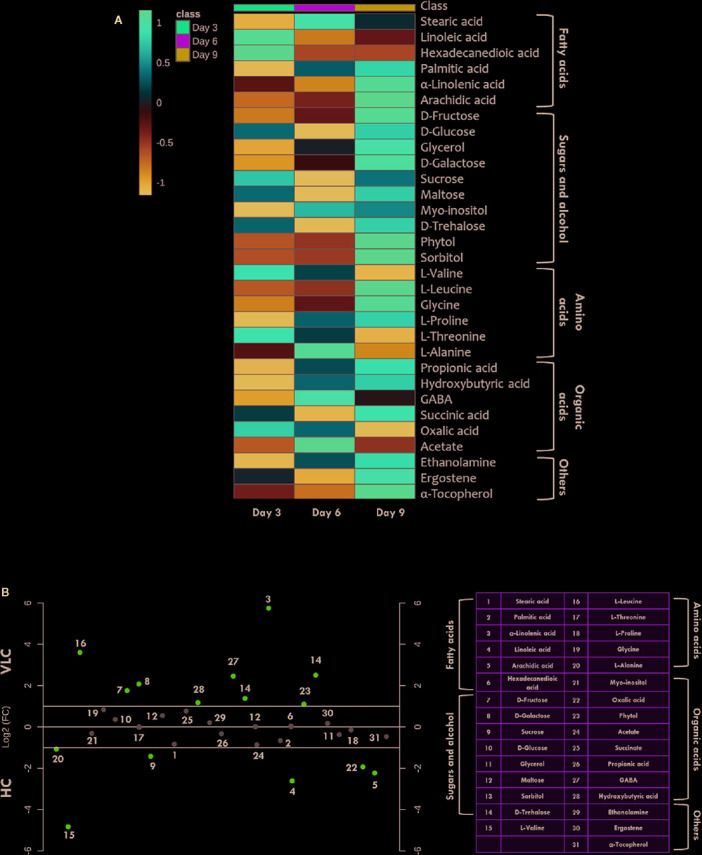
Photosynthetic organisms fix inorganic carbon through carbon capture machinery (CCM) that regulates the assimilation and accumulation of carbon around ribulose-1,5-bisphosphate carboxylase/oxygenase (Rubisco). However, few constraints that govern the central carbon metabolism are regulated by the carbon capture and partitioning machinery. In order to divert the cellular metabolism toward lipids and/or biorenewables it is important to investigate and understand the molecular mechanisms of the CO-driven carbon partitioning. In this context, strategies for enhancement of CO fixation which will increase the overall biomass and lipid yields, can provide clues on understanding the carbon assimilation pathway, and may lead to new targets for genetic engineering in microalgae. In the present study, we have focused on the physiological and metabolomic response occurring within marine oleaginous microalgae NIES 2587, under the influence of very-low CO (VLC; 300 ppm, or 0.03%) and high CO (HC; 30,000 ppm, or 3% v/v). Our results demonstrate that HC supplementation in channelizes the carbon flux toward the production of long chain polyunsaturated fatty acids (LC-PUFAs) and also increases the overall biomass productivities (up to 2.0 fold). Also, the qualitative metabolomics has identified nearly 31 essential metabolites, among which there is a significant fold change observed in accumulation of sugars and alcohols such as galactose and phytol in VLC as compared to HC. In conclusion, our focus is to understand the entire carbon partitioning and metabolic regulation within these photosynthetic cell factories, which will be further evaluated through multiomics approach for enhanced productivities of biomass, biofuels, and bioproducts (B3).
光合生物通过碳捕获机制(CCM)固定无机碳,该机制调节核酮糖-1,5-二磷酸羧化酶/加氧酶(Rubisco)周围碳的同化和积累。然而,很少有控制中心碳代谢的限制因素受碳捕获和分配机制的调节。为了使细胞代谢转向脂质和/或生物可再生资源,研究和理解CO驱动的碳分配的分子机制很重要。在这种背景下,增强CO固定的策略可以增加总生物量和脂质产量,这可以为理解碳同化途径提供线索,并可能为微藻基因工程带来新的靶点。在本研究中,我们聚焦于海洋产油微藻NIES 2587在极低CO(VLC;300 ppm,或0.03%)和高CO(HC;30,000 ppm,或3% v/v)影响下发生的生理和代谢组学反应。我们的结果表明,补充HC可使碳通量导向长链多不饱和脂肪酸(LC-PUFAs)的产生,还能提高总生物量生产力(高达2.0倍)。此外,定性代谢组学鉴定出近31种必需代谢物,其中与HC相比,VLC中半乳糖和叶绿醇等糖类和醇类的积累有显著的倍数变化。总之,我们的重点是了解这些光合细胞工厂内的整个碳分配和代谢调节,这将通过多组学方法进一步评估,以提高生物质、生物燃料和生物产品(B3)的生产力。