Harder Helena, Shilling Valerie M, May Shirley F, Cella David, Schmid Peter, Fallowfield Lesley J
Sussex Health Outcomes Research and Education in Cancer (SHORE-C), Brighton and Sussex Medical School, University of Sussex, Brighton, UK.
Department of Medical Social Sciences, Feinberg School of Medicine, Northwestern University, Chicago, IL, USA.
Breast Cancer Res Treat. 2020 Oct;183(3):629-638. doi: 10.1007/s10549-020-05798-w. Epub 2020 Jul 27.
Chemotherapy-induced diarrhoea (CID) is a common, but often underreported problem in patients with breast cancer that has a profound effect on quality of life. It is best measured from a patient's perspective, but tools are limited. The aim of this study was to develop and evaluate the Diarrhoea Management Diary (DMD), a self-report measure to assess CID, use of self-management strategies and treatment adherence.
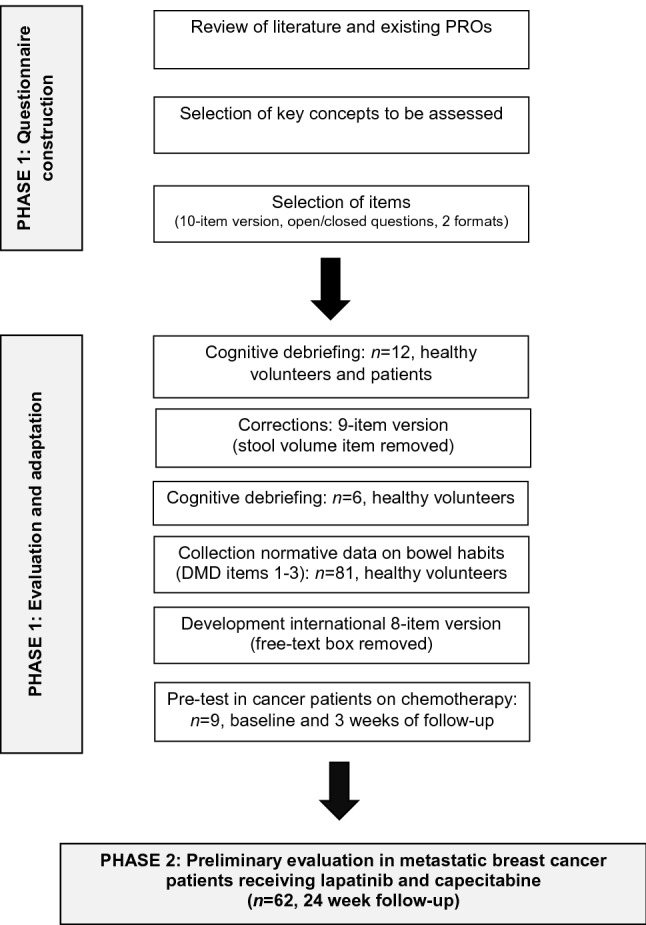
The DMD was constructed using an iterative process of instrument development: concept elicitation (literature review), item generation and reduction (cognitive debriefing), and pilot testing in the target population. After translation into eight languages, the DMD was used in an international randomised trial for women receiving lapatinib and capecitabine for metastatic breast cancer with or without prophylactic octreotide. Patterns of missing data and sensitivity to change were examined.
The understandability and completeness of the 8-item DMD was confirmed in cognitive interviews and pilot testing. Practicability of the DMD was evaluated in 62 women with metastatic breast cancer (median age 57). Up to 68% reported CID at any given time-point, and 19% had diarrhoea at each time-point. Patients also described efficacy of different strategies for diarrhoea management. Missing data were associated with study discontinuation. DMD missing item response was 0.9%. Sensitivity to change was good at most assessment points.
Although further psychometric testing is recommended, initial evaluation of the DMD showed good content validity and practicability in international research with cancer patients.
化疗引起的腹泻(CID)是乳腺癌患者中常见但常未得到充分报告的问题,对生活质量有深远影响。从患者角度进行评估最为合适,但相关工具有限。本研究旨在开发并评估腹泻管理日记(DMD),这是一种自我报告工具,用于评估CID、自我管理策略的使用情况及治疗依从性。
DMD采用仪器开发的迭代过程构建:概念引出(文献综述)、条目生成与缩减(认知访谈)以及在目标人群中进行预试验。翻译成八种语言后,DMD用于一项国际随机试验,该试验针对接受拉帕替尼和卡培他滨治疗转移性乳腺癌的女性,无论是否使用预防性奥曲肽。检查了缺失数据的模式和对变化的敏感性。
在认知访谈和预试验中证实了8项DMD的可理解性和完整性。在62名转移性乳腺癌女性(中位年龄57岁)中评估了DMD的实用性。在任何给定时间点,高达68%的患者报告有CID,每个时间点有19%的患者出现腹泻。患者还描述了不同腹泻管理策略的效果。缺失数据与研究中断有关。DMD缺失条目的回答率为0.9%。在大多数评估点,对变化的敏感性良好。
尽管建议进一步进行心理测量测试,但DMD的初步评估显示,在针对癌症患者的国际研究中,其具有良好的内容效度和实用性。