Department of Ecological Modelling, Helmholtz Centre for Environmental Research-UFZ, Leipzig, Saxony, Germany.
Institute of Environmental Systems Research, University of Osnabrück, Osnabrück, Lower Saxony, Germany.
PLoS One. 2020 Jul 28;15(7):e0236546. doi: 10.1371/journal.pone.0236546. eCollection 2020.
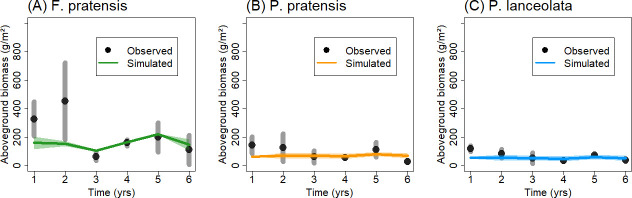
Grasslands contribute to global biogeochemical cycles and can host a high number of plant species. Both-species dynamics and biogeochemical fluxes-are influenced by abiotic and biotic environmental factors, management and natural disturbances. In order to understand and project grassland dynamics under global change, vegetation models which explicitly capture all relevant processes and drivers are required. However, the parameterization of such models is often challenging. Here, we report on testing an individual- and process-based model for simulating the dynamics and structure of a grassland experiment in temperate Europe. We parameterized the model for three species and confront simulated grassland dynamics with empirical observations of their monocultures and one two-species mixture. The model reproduces general trends of vegetation patterns (vegetation cover and height, aboveground biomass and leaf area index) for the monocultures and two-species community. For example, the model simulates well an average annual grassland cover of 70% in the species mixture (observed cover of 77%), but also shows mismatches with specific observation values (e.g. for aboveground biomass). By a sensitivity analysis of the applied inverse model parameterization method, we demonstrate that multiple vegetation attributes are important for a successful parameterization while leaf area index revealed to be of highest relevance. Results of our study pinpoint to the need of improved grassland measurements (esp. of temporally higher resolution) in close combination with advanced modelling approaches.
草原对全球生物地球化学循环有贡献,并且可以容纳大量的植物物种。两种物种的动态和生物地球化学通量受到非生物和生物环境因素、管理和自然干扰的影响。为了了解和预测全球变化下的草原动态,需要使用明确捕捉所有相关过程和驱动因素的植被模型。然而,这种模型的参数化通常具有挑战性。在这里,我们报告了对一种基于个体和过程的模型进行测试的情况,该模型用于模拟温带欧洲草原实验的动态和结构。我们为三种物种进行了模型参数化,并将模拟的草原动态与它们的单培养物和一种两种物种混合物的经验观测进行了对比。该模型再现了单培养物和两种物种群落的植被模式(植被覆盖度和高度、地上生物量和叶面积指数)的一般趋势。例如,该模型很好地模拟了物种混合物中平均每年 70%的草原覆盖度(观察到的覆盖度为 77%),但也与特定的观测值存在不匹配(例如地上生物量)。通过对应用的逆模型参数化方法的敏感性分析,我们证明了多个植被属性对于成功的参数化很重要,而叶面积指数被证明具有最高的相关性。我们研究的结果指出需要改进草原测量(特别是更具时间分辨率的测量),并与先进的建模方法密切结合。