Department of Psychiatry, Wrocław Medical University, Ul. Pasteura 10, 50-367, Wroclaw, Poland.
I. M. Sechenov First Moscow State Medical University of the Ministry of Health of the Russian Federation (Sechenov University), 8/2 Trubetskaya Str., Moscow, 119991, Russian Federation.
Curr Neuropharmacol. 2021;19(2):152-169. doi: 10.2174/1570159X18666200729093724.
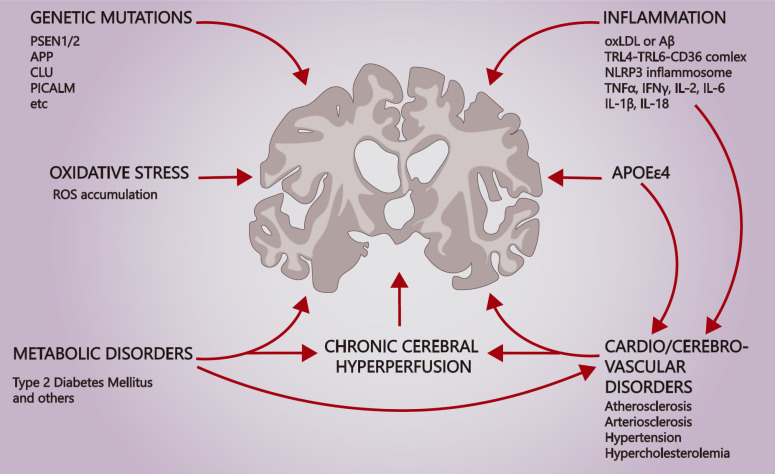
The root cause of non-inherited Alzheimer's disease (AD) remains unknown despite hundreds of research studies performed to attempt to solve this problem. Since proper prophylaxis remains the best strategy, many scientists have studied the risk factors that may affect AD development. There is robust evidence supporting the hypothesis that cardiovascular diseases (CVD) may contribute to AD progression, as the diseases often coexist. Therefore, a lack of well-defined diagnostic criteria makes studying the relationship between AD and CVD complicated. Additionally, inflammation accompanies the pathogenesis of AD and CVD, and is not only a consequence but also implicated as a significant contributor to the course of the diseases. Of note, АроЕε4 is found to be one of the major risk factors affecting both the cardiovascular and nervous systems. According to genome wide association and epidemiological studies, numerous common risk factors have been associated with the development of AD-related pathology. Furthermore, the risk of developing AD and CVDs appears to be increased by a wide range of conditions and lifestyle factors: hypertension, dyslipidemia, hypercholesterolemia, hyperhomocysteinemia, gut/oral microbiota, physical activity, and diet. This review summarizes the literature and provides possible mechanistic links between CVDs and AD.
尽管已经进行了数百项研究来试图解决这个问题,但非遗传性阿尔茨海默病(AD)的根本原因仍然未知。由于适当的预防仍然是最好的策略,许多科学家已经研究了可能影响 AD 发展的风险因素。有大量证据支持心血管疾病(CVD)可能导致 AD 进展的假设,因为这些疾病经常同时存在。因此,缺乏明确的诊断标准使得研究 AD 和 CVD 之间的关系变得复杂。此外,炎症伴随着 AD 和 CVD 的发病机制,它不仅是疾病的结果,而且被认为是疾病进程的一个重要因素。值得注意的是,ArоЕε4 被发现是影响心血管和神经系统的主要危险因素之一。根据全基因组关联和流行病学研究,许多常见的风险因素与 AD 相关病理的发展有关。此外,患 AD 和 CVD 的风险似乎会因多种情况和生活方式因素而增加:高血压、血脂异常、高胆固醇血症、高同型半胱氨酸血症、肠道/口腔微生物群、身体活动和饮食。这篇综述总结了文献,并提供了 CVD 和 AD 之间可能的机制联系。