Credence Management Solutions, LLC, the Global Health Technical Professionals, USAID, 8609 Westwood Center Drive, Suite 300, Vienna, VA, 22192, USA.
Department of International Health, Johns Hopkins Bloomberg School of Public Health, 615 N Wolfe St, Baltimore, MD, 21205, USA.
Hum Resour Health. 2020 Jul 29;18(1):52. doi: 10.1186/s12960-020-00491-x.
Mentoring programs for nurses already in the health workforce are growing in importance. Yet, the settings, goals, scale, and key features of these programs are not widely known.
To identify and synthesize research on in-service nurse mentoring programs.
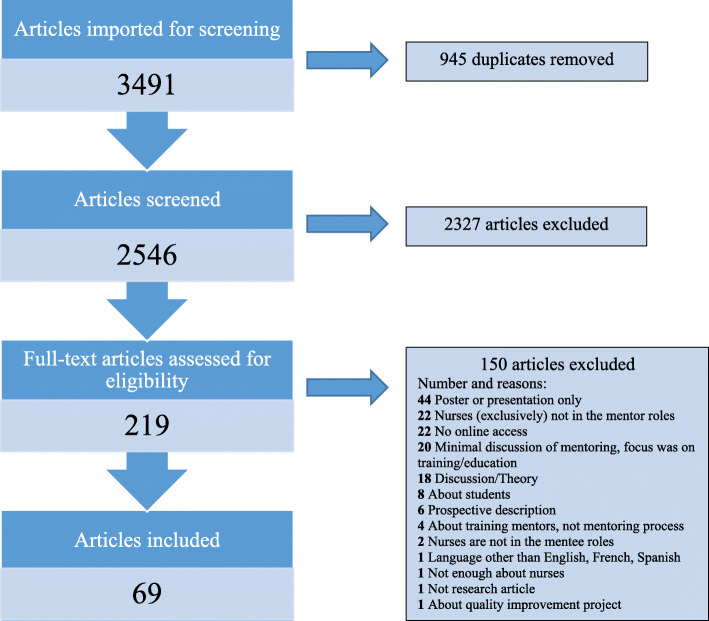
We reviewed nurse mentoring research from six databases. Studies either referred explicitly to in-service nurse mentoring programs, were reviews of such programs, or concerned nurse training/education in which mentoring was an essential component.
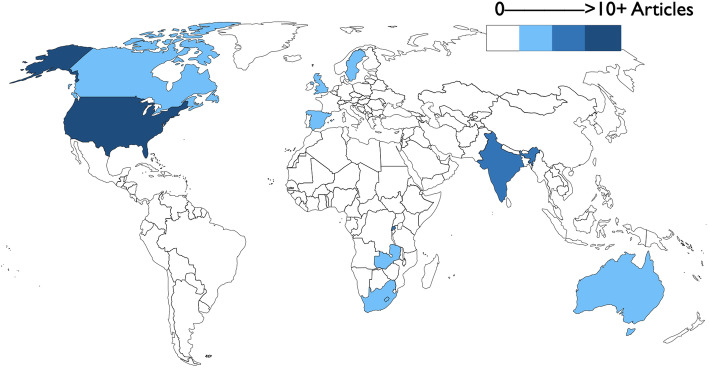
We included 69 articles from 11 countries, published from 1995 to 2019. Most articles were from high-income countries (n = 46) and in rural areas (n = 22). Programs were developed to strengthen clinical care (particularly maternal and neonatal care), promote evidence-based practice, promote retention, support new graduate nurses, and develop nurse leaders. Of the articles with sufficient data, they typically described small programs implemented in one facility (n = 23), with up to ten mentors (n = 13), with less than 50 mentees (n = 25), meeting at least once a month (n = 27), and lasting at least a year (n = 24). While over half of the studies (n = 36) described programs focused almost exclusively on clinical skills acquisition, many (n = 33) specified non-clinical professional development activities. Reflective practice featured to a varying extent in many articles (n = 29). Very few (n = 6) explicitly identified the theoretical basis of their programs.
Although the literature about in-service nurse mentoring comes mostly from small programs in high-income countries, the largest nurse mentoring programs in the world are in low- and middle-income countries. Much can be learned from studying these programs in greater detail. Future research should analyze key features of programs to make models of mentoring more transparent and translatable. If carefully designed and flexibly implemented, in-service nurse mentoring represents an exciting avenue for enhancing the role of nurses and midwives in people-centered health system strengthening. The contents in this article are those of the authors and do not necessarily reflect the view of the U.S. President's Emergency Plan for AIDS Relief, the U.S. Agency for International Development or the U.S. Government.
针对在职护士的导师计划在卫生工作者中的重要性日益凸显。然而,这些计划的设置、目标、规模和关键特征尚未广为人知。
确定并综合在职护士导师计划的研究。
我们从六个数据库中检索护士导师研究。研究要么明确提到在职护士导师计划,要么是对这些计划的综述,要么涉及到护理培训/教育,其中导师制是一个重要组成部分。
我们从 11 个国家的 69 篇文章中纳入了研究,发表时间为 1995 年至 2019 年。大多数文章来自高收入国家(n=46)和农村地区(n=22)。这些计划旨在加强临床护理(特别是孕产妇和新生儿护理)、促进循证实践、促进保留、支持新毕业护士和培养护士领导者。在有足够数据的文章中,它们通常描述了在一个机构实施的小型计划(n=23),有多达 10 名导师(n=13),不到 50 名学员(n=25),每月至少会面一次(n=27),持续至少一年(n=24)。虽然超过一半的研究(n=36)描述了几乎完全专注于临床技能获取的计划,但许多研究(n=33)指定了非临床专业发展活动。在许多文章中,反思实践都以不同的程度为特色(n=29)。很少有研究(n=6)明确确定其计划的理论基础。
尽管在职护士导师的文献主要来自高收入国家的小型计划,但世界上最大的护士导师计划在中低收入国家。从更详细地研究这些计划中可以学到很多东西。未来的研究应该分析计划的关键特征,使导师模式更加透明和可移植。如果精心设计并灵活实施,在职护士导师制代表了增强护士和助产士在以人为中心的卫生系统强化中的作用的一个令人兴奋的途径。本文中的内容是作者的观点,不一定反映美国艾滋病紧急救援计划、美国国际开发署或美国政府的观点。