Department of Endocrinology and Metabolism, West China Hospital, Sichuan University, No. 37 Guoxue Xiang, Chengdu, Sichuan, People's Republic of China.
Department of Neurology, The People's Hospital of Chongqing Yubei District, Chongqing, People's Republic of China.
Sci Rep. 2020 Jul 29;10(1):12708. doi: 10.1038/s41598-020-68166-0.
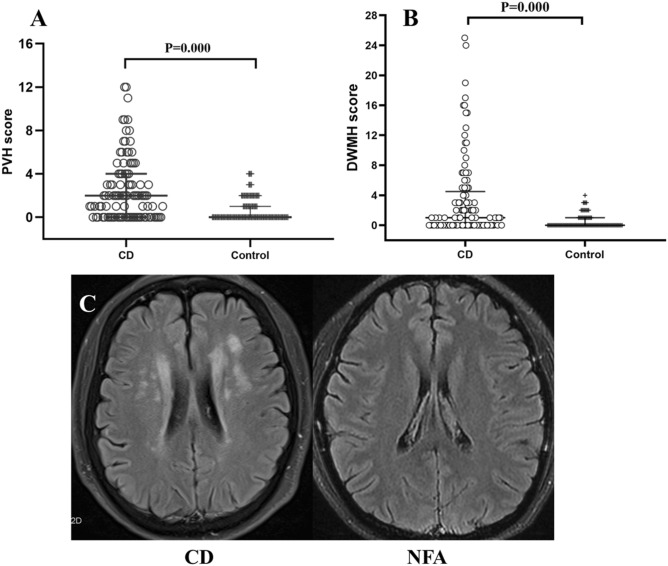
Brain structural abnormalities are often observed on magnetic resonance imaging (MRI) scans of Cushing's syndrome patients, but the pathogenesis is not fully understood. To understand the relationship between brain structural abnormalities and potential risk factors in active Cushing's disease (CD) patients, a total of 101 treatment-naïve CD patients and 95 sex-, age- and education matched controls with non-functioning adenomas (NFA) underwent clinical evaluation and MRI investigation, and the relative risk factors were analyzed. 14 patients in sustained remission after transsphenoidal surgery were followed. Compared with the NFA subjects, the patients with CD had more cortical (P < 0.01) and subcortical atrophy (P < 0.01) and a higher prevalence of white matter hyperintensity (WMH) (P < 0.01). WMH severity in CD patients positively correlated with age (r = 0.532, P = 0.000), disease course (r = 0.257, P = 0.009), postprandial glucose (r = 0.278, P = 0.005), frequency of left ventricular hypertrophy (r = 0.398, P = 0.001) and hypothyroidism (r = 0.246, P = 0.014). The markers of cortical and subcortical atrophy (sylvian fissure ratio, bifrontal ratio, bicaudate ratio and third ventricle width) were positively associated with the progression of WMH in the CD patients. In the follow-up of 14 patients with CD, brain atrophy and WMH was partially reversible after correction of hypercortisolism. In conclusions, brain atrophy and WMH were more likely to appear in CD patients and were possibly partially reversible following correction of hypercortisolism.
库欣综合征患者的磁共振成像(MRI)扫描常观察到脑结构异常,但发病机制尚不完全清楚。为了了解活动期库欣病(CD)患者脑结构异常与潜在危险因素的关系,对 101 例未经治疗的 CD 患者和 95 例性别、年龄和教育程度匹配的无功能腺瘤(NFA)患者进行了临床评估和 MRI 检查,并分析了相关危险因素。对 14 例经蝶窦手术后持续缓解的患者进行了随访。与 NFA 患者相比,CD 患者皮质(P < 0.01)和皮质下萎缩(P < 0.01)更明显,且脑白质高信号(WMH)更常见(P < 0.01)。CD 患者的 WMH 严重程度与年龄(r = 0.532,P = 0.000)、病程(r = 0.257,P = 0.009)、餐后血糖(r = 0.278,P = 0.005)、左心室肥厚的频率(r = 0.398,P = 0.001)和甲状腺功能减退(r = 0.246,P = 0.014)呈正相关。皮质和皮质下萎缩的标志物(大脑外侧裂宽度比、额间裂宽度比、双侧尾状核头宽度比和第三脑室宽度)与 CD 患者 WMH 的进展呈正相关。在 14 例 CD 患者的随访中,皮质醇过多症纠正后,脑萎缩和 WMH 部分可逆。总之,CD 患者更易出现脑萎缩和 WMH,皮质醇过多症纠正后可能部分可逆。