Enuneku Alex A, Abhulimen Peter I, Isibor Patrick Omoregie, Asemota Charming Osaro, Okpara Benjamin, Imoobe Tunde O, Ezemonye Lawrence I
Department of Environmental Management and Toxicology, Faculty of Life Sciences, University of Benin, PMB 1154, Benin City, Nigeria.
Department of Animal and Environmental Biology, Faculty of Life Sciences, University of Benin, PMB 1154, Benin City, Nigeria.
Heliyon. 2020 Jul 22;6(7):e04477. doi: 10.1016/j.heliyon.2020.e04477. eCollection 2020 Jul.
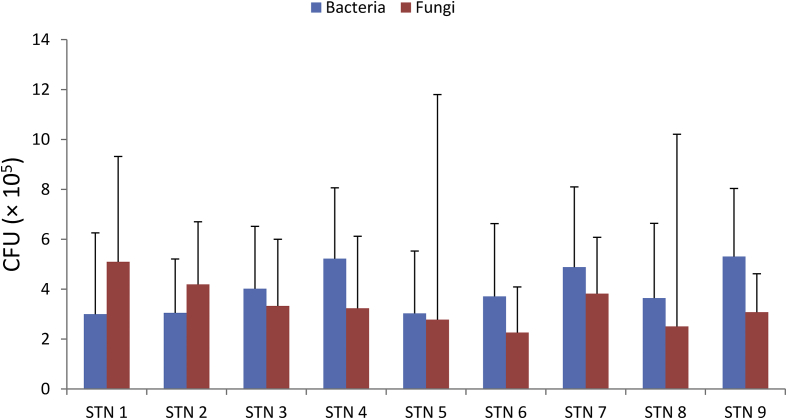
This study was aimed at investigating the relationship of trace metals with prevalence of bacteria and fungi in polluted farmland of Egbema Kingdom, Delta state. This may contribute to the knowledge on the influence of the microorganism to the arability of agricultural soil from an ecotoxicological viewpoint. Soil samples were analyzed for physico-chemical parameters and trace metals using atomic absorption spectrophotometer (Buck Scientific, 210VGP). The samples were also screened for fungi and bacteria isolates. Trace metals (Fe, Zn, Cd, Ni and Cu) determined in the agricultural soils of Egbema kingdom were below WHO limits. The fungi species with the highest number of occurrence was , while the species with the lowest occurrence were and . The order of abundance of fungi across the stations was Station 2> Station 4> Station 3> Station 1> Station 7> Station 5> Station 6> Station 9> Station 8. The bacteria species with the highest number of occurrence was , while the species with the lowest occurrence was . which occurred only once at Station 5. The order of abundance of bacteria in the soil samples across the stations was Station 4> Station 3> Stations 5 and 9> Station 2> Station 8> Station 7> Station 6. All trace metals in the agricultural soils of Egbema kingdom were below WHO limits. Fe, Zn, Cd and Ni showed no relationship with the microbial contents of the soil. Various strains of fungi and bacteria (gram positive and gram negative) were observed in the soil samples. An antagonistic relationship was observed between bacteria and fungi. Significant positive correlation occurred between the concentration of copper and bacteria counts indicating that the concentration of copper in the soil might have enhanced the abundance of bacteria in the soil, vice versa. The bacteria might be a promising tool in regulation of soil copper concentration.
本研究旨在调查三角州州埃格贝马王国污染农田中微量金属与细菌和真菌流行率之间的关系。从生态毒理学角度来看,这可能有助于了解微生物对农业土壤适宜性的影响。使用原子吸收分光光度计(巴克科学公司,210VGP)对土壤样本进行物理化学参数和微量金属分析。还对样本进行了真菌和细菌分离株的筛选。在埃格贝马王国农业土壤中测定的微量金属(铁、锌、镉、镍和铜)低于世界卫生组织的限值。出现次数最多的真菌种类是 ,而出现次数最少的种类是 和 。各站点真菌丰度顺序为站点2>站点4>站点3>站点1>站点7>站点5>站点6>站点9>站点8。出现次数最多的细菌种类是 ,而出现次数最少的种类是 ,其仅在站点5出现过一次。各站点土壤样本中细菌丰度顺序为站点4>站点3>站点5和9>站点2>站点8>站点7>站点6。埃格贝马王国农业土壤中的所有微量金属均低于世界卫生组织的限值。铁、锌、镉和镍与土壤微生物含量无相关性。在土壤样本中观察到了各种真菌和细菌菌株(革兰氏阳性和革兰氏阴性)。观察到细菌和真菌之间存在拮抗关系。铜浓度与细菌数量之间存在显著正相关,表明土壤中铜的浓度可能提高了土壤中细菌的丰度,反之亦然。细菌可能是调节土壤铜浓度的一种有效工具。