Department of Neurology, Erasmus Medical Center, NF-331, Post box 2040, 3000 CA, Rotterdam, The Netherlands.
Dementia Research Centre, University College London, London, UK.
J Neurol. 2021 Jan;268(1):102-113. doi: 10.1007/s00415-020-10096-y. Epub 2020 Jul 29.
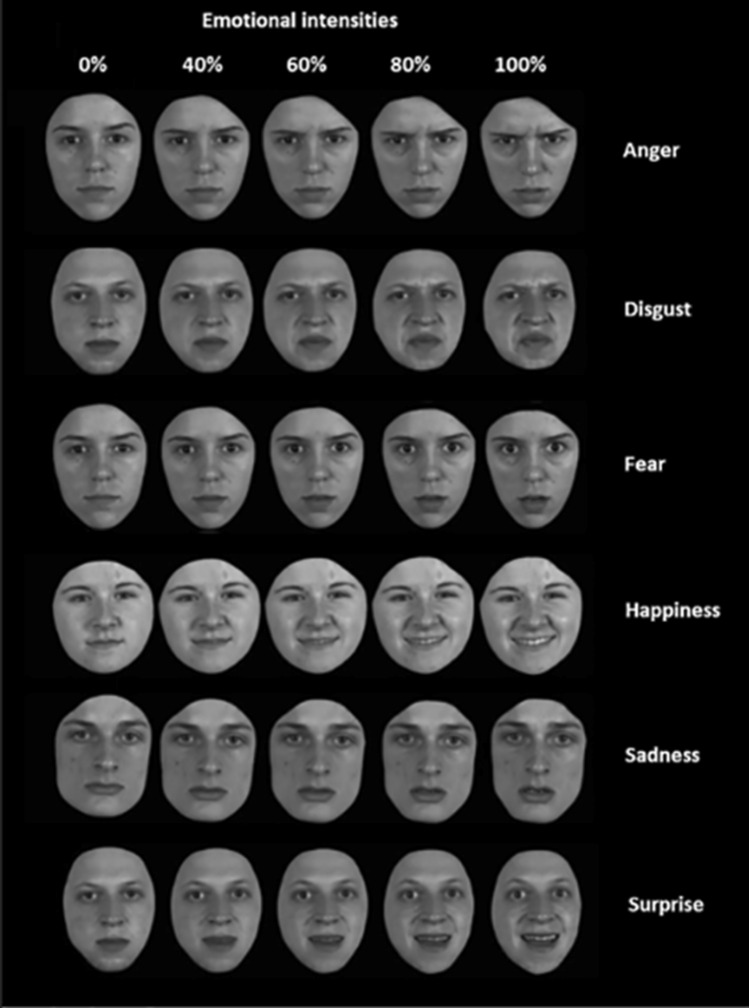
The emotion recognition task (ERT) was developed to overcome shortcomings of static emotion recognition paradigms, by identifying more subtle deficits in emotion recognition across different intensity levels. In this study, we used the ERT to investigate emotion recognition deficits across the frontotemporal (FTD) and Alzheimer's Dementia (AD) spectrum.
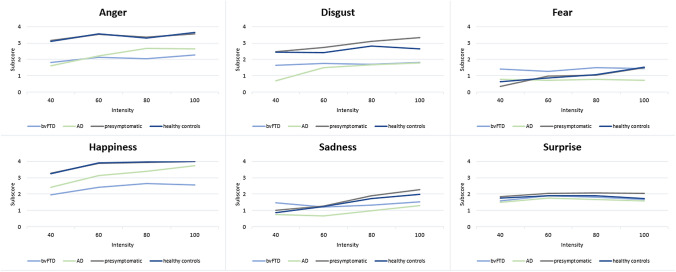
With the ERT, we assessed the recognition of facial emotional expressions (anger-disgust-fear-happiness-sadness-surprise) across four intensities (40-60-80-100%) in patients with behavioural variant FTD (bvFTD; n = 32), and AD (n = 32), presymptomatic FTD mutation carriers (n = 47) and controls (n = 49). We examined group differences using multilevel linear regression with age, sex and education level as covariates, and performed post hoc analyses on presymptomatic (MAPT, GRN and C9orf72) mutation carriers. Classification abilities were investigated by means of logistic regression.
Lowest ERT total scores were found in patients with bvFTD and AD, whereas equal highest performance was found in presymptomatic mutation carriers and controls. For all emotions, significantly lower subscores were found in patients with bvFTD than in presymptomatic mutation carriers and in controls (highest p value = 0.025). Patients with bvFTD performed lower than patients with AD on anger (p = 0.005) and a trend towards significance was found for a lower performance on happiness (p = 0.065). Task performance increased with higher emotional intensity, and classification was better at the lowest than at the highest intensity. C9orf72 mutation carriers performed worse on recognizing anger at the lowest intensity than GRN mutation carriers (p = 0.047) and controls (p = 0.038). The ERT differentiated between patients with bvFTD and controls, and between patients with AD and controls (both p < 0.001).
Our results demonstrate emotion recognition deficits in both bvFTD and AD, and suggest the presence of subtle emotion recognition changes in presymptomatic C9orf72-FTD. This highlights the importance of incorporating emotion recognition paradigms into standard neuropsychological assessment for early differential diagnosis, and as clinical endpoints in upcoming therapeutic trials.
情绪识别任务(ERT)旨在通过识别不同强度水平下的更细微的情绪识别缺陷,克服静态情绪识别范式的缺点。在这项研究中,我们使用 ERT 来研究额颞叶(FTD)和阿尔茨海默病(AD)谱系中的情绪识别缺陷。
使用 ERT,我们评估了 32 名行为变异型额颞叶痴呆(bvFTD)患者、32 名 AD 患者、47 名无症状 FTD 突变携带者和 49 名对照组对四种强度(40-60-80-100%)的面部情绪表达(愤怒-厌恶-恐惧-快乐-悲伤-惊讶)的识别能力。我们使用多元线性回归分析了年龄、性别和教育水平作为协变量的组间差异,并对无症状(MAPT、GRN 和 C9orf72)突变携带者进行了事后分析。使用逻辑回归分析了分类能力。
bvFTD 和 AD 患者的 ERT 总分最低,而无症状突变携带者和对照组的总分最高。对于所有情绪,bvFTD 患者的得分均显著低于无症状突变携带者和对照组(p 值最高为 0.025)。bvFTD 患者在愤怒情绪上的表现低于 AD 患者(p=0.005),在幸福感上的表现也有较低的趋势(p=0.065)。随着情绪强度的增加,任务表现也随之提高,在最低强度下的分类效果更好。与 GRN 突变携带者和对照组相比,C9orf72 突变携带者在识别愤怒表情时,在最低强度下的表现更差(p=0.047)和(p=0.038)。ERT 可以区分 bvFTD 患者和对照组,以及 AD 患者和对照组(均 p<0.001)。
我们的结果表明,bvFTD 和 AD 均存在情绪识别缺陷,并且在无症状的 C9orf72-FTD 中存在微妙的情绪识别变化。这凸显了在标准神经心理学评估中纳入情绪识别范式进行早期鉴别诊断的重要性,以及作为即将进行的治疗试验的临床终点。